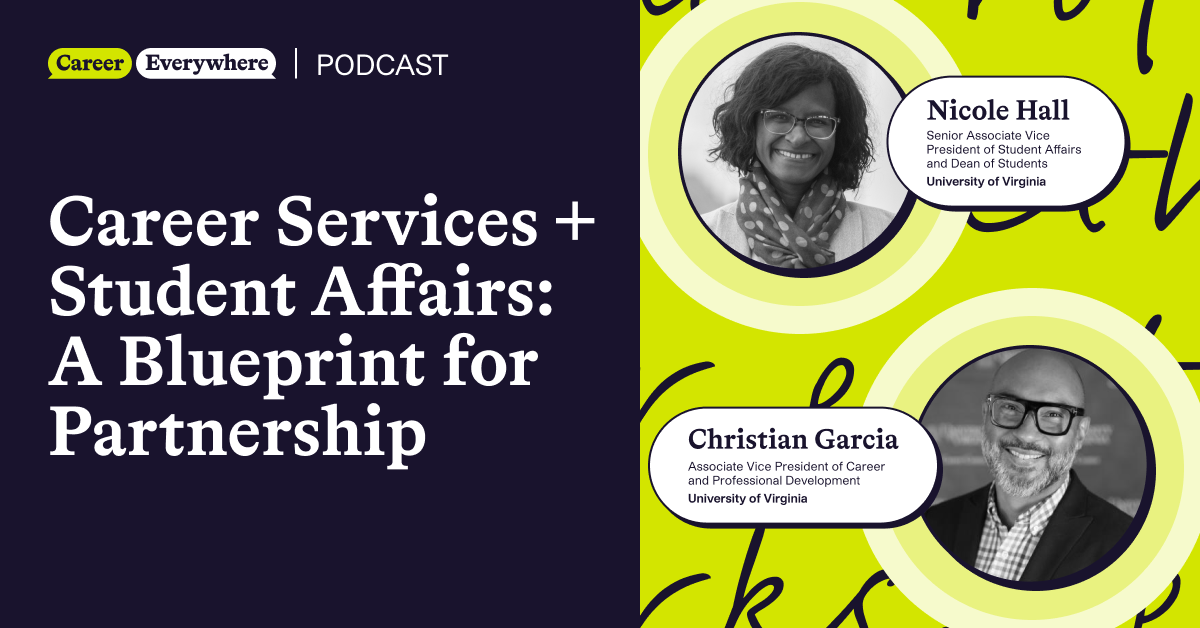




In this episode of the Career Everywhere Podcast, host Meredith Metsker sits down with Dr. Nicole Hall, Senior Associate Vice President of Student Affairs and Dean of Students, and Christian Garcia, Associate Vice President of Career and Professional Development, at the University of Virginia. Christian is also Nicole’s direct report—a dynamic that shapes nearly everything they discuss.
The conversation opens with trends the two surfaced during a recent fireside chat at the Virginia ACE conference: the deepening of skills-based hiring, a widening gap between internship demand and supply, the state of Virginia’s growing involvement in internship policy, and the layered, still-unsettled role AI is playing in the job market.
Nicole, who currently chairs the NACE Board of Directors, brings a national data lens. Christian brings the day-to-day view from UVA’s career center, where he’s seeing high fair attendance and strong demand for one-on-one advising even as some employers pull back on-campus interviewing (or “on-grounds” as they call it at UVA).
From there, the episode turns to what makes this pairing unique: Nicole’s path from 20+ years leading career centers into executive student affairs leadership, and her decision—negotiated during her own UVA hiring process—to bring career services into her portfolio rather than let it sit as a separate, siloed unit.
Christian and Nicole talk candidly about what it’s like to work together day to day, how they balance “reading the tea leaves” with tactical execution, and the advice they’d give other career leaders hoping to build stronger relationships with student affairs (or vice versa).
Key takeaways:
- Career Everywhere means shared ownership, not shared job titles. Christian compares it to a mental-health-referral mindset: you don’t need to be a career counselor to play a role in a student’s career readiness—faculty, staff, peers, and alumni all have a part.
- Skills-based hiring is deepening, not just spreading. Nicole points to NACE data showing employers have moved from mentioning desired skills in job postings to building specific skills assessments directly into their application and interview processes.
- Internship demand is badly outpacing supply. A 2023 Business-Higher Education Forum survey found that eight million students wanted internships, but only about four million internships were available—pushing career centers toward creative alternatives like short-term, skills-rich projects that don’t require a full semester or summer commitment.
- AI anxiety is real, but the “doom and gloom” narrative isn’t backed by employer data. Citing NACE’s 2026 Job Outlook, Nicole notes 61% of employers surveyed have no intention of replacing roles with AI, while about 25% are exploring ways to augment existing roles with it. The bigger opportunity for students, both guests agree, is building genuine AI literacy.
- Bringing career services under student affairs was a deliberate, negotiated choice. Nicole pushed for the structure before she’d even accepted her offer, driven by a belief that career development should be woven through the entire student experience rather than managed in isolation.
- A thought-partnership beats a reporting relationship. Christian and Nicole describe weekly check-ins built around mutual trust rather than oversight—Nicole intentionally stays “at arm’s length” from day-to-day career center decisions so Christian can lead.
- Relationship-building is the real integration strategy. Christian’s practice of meeting broadly across campus (352 meetings in one semester alone) helped him build trust quickly in a new role—something both guests see as foundational to breaking down silos between career services and the rest of the institution.
- Career leaders should apply their own advice to their own careers. Both guests encourage career professionals to stay open to unexpected opportunities and to release the pressure that career advancement has to mean climbing to a director- or VP-level title.
About the guests:
Dr. Nicole Hall is the Senior Associate Vice President of Student Affairs and Dean of Students at the University of Virginia, and the current Chair of the NACE Board of Directors. She spent 20+ years leading career centers before moving into executive student affairs leadership, and now oversees career services alongside orientation, fraternity and sorority life, leadership development, and other student-facing units at UVA.
Christian Garcia is the Associate Vice President of Career and Professional Development at the University of Virginia and 2024 winner of the NACE Mackes Leadership Award. Longtime listeners may recognize him from Season 1 of the podcast, when he led career services at the University of Miami. He also hosts UVA’s “Living Room on the Lawn” video interview series.
Resources from the episode:
- Christian’s LinkedIn profile
- Nicole’s LinkedIn profile
- NACE Job Outlook 2026 (referenced for AI adoption data among employers)
- Business-Higher Education Forum internship demand/supply survey
- Christian’s previous Career Everywhere Podcast appearance (episode 14)
Nicole Hall:
What we’ve started to focus on are where are the points of connection and intersection? And so some of this started with identifying some of our shared priorities across looking at student navigation, student engagement, their development, their connection and sense of belonging. What are the different ways that all of the units can contribute to that?
Where is the point that our work is most important to bring together? And we had an agreement that it really feels like it’s in the first and second year of the student’s experience. And so with that, we’ve now as a natural next step, we’ve identified some areas of assessment that we’re going to focus on.
What that will allow us to do is to have a better sense of where and how we’re engaging. I would say historically, every leader has gathered data for their unit. We know things about the student experience, but it’s never been woven together.
And so I’m excited that we’re really on the cusp of being able to do that for the first time. And so I think that will not only give us a sense of a baseline of, yes, how are we engaging, but it’s really going to help us to identify the gaps. It’s going to help us understand where we can more tightly weave together our offerings and where we can really focus on having some shared outcomes to impact student development.
Meredith Metsker:
Hey, everyone. Welcome back to the Career Everywhere Podcast. I’m your host, Meredith Metsker. And today I am joined by two incredible guests from the University of Virginia. We have Christian Garcia, the Associate Vice President of Career and Professional Development, and Dr. Nicole Hall, the Senior Associate Vice President of Student Affairs and the Dean of Students. Nicole is also Christian’s boss, so no pressure, Christian.
Nicole Hall:
No pressure.
Christian Garcia:
None whatsoever.
Meredith Metsker:
Well, thank you both for being here.
Christian Garcia:
Thanks for having us.
Nicole Hall:
I’m happy to be here.
Meredith Metsker:
Yeah. I’m so glad to have you both. And Christian, our longtime listeners might remember you from back in Season One, back when you were leading career services at the University of Miami. So it’s great to have you back now on the other side of your big move to UVA and a major leadership award from NACE a couple years ago that I got to see you receive. So that was pretty cool.
Christian Garcia:
Thank you. A little bit has changed.
Meredith Metsker:
Just a few things. Yeah. And Nicole, this is your first time on the podcast and I am so excited to get your perspective today as an executive leader there at UVA who also happens to have a very extensive background in career services. And you are also the newly minted chair of the NACE Board of Directors. So it’ll be great to hear your take on some of the broader trends we’re seeing in higher ed and career services these days.
Nicole Hall:
Thanks, Meredith. I’m very excited to be here.
Meredith Metsker:
Yeah, likewise. And I first connected with you both after seeing your fireside chat at the recent Virginia ACE Conference where you tackled some really great audience questions on employer relations, AI of course, and how career services can support students in a really tough job market right now. So we’re going to dig into some of those trends today, but I also want to spend some time on a few things that are unique to the two of you. So Nicole, your path from career services leader to executive higher ed leadership, how career services became part of your portfolio at UVA, and then how you two work together as student affairs and career services leaders.
So there’s a lot to unpack and we’ll get into all of that in a sec. But before I get into my questions, is there anything else either of you would like to add about yourselves, your backgrounds, or your roles at UVA?
Christian Garcia:
I’ll let you start, Nicole.
Nicole Hall:
Okay. Well, I always like to share the story of how I moved into my new position as a Dean of Students. If you had asked me if I would ever hold this type of role, I would’ve said, “No, no way.” But it was really an interesting story. We had had a wonderful colleague who was an interim Dean of Students, and he had been asked by the president to do it for a couple of years. And so we then posted the job and got ready to hire. And so my VP asked if I would serve on the search committee. And of course I was honored to do so. I’d been at UVA for maybe a year and a half at that point. And so we would go through the search committee process and it’s run by UVA Executive Search. And as is common, we start with listening sessions.
And so we were meeting with students, asking them about what they were looking for in a Dean of Students. And it was pretty wonderful because there were students who were making comments about ways that they had interacted with me. And there was one particular student who was asked, “How would you want a Dean of Students to get to know students?” And so she was like, “Oh, I would love for them to do it exactly like Dr. Hall did. When she came, she met with us, she met with our exec team. She came to the general body meeting. We planned events together.”
And so needless to say, literally two or three days later, I got a call from the executive search lead strongly encouraging me to move off of the committee and become a candidate. And so I became a part of the national search. I was the only internal candidate and was just really fortunate to have this opportunity to contribute at UVA in an expanded way.
Meredith Metsker:
That’s so cool. What an impression you must have made on those students.
Nicole Hall:
Thank you.
Christian Garcia:
And so I love that you went first, Nicole, because I shared this story yesterday with our team, which Nicole joined us for our staff meeting yesterday. But I’ve known Nicole for a number of years through the career services circuit, through conferences, but didn’t know her really well. But I knew enough to know that there was something special. Just like those students honed in on something special about Nicole, I felt that. And so here I am on LinkedIn, as I start thinking about maybe it’s time for my next act after University of Miami. And I see on LinkedIn that she’s promoted to Dean of Students. And I’m like, “Oh my gosh, that’s so amazing for her. But what’s going on with that AVP role?” And so I decided to reach out to her and the timing couldn’t have been more perfect because the position was being posted, I believe the following day after our conversation.
And she had told me that, she had thrown my name into the rank. But with my history at Miami, I think maybe she was thinking it was a long shot, but it all worked out. The timing was perfect. And obviously UVA, the name, the school itself drew me to this role. But to have someone who’s done the work of career services and done it at the same institution, that is so rare and it’s a true gift. And I was like, “I can’t pass this up.”
And in one of those early conversations, Nicole and I talked about really being thought partners together, which really resonated with me. Still as career services leaders, we find ourselves having to educate and convince executive leaders on the importance of career readiness and just embedding career across an institution. And so to know that I don’t have to worry about that, I could just immediately jump in and focus on the work has been refreshing. So I feel extremely lucky to be here.
Nicole Hall:
Well, and one of my favorite comments that I get, Meredith, from members of NACE is, they’re like, “How in the world did you get Christian Garcia? You are so lucky.” And I’m like, “Yes, yes, yes, I am.” But it has been wonderful. And I love sometimes when things just line up and I literally cannot imagine someone else leading this work in the way that Christian is doing. So it’s great.
Meredith Metsker:
Yeah, it sounds like it was meant to be and that you reached out the day before it went live.
Christian Garcia:
I know, yes.
Meredith Metsker:
Yes. Cool. Well, I know we’ll dig into your partnership here in a little bit and how much just time and energy you save when you don’t have to convince the senior leaders that career services is important. So we will dig into that for sure. But before I get into our more specific questions about our topic today, I do want to kick us off with a question I ask all of our guests, and Christian has answered this before. What does Career Everywhere mean to you?
Christian Garcia:
Well, for me, Career Everywhere means just that. It means that no one office can be or should be responsible for the career education and guidance of its students. It doesn’t make sense. It’s not realistic. And I often use mental health as an analogy. So I’m not a mental health counselor. That’s not what I went to school for. However, as someone who works on a college campus, I have a duty to step in should I see something. If I see that a student’s having a hard time, at the very least to say, “Is everything okay? Do you want to chat or make a referral?”
We all have a responsibility as a community. And so when I look at career services, fortunately, the risk isn’t as high. The stakes aren’t as high. But I believe that Career Everywhere means that we all have a stake in this in order to truly support our students.
For too long, career services was seen as the one singular place to support students. It’s that place you go to to get your resume critiqued. It’s the place you go to to interview. And yes, those things are still part of it, but it’s way more complex. And whether you’re a faculty member, an advisor, any number, whatever role you have, students are looking to these individuals for support. And so while it’s not about making people career advisors all over our grounds, it’s about making sure that folks understand their role in it. And so to me, that’s what Career Everywhere is, or means, I’m sorry, whether it is peers, or again, like I said, faculty, staff, mentors, so on, alumni is another piece to it as well.
Nicole Hall:
Yeah, I completely agree. And I guess the way I tend to think about it is I feel very strongly that career development, career readiness should be literally a pillar in every institution. And the way that they think about educating students and supporting them, it should all be grounded in this pillar. And so for someone like me who has recently moved into a more executive level role, one of my core accountabilities is to update senior leadership and to make sure that they are viewing our focus on career readiness as critically important to the institution. And I also highly value the work that Christian has done, bringing together stakeholders across grounds to invite them into strategic conversations about how we prepare our students. So I think there’s truly a role, I think, for everybody to play in supporting our students’ career development.
Christian Garcia:
And Meredith, I just want to say, you probably hear us using the word grounds. We don’t call it a campus here. We say grounds. So just wanted to put that out there for you and for our listeners. We also don’t say freshmen, sophomore. We say first year, second year, third years. It’s a thing at UVA.
Meredith Metsker:
Noted. Good to know. We’re talking about the campus, not like coffee grounds or something.
Christian Garcia:
Yes.
Meredith Metsker:
All right. Good to know. Okay. So now I would love to dig into our topics today. So as I mentioned earlier, I first reached out to you both because you hosted this really great fireside chat at Virginia ACE earlier this year. And I know you got some very interesting and timely questions from the audience around trends and employer relations, AI, the job market, and so on. So I would love to dig into a few of those trends with you both and hear about any other notable trends or concerns that came up either at that conference or at the big NACE conference back in June.
And I’m excited to get both of your perspectives on these with Nicole coming from the bigger picture student affairs side, and then Christian coming from career services, the operational side. So I would love to start with employer relations. I’m curious, what trends are you seeing right now when it comes to employer relations and hiring?
Christian Garcia:
So I’ll jump in on this. So the way we do employer relations at UVA, we have a distributed model. So I lead the Central Career Center, but we have folks all over grounds that are also doing career development work, doing employer relations work. And it actually works really well. And I think it’s a testament to the people here who are really collaborators and realize that this isn’t a competition. It’s about more and it’s not about hoarding things. So that’s been really refreshing.
And I’ve been attending, so we have what we call our employer relations group meetings, and those happen actually weekly. And I’ve been attending them here and there. And this last one that I attended, what we’re seeing at UVA is, we’re certainly seeing a dip in the number of interviews that are happening on grounds, but it is still extremely robust. And this is really different from what we were experiencing at the University of Miami and many other institutions.
I think it’s because of the type of student that comes here. We have amazing students. The academic rigor here is significant. And so employers know that they’re going to get talent in many different ways. Academic talent, students who are involved, students who believe in the greater good, who are servant leaders, all those things. So because of that, it helps the way we do recruiting.
So we do have a lot of employers coming on grounds doing interviews, but also coming to our numerous career fairs. As Nicole knows, we do over 23 career fairs and events. And I was really shocked to see that not only do we do that many, but these events are very well-attended. When I tell you standing room only, students are engaged, they are there to talk to employers to start that networking. So it’s great that they’re really dialed in.
So while we’re seeing a dip in the number, it’s not as big as maybe some other schools are experiencing across the country. I will say that employers are looking to engage with universities beyond just the recruiting. And so I look at that as employer engagement, whereas employer relations to me is the day-to-day, the operational components of the work, making sure that we’re maintaining the relationships with our current employer base, getting them to sign up for career fairs, interviews, all those things. And we do a really great job of that. I think the trend, what we’re seeing is that employers want more than that. They want to see all the myriad ways that they can engage with the university. And as you can imagine, that’s challenging because at a place like UVA, as it is at many institutions, is extremely decentralized. So not only do we have a distributed model of career services, on top of that, we have the folks in advancement, central advancement, also advancement within the schools.
There’s a lot of touch points. We have entrepreneurship, athletics, any number of ways that companies are engaging. So we launched an employer engagement strategic planning process in January to try to figure out what are the good things that we’re doing that we can maximize? What are the gaps and opportunities? And one of the biggest opportunities is, how do we harness all this information? How do we get everybody to the table? Not to centralize, not to create one system. I think that’s the dream, have one CRM, but that’s never going to happen. But instead, how do we do this more strategically in talking to each other? And it’s not because people don’t want to, it’s just a very complex institution, but employers really want more of that. And so that’s, I would say, is one of the trends that we’re really dealing with right now.
Nicole Hall:
Yeah. And it definitely is, I think, an interesting time. And I think for employers as they are navigating their approach to identifying the right talent and hiring. And one of the things that we’ve been following through NACE is certainly the trend around skills-based hiring that continues to increase. And I think what has been fascinating is to see how it’s evolving, because I think it started in somewhat of a muted way where recruiters may try to be thoughtful about including in a job description some of the specific skills they’re looking for.
And so in that way, they were trying to increase the chance that they would get the types of skills that they were seeking. But now we’re seeing that deepen into the process where now it might be a part of their applicant tracking portal and they’re asking specific questions that really confirm a particular skillset.
As students are getting into interviews, they’re asking about skills, they have special assessments. And so that is something that we’ve seen through the association that has just increased significantly. The other trend, which isn’t a surprise to either of you, is just the sheer volume of internship demand. There’s a survey that was conducted recently by the Business Higher Education Forum, and they were trying to determine and assess what the demand was, and they found that there was sheer demand from students for eight million internships, which is staggering.
And in comparison, when they analyzed, there were actually just under four million that were posted. And so what it shows is that we don’t necessarily have the supply that’s needed across our industry. And so I think the onus is on individuals like Christian and other career services leaders to think about creative ways to engage employers so that they can still provide a way for students to develop those skills, whether it’s short-term projects or other creative approaches.
But those are a couple of the things that we’ve seen and we’ve been watching through NACE.
Christian Garcia:
The other thing I’ll add to that is, you’re starting to see more states get involved in this game, especially with internships. So I’ll speak to Virginia. I’ve been really pleasantly surprised to see how active they are in trying to fix this problem and trying to engage small to medium-sized companies in the state, sorry, the Commonwealth of Virginia, as we call it here. And so our legislators are really involved. So there is a new role that was created for the state that this person is there to really help identify, create, work with companies to create internship opportunities. They’re putting a lot of pressure on institutions to provide data to combine all the data from the state schools to show how many students are engaging in internships and academic internships, which is placing some pressure on the schools. But I think that’s a good thing because we’re trying to figure out how many students really are engaging in internships.
And it’s hard to know, but it’s really refreshing to see the state really be so active in wanting to not just collect the data, but actually create internship opportunities for students.
Meredith Metsker:
Yeah, I’m glad you brought that up because our last guest was Dr. Barbara Blake from Old Dominion, and she was talking about some of this upcoming legislation or just mandates from the state level around internships and tracking. So it’ll be really interesting to see if that catches on across the country and how that impacts higher ed. So we’ll have to stay tuned on that front.
Nicole Hall:
Yes.
Meredith Metsker:
Well, speaking of the skills-based hiring and skills that are in demand right now, I know AI came up a lot in your fireside chat and it comes up on this podcast constantly too. So I’m curious what you both are seeing in terms of how AI is shaping the job market and then how career services should be responding.
Christian Garcia:
What’s AI? I’m kidding.
Meredith Metsker:
What even is that?
It doesn’t sound important at all.
Christian Garcia:
I mean, obviously this is the topic and it’s so layered because it’s about the job market and the impact it’s having. It’s also the skills, the AI skills that students are expected to have, but then it’s also what is it that employers want? What is it that employers know about AI? And I’ll come back to that in a second. But then also how is AI being used or adopted within universities? And there are a lot of mixed messages that students get. Some faculty members seem to be going all in, whereas others are not. So I think it’s really hard for students to know, can I use it? When can I use it? I know that there’s some ambivalence on how to use it in the job search just out of fear of being called out that they used AI in their, whether it’s for a resume or interview prep or a cover letter, so on and so forth.
So it’s just a really layered thing. But what we hear from employers, and I’ve heard this from numerous, not just employers, but other organizations, is that with all the talk about AI and employers saying that students need AI skills, when pressed about, okay, so how are you using AI? What are your views on it? Or where do you see it going? A lot of it, the response is we don’t know. We still don’t know. It’s still early days. So it’s a really interesting thing that on the one hand it’s like, oh, students need these skills, but we still don’t know much about AI. It’s still early on.
So there’s that. I will say, obviously there’s a lot of talk about it’s decimating entry-level jobs and it’s taking away jobs. And certainly that’s happening with certain industries or certain roles or types of jobs, but I think it will create new jobs.
It will definitely change the way we do work. But this idea of it being doom and gloom is not something that I subscribe to.
I’ve done this long enough to know, and I think Nicole will agree, you see these things, these spikes that happen after every certain number of years. And I kind of liken this to the Great Recession. Two very different moments. But during the Great Recession, there was so much doom and gloom. There are no jobs, no one’s going to get hired. And so there were all these messages. And so students became very anxious and students fall into various camps in these kinds of situations.
Some will dig their head in the sand and act like it’s not happening, nothing’s happening. There are those students who will say, “Well, I’ll just go to grad school,” which obviously we’re big proponents of furthering your education, but you need to be a little bit more strategic about that or really think that through. It’s more time, it’s more effort, and you get more education, but then when you’re done, you still don’t have experience and you really have to think about what that means for who you’re competing against for those jobs when you are ready to look for a job.
And so there are a lot of those negative messages, and I see a lot of that now with AI. And so what I would say to students is really to not let the noise overwhelm you or make you feel like there’s no hope. Again, not being Pollyanna and acting like there aren’t any challenges, but I do believe that universities provide such a strong foundation for students to really succeed in the workplace. And then you look at a place like UVA, I think that’s even more so.
So yes, it’s changing the way recruiting is happening. It’s changing industries. But I think if students are flexible, if they are paying attention, if they are adding skills to… And not just AI skills by the way, all kinds of skills, I believe that they will be successful. I strongly believe in that. But of course, students are anxious and I don’t want to take that away. That message is definitely there.
Nicole Hall:
Yeah, I think that’s great advice, Christian. Because I mean, you’re right, it is multi-layered. I think many people are familiar with NACE’s job outlook. That’s a survey and a report that we put out every year. And I was looking back at the data for 2026 because we have been for many cycles asking about AI. And to Christian’s point, when we survey employers, we don’t hear that they are abolishing tons of roles. I mean, literally 61% of the employers that were surveyed said they have no intention to replace roles with AI. What’s interesting in this most recent year, 2026, there were about 25% of employers who said that they are thinking about augmenting some of the roles with AI.
And so you can see there’s some progressive change, but it’s not widespread. And so the message that we tend to continually hear from employers is it’s really about AI literacy.
If students can understand how it functions, if they can understand how it works, that is absolutely going to be viewed as an asset. But I think honestly, employers across many industries are still trying to figure out where this is going to fit in with their objectives as an organization.
Meredith Metsker:
Yeah, that makes a lot of sense, especially since like you both were saying, we’re still in such early days with AI. I mean, it would be a bold move to replace everything with AI at this point. And I think we have even seen that with some larger corporations who did do big reductions and are now hiring folks back, because they realized you can’t replace some things with AI. So interesting to watch. Speaking of the job market, I am curious what you both are hearing from students right now about how they’re feeling about this job market and how that is shaping some of the work you’re doing.
Christian Garcia:
Well, another thing that is remarkable about the UVA student is that they’re really dialed in with their career. These students, they are using our services. They are really into the one-on-one career advising, which really has blown me away. These career advisors on our team are amazing and they are meeting with tons and tons of students. Anywhere from exploration to one of our many career communities or pre-health, pre-law, these are students who are really dialed in. And so as I talk to my team members just to get a pulse on what’s going on, how are students feeling?
There isn’t that sense of doom and gloom. Yes, there are some anxieties, but I think that that’s college students these days. I think there’s just a lot of anxiety as it is. When you’re at a place like UVA that is so high-performing, high-achieving, you’re going to get that regardless. Even if things are great, the economy was, we had tons and tons of jobs. It’s just that kind of time that we’re in. But I think that students really are open to asking for help, which is really refreshing because what you don’t want them to do is to not ask for help. And like I said a minute ago, to dig their head in the sand and act like nothing’s happening, just waiting for this to pass. So I do see a lot of hope among our student body, which is nice. And they continue to use our resources, which again, gives me hope that they’re not giving up.
I think that they’re certainly open to broadening their knowledge and their skills. Nicole mentioned briefly short-term projects. We’re really leaning into that heavily to provide shorter term experiences that are rich in skills, both the hard skills and the durable skills that don’t take up an entire semester, an entire summer that can easily be dropped into a course that currently exists. We’ve also done these with student organizations.
And so imagine a student who doesn’t have the luxury to go off grounds to do a full-fledged internship, which by the way, are getting more and more scarce or more competitive to get. But now you have access to these shorter term projects. I think that that really is one of the best ways to scale skills attainment. And we’re seeing a lot of students really take us up on those opportunities, which is really refreshing.
Nicole Hall:
Yeah. I want to underscore, yes, I think that’s going to be a huge opportunity for our students as we move forward. I was thinking about, because I’m in a little bit of a unique role, I’m not in it on a day-to-day like Christian is, but I hear from students as a Dean of Students about all kinds of things. And there’s probably three trends I would say around the type of feedback I’ve gotten, especially from the class of 2026 as they were wrapping up.
There was the group that was like, “I am so glad that I have a job offer,” because they went through a traditional recruiting cycle provided by Christian and his team where they literally came back to grounds and it was like August, September they knew they had a job. So there was a sigh of relief. So I have that group. But then there’s another group that back when they entered UVA, they had all these hopes and aspirations for what they might go into.
And now that industry may not be as solid as it used to be. And so there’s been a little bit of the heartache of pivoting. And to Christian’s point, not despair that they’re not going to find something, but it’s just not that thing that they initially had in mind. And then the third group, there’s a little bit of a peak where I’ve run into students where they’re like, “Yeah, I’m going to grad school.” And we know that happens. When the economy feels a little bit tough, they’re like, “Why not get more education?” So we do have, I think, a smaller subset of that population as well. But I would say overall, we’re really fortunate that I think our students are incredibly resilient. To Christian’s point, they tap into their resources.
And so I think they have been able to manage, even though I think this economy and the job market has been a little bit different than what they’ve seen before for other classes.
Christian Garcia:
I think a big part of our responsibility is to really educate students on what this process looks like, because why would they know? They’ve never done it before. And by the way, their parents have done it, but in a completely different time. This is such a different, unique, challenging, exciting time, all those things. But it’s very easy for students to take this personally. They’ve never done it. Up until right now, they have been just preparing for getting into college. It’s a very specific process. And then you come to college and the world is your oyster and you start applying for jobs and internships and jobs, and it’s just a completely different way of being there that they’re not used to. So as we mentioned, as Nicole mentioned, with demand continuing to rise for internships, that means students are hearing no more often, or even worse for them, nothing.
And it’s easy to internalize that. It’s easy to take that personally and to say, “There’s something wrong with me.” So part of the work that’s really critical for us to lean into even more is to really explain to them this process, that they have to take themselves out of it in terms of saying that this is an indictment on me. Because obviously they’re talented, but it’s a numbers game at this point.
And that’s really, really hard because they had never had to do it. And so my heart goes out to students who put their heart and soul into this process, but it’s also educating them. You can apply for a hundred jobs, but is that serving you? Let’s be more strategic about it. Let’s be more intentional rather than putting yourself out there and to be left with a bunch of no responses or being ghosted, as they say.
Meredith Metsker:
Gosh. Yeah, that’s great insight. And man, you all are dealing with a lot right now. So are the students. It’s so interesting to watch from our perspective here at UConnect being higher ed-adjacent to seeing how everyone is managing this, what advice is being given, and how students are faring in this very weird job market right now.
Christian Garcia:
And I just want to close the loop on this. I mean, how amazing that now the Career Center is part of the Dean of Students ecosystem, because if you saw Nicole’s calendar, I think you would die because she is nonstop. She is there, she’s plugged in. But how amazing that she has that connection to students so that I have the connections to students so that she’s hearing things, I will immediately hear them.
Whether it’s one student or if it’s a trend, we’re able to really address those or just have the awareness of it. So I really cherish that to be able to hear that. And I’m trying to take a page out of Nicole to put myself out there as much as possible because I think that’s important, to make sure that students feel comfortable and feel a connection to career because career still has a lot of anxiety attached to it, fear.
I feel like students talk about seeing a therapist, like no big deal. That taboo no longer exists, but career is still fraught with a lot of anxiety. So it’s important for them to know that they have someone like Nicole and me and the rest of my team to be able to be in their corner.
Meredith Metsker:
So Christian, I’m glad you brought up the fact that career services is under the Dean of Students because I would love to talk about that. I know that’s not always the case. And Nicole, I think I remember hearing that you negotiated for that specifically. So Nicole, can you walk me through how it came to be that career services is under your purview and then why you were so passionate about that?
Nicole Hall:
Yeah, no, I appreciate the question. And again, I think this whole scenario of how we’re structured is very unique. I report into the Vice President and Chief Student Affairs Officer. And so when I was hired, I was a direct report to him, part of his leadership team. And he came from an institution where he had been accustomed to having the career center in his portfolio. So I knew he was an advocate. As I became a candidate, it became clear that I was going to be moving into this role.
I began to think about our structure because all of the areas that I was inheriting are student-facing, it’s everything from orientation to fraternity and sorority life to leadership development programs. And then of course, the idea of having the career center sit separately just felt odd to me. It’s almost like I would manage a portion of the student experience and then forget about the important thing that weaves through their entire experience, which is their career development.
And so early on, even when I was at candidate phase before I even knew that I was going to become the finalist, I began to talk with our VP about it. And he was great about wanting to understand the rationale. And I talked about my desire to really focus more on curating the student experience and thinking about how all of the work of our distinct units can really weave together. And from that effort, we would be able to do a better job collectively helping to integrate academic career and social development for our students. That was the aim.
And so fortunately, I was able to obviously get the offer, but he didn’t commit to anything until after I’d gotten the offer. Once I had the offer, then we sat down and talked about it and he agreed and he understood the critical importance of it. And I think because I’d had the pleasure of working with him for a little over a year at that point, he had a sense of the knowledge in the area.
And so I think there was a lot of trust. The one question he asked me, which I think both of you will appreciate, he was like, “So if we pull this into your portfolio, Nicole, how are you going to do with pulling back and not being in the mix of everything with the career center?” And I was like, “That’s a fair question.”
And I said, “I look back to when I started at UVA as the AVP for Career and Professional Development, and I was completely afforded the opportunity to cast my vision, work with my team, make everything happen. So the last thing I would want to do is create a situation where I’m micromanaging or I’m in the mix simply because I have this area of professional knowledge.”
And so when Christian referred to our early conversation, that was something that I had already set my mind that if anything, I feel like I’m even more purposeful about being at arm’s length so that there really is space for him to be able to lead in all the incredible ways that he has done.
But yeah, so I’m fortunate. I was able to get the support of our VP, and I think we all agree this was an excellent way for us to move forward. And obviously I’m biased. I think it would be great for every institution. I know that this is not necessarily a normal type of structure, but I do think that it has benefited. And between Christian and I, our collective leadership, I think we’ve been able to work very effectively with creating more visibility around the importance of career readiness at UVA.
Meredith Metsker:
Yeah. I’m curious what it looks like in practice, having career services be integrated under your portfolio and really worked into that holistic student experience. Can you share more about what that looks like on a day-to-day basis?
Nicole Hall:
Yeah, I would describe that we’re kind of at the early phases of this. So Christian hasn’t quite been here for a year yet, but he’s aware that as I’ve worked with him and other members of my leadership team, what we’ve started to focus on are where are the points of connection and intersection?
And so some of this started with identifying some of our shared priorities across looking at student navigation, student engagement, their development, their connection and sense of belonging. What are the different ways that all of the units can contribute to that? Where is the point that our work is most important to bring together? And we had an agreement that it really feels like it’s in the first and second year of the student’s experience. And so with that, we’ve now as a natural next step, we’ve identified some areas of assessment that we’re going to focus on.
What that will allow us to do is to have a better sense of where and how we’re engaging. I would say historically, every leader has gathered data for their unit. We know things about the student experience, but it’s never been woven together. And so I’m excited that we’re really on the cusp of being able to do that for the first time. And so I think that will not only give us a sense of a baseline of, yes, how are we engaging? But it’s really going to help us to identify the gaps. It’s going to help us understand where we can more tightly weave together our offerings, and where we can really focus on having some shared outcomes to impact student development.
So that’s where we’re headed. And I would say that we’re new in it only just because of the time. I’ve been in my role a little over a year.
Christian hasn’t been here quite a year, but I feel really good about the foundation that we’ve laid.
Meredith Metsker:
Yeah, that’s super helpful to hear. And I am curious, Christian, from your perspective as the career leader, I guess how are you thinking through that integration making career more part of the holistic experience?
Christian Garcia:
Yeah, so I’ve gone through all the feelings, even before this role of where a Career Center should report. So when I first started in career services, we reported to student affairs. And then when I got promoted to Director, I had two bosses. So I was reporting to the Vice President for Student Affairs and the Senior Vice Provost and Dean of Undergraduate Education. And then eventually I was moved completely under the provost office.
And there’s a lot of conversation about this nationally. You talk to any Career Center director, some will tell you, “You have to report to the provost office. It’s better if you report to advancement.” And what I’ve realized in all these years is that really what matters is the person you’re reporting to, whether they get it or not, because you could report directly to the president, but if the president is not a champion of the work that you do, well, then you might as well be reporting to anybody, really to any role.
So I say that because for me coming here and going back into student affairs, but then reporting directly to the Dean of Students, I was really excited about it because obviously I wanted to have this relationship with Nicole. When you think of the traditional Dean of Students area, however, it tends to be very much focused on judicial affairs, conduct, those kinds of things. And fortunately for us, that’s not the case for our structure, which I’m not saying that that’s not important. Obviously that’s important, but I think it takes away potentially the focus on career and some of the other things.
So it allows us to really, with the other departments that are part of our portfolio, to really see what are the things that tie us together. And there are more things than not actually. And so in that exercise that we had that Nicole referred to, it was great to just hear from my colleagues the things that they’re prioritizing, how they’re engaging with students.
I think that they were surprised to hear my response to the question of when is the ideal time to engage with students, like I said, first year. And they’re like, “Really?” And I said, “Absolutely.” So to have those conversations, and yeah, we’re the same, and you’re absolutely right. If you don’t get them in the first year, then you’re playing catch up. So it has worked out nicely for us and to not be mired down in the important work of conduct.
Fortunately, we have folks that handle that, and that’s a whole other show that we can get into with student self-governance here at UVA. But it really works out, because again, I used to be an orientation person, so I almost feel like I’m back home in a lot of ways because my colleagues are right there working alongside of me. But to see that from the very beginning, all the way to the end of the college experience, it’s really nice to be together.
It makes a lot of sense for UVA. So yeah, we should be a national model for how… And I have no doubt that we will be, but yeah, it’s early days for sure.
Meredith Metsker:
Yeah. And I also have no doubt that it will become a template for others. And I imagine that it’s just a better experience for students too, because they’re not seeing this siloed way a lot of institutions handle career services. They just see their experience.
Christian Garcia:
Absolutely. They don’t understand departments and reporting structures, not because they’re not [inaudible 00:42:50] but it’s because they’re students. Their focus is on other things. And so for us to be able to meet them where they are throughout their experience, I think is really important.
Meredith Metsker:
Yeah, absolutely. So I would love to talk a little bit more about how you two work together as the Dean of Students, as the Career Services Leader. So can you just both share a little bit about how you work together? How often are you meeting? How do you communicate? What do you communicate about? Those kinds of things.
Christian Garcia:
Okay. Well, I will say, so back to what Nicole mentioned about Kenyon’s question about will you be able to let go? Obviously that was in the back of my mind too, because I was excited to have a boss who has done the work. But the other side of that coin potentially could be, would she be able to let go and let me lead? And so fortunately, that has not been the case. She has allowed me to bring my expertise, my experience, the way I do things, and that’s been really refreshing. That’s great. That’s what I wanted.
And I mentioned earlier, thought partnership, and that’s exactly what it has been. Yes, she’s my supervisor. There’s no doubt about that. But in a lot of ways, we are looking to each other just to work through… It could be a problem or it could be we’re working on a proposal, being able to get her thoughts on it without necessarily needing her to solve it, but just to get her thoughts is really refreshing because she’s done the work.
Also knowing I can lean on her to grease some wheels when I need her to grease some wheels because she gets it is really, really nice. We’re both fortunate that we have Kenyon Bonner. Kenyon Bonner is our Vice President for Student Affairs. This man understands this work. He’s a champion of it. So again, I feel like I got a two-for-one special with these two individuals.
So it’s not difficult to go to him and get him to understand and to be a champion for whatever it is we’re trying to champion. So that’s been great. Early on, one of the things that I was tasked with was to create, put together a budget proposal that really was looking really ahead and how do we do something that is unique, remarkable, all the things. And Nicole was really there with me every step of the way, not writing it with me, not in the weeds.
But what I mean by that is that I can go to her and say, “What do you think about this? Or what are your thoughts on this?” Or if someone questioned something, we were able to work through it. And we’ve had many iterations of it and we’ve moved on to some other things. So that has been really, really great. So yeah, I think that that’s how our relationship has been. But then also getting to do these things. So we did the Virginia ACE fireside chat. We’ve been able to do this. I have a series that I do, called Living Room on the Lawn, and Nicole was one of my first guests.
I mean, that is so much fun to do. And I just think it’s very unique. I don’t think a lot of people get that opportunity. So I’ll stop there because I can go on and on.
Nicole Hall:
Yeah. I mean, I would just echo, I think it’s been almost just like an effortless partnership. And again, I think it was important. It’s not even my style to micromanage or want to be in the weeds, but clearly when you know something, I could see how the temptation might be there, but I think it has been seamless. Part of that I think has just been Christian’s openness for us to be able to discuss everything and brainstorm together.
But also for me, it honestly feels incredible to have somebody that I know has such strong leadership, such deep knowledge, who has an innovative mindset, who is really forward-thinking about this work. And so I feel like I have an incredibly easy job. And so I feel like we meet typically on a weekly basis and it’s a chance for him to share some updates. I’ll share updates.
If there’s something that we’re grappling with, we’ll walk through it. One of the things I have appreciated, and I think Christian has seen this because of my portfolio and the fact that I’m focused on other aspects of the student experience, there have been times where I’ve approached him to think about how he might be able to integrate some of the work of the Career Center. It would be really easy for him to say, “Yeah, that’s extra work for me,” or, “Maybe that’s not convenient for me.”
But I really have valued that he has embraced the bigger picture of where we’re trying to head as student affairs, how we’re trying to support students in all different ways. And he has just made himself available to help me figure that out. So it’s just been very powerful, and I feel very fortunate that we get to work together in this way.
And I do feel very confident about where we’re headed in our support of students.
Meredith Metsker:
Yeah. It sounds like you’re both really aligned on the strategy, what’s important, what you’re prioritizing. I’m curious, and Nicole, you mentioned in those weekly meetings that you’re giving each other updates. What are some examples of some types of updates coming from career services to student affairs, and then vice versa?
Nicole Hall:
Yeah, I think for me, one of my most important roles is to read tea leaves. And so if I know something’s on the horizon, a lot of times I will say that, “Oh, our VP had a meeting and here’s some things that are coming, or we have a sense that maybe this is at the highest levels of the university they’re thinking about this thing.” So I try to be really diligent about just giving a heads-up when something’s coming. The other thing, and I don’t think I’m misspeaking, I think Christian would say this, it’s been helpful that I was here for two years, two and a half years before he came. And because of that, I know the people, I know the culture. And so sometimes I’m like, “Hey, this person, here’s how you might want to think about it or approach it in this way.”
And sometimes we’re like, “Okay, he’ll go and meet.” Or I’m like, “Ooh, for this one, maybe the two of us will go and meet, or you go first and then I’ll follow up.” And so it’s just great that we’re able to think through that.
So I think my goal, my objective is to remove any barriers that he and the team runs into, for me to play a role in ensuring that I have very strong relationships up the org chart that can really help us in the work that we’re doing. And then to make sure that I really clearly understand what is needed so that I can be a partner in advocating for resources.
Christian Garcia:
And I will co-sign that. Absolutely, that’s exactly what she’s provided for me. I came from a place where I had 24 years of tremendous institutional knowledge, years of colleagues, partnerships, friendships. And then you start somewhere new and that dial goes to zero. And so that could be really daunting. And so you want to make sure that you avoid as much as possible any potential landmines. Because universities are political places.
And I have to say in the almost year that I’ve been here, I’ve been able to avoid any landmines. And a lot of that is, A, getting to know the place, being really diligent about meeting people across grounds, both faculty, staff, administrators, students, to learn the place. But then whenever there’s a question, always checking in with Nicole and saying, “Am I misreading this? This is what I’m feeling.” And she will say, “Yes, you’re on the right path.” Or she’ll give me the heads-up.
And so that’s been really refreshing to be able to have that guidance. Again, being able to lead this team, and it’s not just the team. I also lead and convene the Career Services Council, which is comprised of leaders that do career across the institution. She gives me the freedom to do all that. But I also know that I can go to her at any time during these one-on-one meetings to say, “Hey, listen, what are your thoughts about this? Can we noodle on this a little bit?” Or lately it’s about budget stuff, which is not the most exciting, but being able to work through some of those challenges that we’re experiencing, I mean, everyone’s experiencing on college campuses these days. But yeah, a lot of it, sometimes it’s tactical and sometimes it’s big picture. Sometimes it’s organizational, talking about things happening within my organization. I’m also a big believer in making my boss’s job easier, removing roadblocks for her.
So how can I support her? When can I step in? If you need me to step in, I think that’s really important, checking in. So yeah, it’s been great.
Meredith Metsker:
So I am curious, if you two, now that you’ve worked together in these capacities for what, almost a year now, do you have any advice for either other career services leaders who want to have a stronger partnership with student affairs or vice versa, student affairs leaders who want or maybe need to be more mindful of career services? I’m just curious if you guys have advice on that.
Nicole Hall:
I would say I think it’s really important, and one of the things I’ve seen Christian do, which he talked about just a moment ago, is just focusing on the relationships. And I think what he has done has really been to just focus on authentically wanting to understand the other individual’s work, where they’re focused. And in a very short period of time, he has established very strong relationships that I think have served not only him well, but his entire unit.
And so I think for those who may not have natural tie-ins with student affairs, just taking time to build those relationships and have a level of curiosity around the work and where they’re focused. I feel like every time I’ve had an opportunity to talk with someone else in another area, I find a point of intersection.
And so I just think that part of this as professionals, we just have to be proactive and not wait for the business of the university to motivate us to work with a particular entity at our campus.
I think it’s important to seek out those relationships. And I honestly think it’s the right thing to do on behalf of students. If we understand the work of professionals in student affairs, I think we can better figure out how that might integrate with the work of a Career Center, particularly if it’s not reporting into student affairs. I think it’s important to have that connection.
Christian Garcia:
Yeah, I agree with that. It’s very easy for a Career Center to become an island onto itself. Oftentimes, it’s a very interesting department. You’d be hard-pressed to find a department that has this many stakeholders, both internal to the organization and external. So that makes us very unique, but it could make us very isolated. So for me, starting this new role and a new place, selfishly, I wanted to soak it all in. I wanted to meet people. I wanted to feel grounded, and I wanted to feel that I belonged.
So that personally was part of what drove me. But then the other part that I kept hearing during my Zoom interview for this job, during my full day on grounds, I kept hearing the word relational. This place is very relational. It’s about, before you start talking about business, you got to get to know the people.
I think maybe some of that is, we’re in the South. It’s just a very… But I kept hearing that, so that was always in the back of my head. Actually, at the beginning of the spring semester, I asked Chase, my assistant, I said, “Just for fun, can you add up the number of meetings I had in the fall?” It was 352 meetings that I had.
Meredith Metsker:
Oh my gosh.
Christian Garcia:
And it’s crazy, to sustain that I think is really difficult. I don’t regret it. It was the right thing to do. That included leaders, that included peers, it included every single person on my team, all the leaders across grounds that do career, students obviously. And it really gave me a lot of insight to this place. So it taught me how this place runs, what the specialness of it, the quirkiness of it, because it is quirky, how decentralized it is. But I think it also started to build trust among people at this place. And that’s really important to me because we can’t talk about collaboration, we can’t talk about partnership if we don’t trust each other.
And so for me, it was about listening and just having fun, getting to know folks. And so I’ve committed that every semester I will have at least one touchpoint with each member of the Career Services Council.
I mean, that’s like 20-something people, but it’s important. So in the fall, it was one-on-one meetings. In the spring, I said, “Let’s do it over coffee or tea.” And I’m going to continue that because it’s important, especially in this kind of model where people are doing this across grounds. And the other thing I would say is, I think sometimes we focus on only making connections with the leadership of the institution.
And yes, that’s important, but it’s just as important to make those connections with your peers and people at all levels of the organization. I have gotten to meet such amazing people that I have learned from, people who are learning from me at all stages of their career. And to me, that’s really important. And so I think that has served me well. I think it’s served our Center well. So that’s been really, really nice to do.
Meredith Metsker:
Cool. Well, before I start wrapping this up, because I do want to be mindful of our time here, is there anything else either of you would like to add? Any final pieces of wisdom or advice for our listeners?
Christian Garcia:
I’ll let you go first, Nicole, unless I can think of something.
Nicole Hall:
Yeah. I would say just to be open when it comes to how you navigate your career path. I often get questions from career services leaders about, “I love career services, but if I want to do something more, I’m not even sure what that is or what I should do.” And obviously I have a unique story in how I came to it. But I also was having a conversation with a female colleague and she made the comment that it’s not uncommon for women to not put themselves out there. And I think about, I could have had somebody who was in my same situation who had been here for about a year and a half. They saw that new job come available and they just jumped at it and went for it. I would’ve never thought to go for it because I’m like, “I just got here. I’ve been here for two seconds.”
So I guess I just want to encourage those who are in the field to just think about, not so focus on the exact timing, but just paying attention to where there may be opportunities for them to pursue ways to continue to expand their engagement. Now, many folks love, love, love career services, and that’s the thing that they want to do. But if there is an interest in maybe adding some other areas where they might focus, I think you have to have a level of paying attention to what’s happening around you to see if you can seize upon that.
Christian Garcia:
Spoken like a true career counselor.
Meredith Metsker:
Yeah.
Christian Garcia:
And I think sometimes, those of us who work in career, we forget about our own career development, and we give great advice, but sometimes we’re not taking our own advice. We’re telling students, “Continue to gain skills, take chances,” you know what I mean? “Be open.” And oftentimes we’re afraid. And it gets harder when you’re older. The stakes are higher because you may have a mortgage or you may have children or any number of things, but you’d be surprised at what you can do. I hadn’t done a job search in a very long time. And so when I started going down this path, I was feeling all the feelings of, “Can I do this? Can I uproot my life? I’m going to start at zero.” All the things, “Can I compete at this level?” And look, it all worked out.
So I think it’s being open. Yes, taking chances, but also being weary of those should statements, like I should do this. I have to do that. And what I mean by that is not everybody has to be a leader of career services. And as I’ve talked to younger colleagues, I think sometimes I have felt this pressure from them that they have to ascend to a certain level.
And if that’s what you want, do it. Fantastic. But if you don’t do it, that doesn’t mean that you are not a leader. It doesn’t mean that you are giving up or that you’re not being ambitious. Maybe it’s channeling it in a different way. And also being open to things outside of career services or maybe it’s starting your own side business doing career counseling, any number of things. But I think sometimes we forget about our own career development.
So that would be my advice, is to, like they say on the airplane, put the mask on you first before you can take care of others. So yeah, it’s important.
Meredith Metsker:
Yeah, that’s great advice from both of you. And Nicole, I would love to have you back on the podcast someday so we can dig more into your transition from career services leader to a higher ed executive. So maybe we can touch base on that when I come back from maternity leave later this year.
Christian Garcia:
Yeah.
Nicole Hall:
Exciting.
Meredith Metsker:
Well, cool. Okay. Well, if people would like to connect with you or learn more from you, where is a good place for them to do that?
Christian Garcia:
LinkedIn.
Nicole Hall:
And LinkedIn.
Meredith Metsker:
All right, perfect. I’ll include links to both of your profiles in the show notes so folks can connect with you there. So now I want to close this out with this answer a question, leave a question segment that we do at the end of every interview. So I’ll ask you a question our last guest left for you, and then you leave a question for the next guest.
Christian Garcia:
Oh my.
Meredith Metsker:
Like I mentioned earlier, our last guest was Dr. Barbara Blake of Old Dominion University, also there in Virginia. And she left this question for you. What internship, or first job in case you didn’t have an internship, taught you the most and what was the most ridiculous task you were asked to do in that first experience?
Christian Garcia:
Oh, I got it. I got it. Yes. So I did not have an internship as… Well, no, I lied. I did have, there were many internships, but I’m going to choose a part-time job I had while I was in college. I was a telemarketer. I was one of those obnoxious people. And I hated that job, but as much as I hated it, I was really good at it. I was really good at convincing people. So back in the day when we were selling, we were working for BellSouth, which was a landline phone company. And that’s when Caller ID and *69 became popular. So we were trying to get people to buy these products. And the more we could bundle them, the better.
And so I had just had a knack for getting people to buy, not just one, but to add the call forwarding, all the things that they didn’t really need.
And so the most ridiculous thing that they had me do is my sister also worked there. And so they did a competition between my sister and me, who would sell the most, which created a lot of animosity between my sister and me at the time. But it was crazy. And it was a little kind of shady and them trying to get us to dupe people into purchasing these things. And so I was young, I was complicit a little bit, but I was young. But I would say that was a little bit ridiculous, but I did learn a lot. I did learn a lot about my sales skills.
Meredith Metsker:
I bet. How about you, Nicole?
Nicole Hall:
Yeah. I was really fortunate to be an Inroads intern. And so this is a program, it still exists, but back in the day it was about helping students get hands-on experiences. And so I worked for Otis Elevator, the elevator company. And so I had an internship with them every summer during college. And one summer I remember that they wanted to create some type of sales-based program. And so they actually had me program it.
And if you know me, I’m not that type of person. And so I remember struggling with it. I ended up having something that I produced, but literally the fact that the office was going to utilize this tool, rely on it, I remember being petrified while I was trying to figure it out and trying to find information. So that was one that I was like, “Really? You’re asking an intern to do this?
This seems crazy.” But one of the moments that was so fun is they wanted me to get a full experience with the industry. And so I got to spend time with one of the gentlemen who maintained the elevators in downtown Dallas. And so he let me ride on top of the elevator and it was like a 50 floors high. So that was very, very cool. But yeah, but it was a fun experience. I learned so much because I had a chance to shadow and really spend time with a lot of people across job functions. So I’m forever grateful for that experience. And it was fantastic financially to have a paid internship every single summer to help me as I was going through school.
Meredith Metsker:
I bet. And now you can say you’ve ridden on top of an elevator, so there you go.
Nicole Hall:
I know.
Christian Garcia:
That’s scary to me. That freaks me out being inside the shop like that. I don’t know about that.
Nicole Hall:
Yeah.
Christian Garcia:
But that’s awesome.
Meredith Metsker:
All right. Well, what question would you like to leave for the next guest?
Christian Garcia:
This question, it’s on my mind a lot because I’m on this side, closer to retirement than I ever have been in my career. So I think about, imagine you retire and you just do a job just for fun. What would that job be? Just to make a little extra income, what would that job be?
Nicole Hall:
Ooh, I love that question.
Meredith Metsker:
That’s a good question.
Nicole Hall:
Use that question. That’s a good one.
Meredith Metsker:
That’s a good question. I’ve always thought I would love to own a coffee shop, if I was after retirement.
Christian Garcia:
For me, it’s work in a spa.
Meredith Metsker:
Oh nice.
Christian Garcia:
Not supervising anyone, just taking appointments. What’s the worst that happens? I double book someone? Oh, well.
Nicole Hall:
Yeah. And I think I would love to maybe get a small job with the city and just support in some way. So almost giving back to my community. So yeah, love that.
Meredith Metsker:
All right. Well, that’s a great question. I’m excited to hear the answer. And just thank you both for taking the time to do the podcast with me today. I feel like we covered a lot of ground, and I know our listeners are going to enjoy hearing about some of those trends and your perspectives on that. And then also the behind the scenes of how student affairs and career services can work together. So just thank you both for taking the time to share your wisdom today.
Christian Garcia:
Thank you so much, Meredith. This was fantastic. And thank you, Nicole, for joining me.