



What does it take to build a 25-year career in higher ed career services—and know when it’s time to walk away on your own terms?
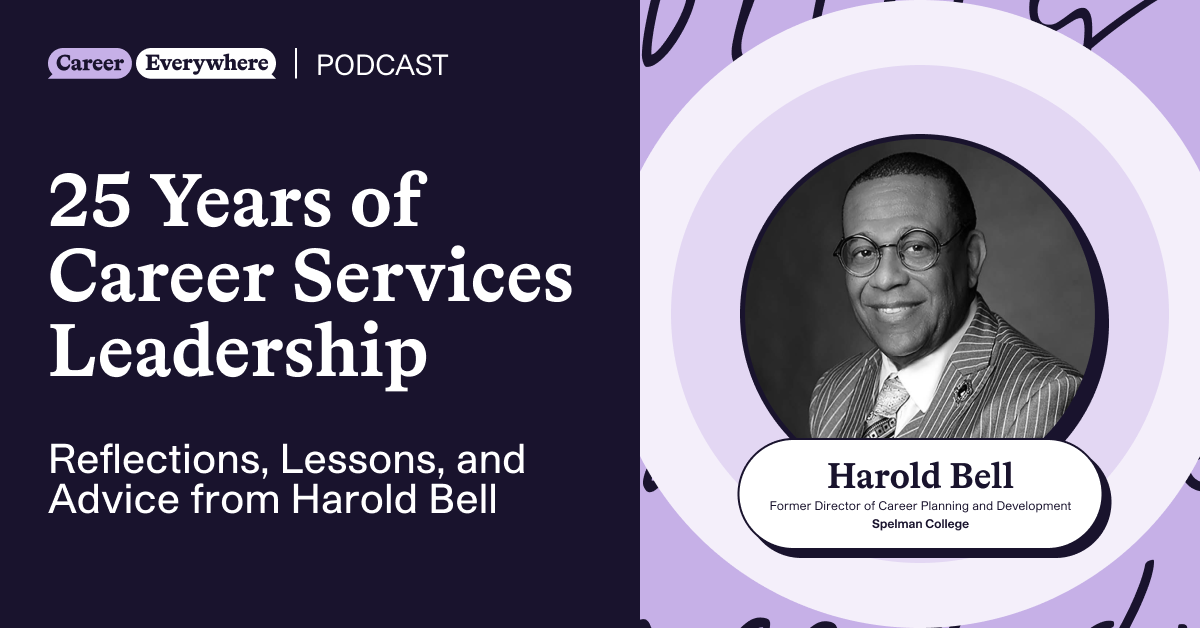
In this episode of the Career Everywhere Podcast, host Meredith Metsker sits down with Harold Bell, who recently wrapped up 25 years as Director of Career Planning and Development at Spelman College, the No. 1-ranked HBCU for 19 consecutive years and, more recently, the top-ranked women’s college in the country. Harold is a longtime NACE leader and a mentor to countless career services professionals across higher ed.
Harold traces his winding path into the field—from an early student affairs role, to a nonprofit that connected him with employer recruiting, to two corporate stints in banking and consulting, and finally to Spelman, where a key introduction (and a very direct first question: “Will you hire men?”) led to a job that had quietly sat open for a year.
He talks about the proudest moments of his tenure, including helping bring career services into the classroom through grant-funded work, building out Spelman’s virtual career center (powered by uConnect) during the pandemic, and being inducted into the NACE Academy of Fellows.
Harold also shares candid reflections on leadership, including why he believes your own team is the most overlooked stakeholder in career services, and why he decided the time was right to leave Spelman this past June.
He closes with what “semi-retirement” looks like for him right now, and his philosophy for anyone thinking about their own next chapter: see yourself as the answer to a problem, and the right opportunity will find you.
Key takeaways:
- Your team is your first stakeholder. Harold argues that career leaders often look outward first—to students, parents, employers—without recognizing their own staff as the biggest stakeholder in the work. Investing in your team (and in yourself as the leader) has to come first, not last.
- A winding path can be the best preparation. Harold’s route to Spelman ran through student affairs, a nonprofit, and two corporate roles in banking and consulting. Each stop added a skill he’d eventually bring to career services—recruiting, training, budgeting, and leadership development among them.
- Relationships open doors that job postings don’t. Harold landed the Spelman role through a networking chain: a former colleague, a mutual contact, and a search committee chair who’d already seen his resume before he applied online. As Harold puts it, “It’s not what you know. It’s not who you know. It’s who you know, who knows what you know, and who likes you.”
- Know the signs it’s time to move on. For Harold, the signal wasn’t burnout or conflict—it was the sense that the work had become repetitive and that he could no longer move the needle on the things he cared most about advancing.
- Choosing your own exit is a privilege. Harold left Spelman voluntarily, on good terms, and with a proud legacy—something he considers rare and worth planning toward.
- Rest before you relaunch. Harold’s framework for his “semi-retirement” transition: rest, reset, reload, relaunch. He’s intentionally giving himself time before deciding what’s next, rather than rushing into consulting or another career services role.
- See yourself as an answer, not just an employee. Harold’s closing philosophy: sustainability in your career comes from identifying the problems you’re uniquely equipped to solve and positioning yourself as the answer to them.
About the guest:
Harold Bell recently retired after 25 years as Director of Career Planning and Development at Spelman College, a private women’s HBCU in Atlanta ranked the No. 1 HBCU for 19 consecutive years. Before Spelman, Harold worked in student affairs, at the nonprofit INROADS, and in corporate roles at NationsBank (now Bank of America) and EY. He is a longtime NACE volunteer and was inducted into the NACE Academy of Fellows. Harold now considers himself “semi-retired” and is exploring what’s next.
Resources from the episode:
- Harold’s LinkedIn profile
- NACE (National Association of Colleges and Employers)
- INROADS—the nonprofit where Harold gained early experience connecting employers with student talent
- Spelman College’s virtual career center (powered by uConnect)
Harold Bell:
We can be so close to career counseling and all that sometimes, and we’re not the best career counselors ourselves. And so, we got to take some of our own advice. And so, I don’t necessarily know now what I did when I started at Spelman, like, I wanted to be a career services director. Now, I don’t have any fear that there won’t be something, but I’m not necessarily walking in with that. But here’s the thing, I have a lot more things to think through in terms of what I bring to the table now than when I started 25 years ago. It’s a different space now.
And so, the great thing about having this time, just what I like to say, reset, reload, and relaunch, and I’m going to even add another one to it, I’m going to put that one at the front, rest. Because I don’t think sometimes… I move fast, I do a lot, and I can get burnt out easy. So, I’m really also just trying to take the time to physically rest while I’m thinking through these other things too, so I can really show up in a way that I like to show up, and really just come out swinging.
Meredith Metsker:
Hey everyone, welcome back to the Career Everywhere Podcast. I’m your host, Meredith Metsker. And today I am joined by Harold Bell, the recently retired director of career planning and development at Spelman College, a longtime higher ed leader, and just an absolute giant in the field of career services. Thank you for being here, Harold.
Harold Bell:
Thank you for having me, Meredith.
Meredith Metsker:
Yeah, I am so happy to have you, and I have been looking forward to this conversation, because today we get to talk about your incredible career in higher ed career services. How you got into the field, your proudest moments, biggest lessons learned, and maybe hear a little bit about what’s next for you. And I feel like at this point, Harold, everyone knows who you are, you’re such a legend in the career services world, and I personally think you’re always the best dressed at NACE. But for those listening who may not know, you just recently wrapped up a 25-year tenure as the director of career planning and development at Spelman College, which is a private women’s liberal arts college in Atlanta, and the number one HBCU for 19 years in a row.
Harold Bell:
Yes.
Meredith Metsker:
And you were there for 25 years, so a coincidence? I don’t know.
Harold Bell:
I’ll never say.
Meredith Metsker:
Just say it. You’ve also been heavily involved in NACE, and you’ve just been an incredible mentor and inspiration for so many in the higher ed career services field. And I’ve had the pleasure of getting to know you a little bit over the past five years as one of our biggest champions and partners here at uConnect as well. So, I am just really excited to just reflect with you today on your 25 years in career services, and hear more about what’s next for you.
Harold Bell:
Okay.
Meredith Metsker:
So, yeah, before I get into my questions, Harold, is there anything else you would like to add about yourself or your background?
Harold Bell:
Sure. So, Spelman wasn’t my first tour of duty in higher ed, I was very fortunate… I always have to pause when I say this because I don’t believe it. But 40 years ago, so way before the 25, my first job out of college was actually working full-time in student affairs, that was unheard of at the time. And that’s actually where I began to cut my teeth on this whole concept of just working in higher ed. And in that particular role, I actually served students of color. So, we were doing programming, that was my office. But what would happen, ironically, is the employers would get to campus, they’d go to the career center, and they would tell the career center director, “Hey, we’re not really seeing the students of color at the propensity that we’d like to see the students of color [inaudible 00:04:19].” And so, I would end up being the person that they would come to.
Now, mind you, this was a programming office that evolved, I should say, into a counseling office, that evolved into the adjacent placement office. And so, really, I can remember just back in those early days, speaking with companies, helping them identify students, identify talent… And so, I don’t think anybody really ever saw that happening. And so, I just wanted to add that my humble beginnings really began 40 years ago in that job, talking to employers, and talking to students, and encouraging them to, “Hey, go to the placement office, this is what you’ll find…” We called it placement then, it’s a naughty word now. But-
Meredith Metsker:
But back in the day that was, yeah.
Harold Bell:
But back in the day, “Go to the placement office, get on the schedules, why are you not getting on the schedules?” Even when they would have their meetings in various settings, I would bring employers in to talk to them, we’d do panels. And so, this really happened really a long time ago is where it started. And I don’t know how deep you want me to get into all that, because it’s kind of layered, but I’ll pause right there. But there was some other pit stops along the way that eventually led me to Spelman, that all culminated into being in a career services role.
Meredith Metsker:
Okay. Yeah, we’ll dig into that in just a minute, how you got started at Spelman and in career services. But before I get into those more specific questions, I do want to kick us off with a question I ask all of our guests here on the podcast, and that’s what does career everywhere mean to you?
Harold Bell:
I think, and I’ll take it from a campus perspective, no longer are the days where the career center is strictly the hub of all things career. The career aspect of the whole concept of career outcomes, that should really be a whole ecosystem. And so, when I think of career everywhere, I think about an ecosystem that could be in the classroom, I think of an ecosystem that could be within student organizations, I think of an ecosystem where staff are involved. And so, it’s no longer, I think, are the days strategically where you just look at, you go to one place, the presence of the whole concept of career outcomes and development, all of that, it exists in an ecosystem. And the career center may be the captain of the ship, but it’s certainly not a one and done, and if it’s not done there, it’s not happening. It has tentacles that spread out throughout the campus, and it gets feed into and it feeds out as well.
And so, I like to think of career center folks as we’re strategic partners to different aspects of the campus, in helping to foster and cultivate and sustain that ecosystem. So, that’s what career everywhere means to me. Not just a career center, but throughout the campus, it’s the lifeblood that flows through the campus.
Meredith Metsker:
Well said. And also, I love all the nautical references. You are the captain of the ships, we have tentacles.
Harold Bell:
Captain and the octopus and then a tentacle.
Meredith Metsker:
Oh, I love that. Okay, great. Well, now, yeah, let’s get back into talking about your 25-year career in career services, and at Spelman College. So, yeah, to get us started, let’s go back to the beginning. You gave us a preview a little bit ago how you got started in higher ed 40 years ago, in student affairs, I am curious, how did you get into career services and then make your way to Spelman?
Harold Bell:
Okay. Yes. Oh goodness, this is fun.
Meredith Metsker:
Story time with Harold.
Harold Bell:
Yeah, story time. And so… It’s interesting telling this story because honestly, growing up, if someone asked me what I wanted to do, I would not have been able to say any of these things. Because I did not know any of these things existed, and I certainly did not know that I could be these things. And I think that’s the beautiful thing about careers. I know it’s easy sometimes to lock in on certain professions. So, I stayed in that higher ed role, was very successful in that role, and one of the things that happened that was sort of interesting is I was helping an organization, it was a nonprofit, called INROADS, and they too worked with students in terms of helping them to get placed in internships, they did professional development, they did counseling. And I actually, while I was still working in higher ed, helping them, actually got an award… I can’t remember, outstanding partner, whatever, whatever, of the year. Because I was helping channel talent.
And they had an opening. And as oftentimes, as sometimes with vendors and institutions and what have you, there’s that sort of dosey-doe and back and forth and that sort of happens. And so, I had did a four-year stint in higher ed, and then I decided to go and work with INROADS, which was again, a nonprofit, which really didn’t take me too far from working with students, but now I was working with students from different institutions. I was truly sitting in the space of working with companies, that’s when I really started getting on the student development side, because I wasn’t on the student development side in the role I was in, I was a programming role prior. So, now we’re talking about all the things around career services, from the counseling to the assessments to all the things that we do, the training, the interviewing, all of that. And that’s where I really started honing those skills and facilitating those skills, because we had corporations that actually paid a fee to be a part of INROADS… I had corporate accounts.
And so, that’s when I started seeing different companies, and finding out from different companies, what did they need? What did they want? Marketing INROADS, helping them understand what it was, helping them understand that you want to make the investment in these students. And we did that, and we went to high schools as well and talked to… So, little did I know that all of that was going to be very foundational to what would eventually happen with getting to Spelman. And so, what happened after that was, because I was talking to so many companies, obviously that was great exposure, and some of them wanted to hire me, but they felt bad because they didn’t want to take the resource away from the nonprofit. They’re like, “We don’t want to do that…” So, basically they would have to put feelers out and I would have to bite.
And so, what would happen eventually after another four-year stint there was, and how I eventually got to Atlanta… Because at this time, by the way, this is all happening in Texas, and I’m in Dallas, Texas at the time. But NationsBank, which is now Bank of America, I worked with them very closely, and they essentially offered me a position at NationsBank at the time, to be in a accelerated HR role. And, well, it was supposed to be in Dallas, but they couldn’t get that part together, so they said, “What do you think about moving to Atlanta?” And of course, I jumped on that because I said, “Ooh, Atlanta, yes.” And so, I went into this accelerated HR, because again, I was looking at a chance to live in a different place, I wanted to see what was all this business about corporate. Everybody was talking about corporate this and corporate that, I want to experience it for myself. Or so I thought.
So, ended up moving to Atlanta, working for Nationsbank, and I was there only a short period of time, in that program, and we were doing rotations. So, it was a rotational program. And so, I was rotating through management development. And so, at that time in the ’90s, early ’90s, banks were doing a lot of consolidation. So, rather than use outplacement firms to do all of that work, NationsBank had an arm within called Outplacement. And a lot of what that person did… And they were working obviously with adults at this point, not necessarily college students. But a lot of the content was things that we did in INROADS. And so, I remember that person taking a leave and decided that they didn’t want to come back, and NationsBank came to me and said, “Hey, really, the work you were doing in INROADS is very similar to this, you’ll have a different audience.. We understand you’re doing your rotations, but sometimes needs occur before the program ends. And so, we’d like you to do Outplacement and run Outplacement for the entire franchise.”
So, it wasn’t just for the Atlanta market, anywhere that they were having rifts, reductions in force, I would be involved in that in some kind of way. And so, it’s like, wow, what is this stuff? Really? And so, now I’m working in different markets, working with people losing their job, talking about all the things, and learned some new things, in terms of things that I did not know in my previous two jobs, because this is now my third job. And I’m like, “Wow, this is some really good stuff.” And so, had a very successful run at that, and while I was doing that, I had very good standup leadership, presentation skills. And so, they also had leadership development, and they said, “Hey, well, what do you think about,” we got a gap over here, “what do you think about delivering leadership development workshops to banking center managers?” So, I did that as well.
And so, all of this was just really forming the Harold Bell that people know about, just really fundamentally building those skills. And again, never knowing that it would lead to where I am. So, fast-forward a little bit, banking can be a little political at times, and so I wasn’t quite moving the way I wanted to move, and in my own journey of doing these workshops and what have you, I said, “You know what? I miss higher ed, working with the students, and I’ve learned all this new stuff, boy, I could bring a lot of stuff, I think I want to be a career services director.” I said, “Okay, but I’m in corporate now. How am I going to convince somebody I could do this work?” I said, “Because they probably don’t know half this stuff I’m talking about in higher ed anyway.”
And so, I said, “What am I missing?” And I said, “I’ve done college recruiting, I’ve done all the other things, the training and development stuff, leadership development, all that,” I said, “I haven’t actually recruited yet.” And so, this was funny, I got picked up by another company in the same building I worked in with Nationsbank.
Meredith Metsker:
Just making the rounds there, Harold.
Harold Bell:
Just making the rounds. And I got picked up by ENY, which now goes by EY, but it was ENY back then. And I went from some higher floor to the fourth floor, kept my parking space and everything, didn’t change. And what I ended up doing from the company perspective was learning. I did campus recruiting, I did experienced higher recruiting, hadn’t done that before. And really learning, seeing the corporate side of things, and how they think, how they operate, how they come up with numbers, and how many people are going to recruit, all of that. So, this was great, and I was really just trying to set everything up. Well, they had some riffs, and unfortunately after about a year and a half, I got caught in a riff. And so, now I’m at home and I’m sitting around, and I’m just thinking, still thinking, I haven’t left my dream of wanting to be in career services.
And so, I had a friend who I had mentioned… Of course, I’m telling people what I want to do, and all of this. And so, I had a friend that I mentioned, “I would love to be a career services director,” I’m just trying to figure out how I’m going to convince a school that I can do it, because I know I can. And I know I have the skills to do it. So, sometime after that, she came back to me and called me, and she said, “Hey, are you familiar with this organization called NACE?” And I said, “As a matter of fact, I am.” And she says, “Well, they have the…” And I said… Even when I worked at INROADS, and she was working at INROADS in another city, I said, “We get their newsletters in the office.” So, I know that they advertise career services jobs, but I’d forgotten all about NACE because I wasn’t really in the space to really access NACE like that. So, I’d forgotten about it. I’m like, “But I know exactly what it is.” She said, “Well, they have an online job board now.”
Meredith Metsker:
Hold the phone.
Harold Bell:
And…
Meredith Metsker:
An online.
Harold Bell:
And keep in mind, and I’m really dating myself, I sound like a dinosaur, but people were just getting internet in the homes back then. Although it just seems like breathing air now, back then it was fairly new. And so, got it, and I was online, I found the website, and I noticed on the 15th of every month they updated the website. And then, all of a sudden, one time I saw Spelman. And I read the job description, and literally I said, “I can do that, I can do that, I can do that…” I said, “There’s nothing on here I can’t do, the only thing on here I’m not is…” It said, “Master’s required, PhD preferred.” Okay, right. Okay. I said, “You don’t need a PhD to do all this because I’ve already done it.”
So, I had a friend that I knew that had previously worked at Spelman, she was an attorney at the time that I called her, and I said, “I’m going to call her and ask her about this.” And so, I called her, she said, “Oh my goodness, you’d be great at that.” And she said, “I’m going to call my friend Eloise.” So, she called Eloise, and she told her about me and everything, “Can you help him try to plug into what you need to do?” And she said, “Okay, I talked to her, here’s her number. You can call her now, and tell her who you are, and all of that.” So, I call Eloise, and I’m telling her what’s going on, and my first question, and I always chuckle now is, “Hey, I know this is a women’s institution, will you hire men?”
Meredith Metsker:
Yeah, I mean, that’s a fair question.
Harold Bell:
Like, I don’t want to waste my time. And she chuckles, “yes, we hire men,” she says, “but this is what I really need to tell you.” She says, “I got your resume, talked to your networking contact, and the person who chairs the search committee for this job sits right next to me in the cubicle adjacent to mine. I’ve already handed over your resume, and you should still go and apply online.” And so, just a quick pause there, I have this saying, it’s one of my favorite sayings, and it’ll jump ahead to probably something you’re going to ask me a little later. But at that point, it was, “It’s not what you know, it’s not who you know, it’s who you know who knows what you know,” is how I learned it. And what I added to that was, “And who likes you.” And we’ll talk about likability a little further down. But this was a person who I knew, who knew what I knew, and was able to communicate that to her friend who worked at the place I was trying to get to.
And she liked me. So, then the friend liked me. So, I went through the interview process, had a very good interview process, it was great, met my supervisor at the time, and she told me, “We’ve had this position open for a year,” they did a silent search. “We finally decided to post it, and you’re the first person that’s walked through that door that I’ve seen and I’ve liked.”
Meredith Metsker:
Okay.
Harold Bell:
And I made a long story short. That began my journey at Spelman College. And so, that was actually how I got there. But it was a culmination of everything I had done from my higher ed experience to my nonprofit experience to my two corporate stints. And when you start thinking about all that, that was the stuff we do in career services. And so, really, you think about that type of job, and you can’t major in career services. But I started realizing, particularly when I started talking about the recruiting side of, what skillset do I feel like I need to really round me out, and it was perfect. And then, it was just a matter of finding the right opportunity at the right time, looking for the right person, and it happened to be me.
Meredith Metsker:
Yeah. And it’s so cool that it was right there in Atlanta too.
Harold Bell:
Yeah. Oh, absolutely. Because I jokingly said two things, one, those people never leave that type of job. I’m guilty.
Meredith Metsker:
I mean, you did eventually, just 25 years later.
Harold Bell:
Right, right, right. I was speaking truth to manifestation. And I said, “They’re always not in cool cities.” And so, I didn’t even have to leave. And so, we took a chance on one another, and it turned out to be a great match for both. And I think over my tenure, I think I ended up working for five presidents. And so, yeah, I mean, it’s pretty awesome the tenure. So, yeah, so that’s how I got there, that was the-
Meredith Metsker:
Okay. Yeah, that’s really cool to hear how intentional you were about the choices that you made to get into career services. And I’m curious, knowing that, I mean, pretty much once you were in corporate, you started thinking about the idea of getting into career services and planning around that. What was it about higher ed career services that drew you?
Harold Bell:
So, I… And I’ll start with the corporate side of things. Obviously, everything, working for two banks was very bottom line, and I was fortunate because I had a training role… I mean, I ran Outplacement for the company, so that was kind of my directorship experience. So, that’s where the budgeting and all that came in, and the standup skills and all of that. But it was also transactional. So, we get a group of folks that would be getting rift, I’d go in, wow them, by noon I had them, they were my friend. Because they would start off calling me the hatchet man. I’m like, “No, the hatchet man’s already swung.”
Meredith Metsker:
You’re kind of-
Harold Bell:
“I’m here to help you now. I’m here to mend the wounds.”
Meredith Metsker:
Yeah.
Harold Bell:
And I just started noticing through helping just people in general, that’s something I wanted to get back to. And the audience that I was familiar with, that I helped out previously was students, and I just felt like I picked up all this experience. And I’m like, “I can bring back so much more to them that I didn’t even have when I first started.” I was coming out of undergrad, I mean, I didn’t know what I knew then, by that point, I didn’t know all that stuff. So, I would be bringing so much more back. And so, career services was just getting back to really being able to develop relationships, really working with students again, because I was missing that. I wasn’t as caught up into the money, money, money, money, this, that, and the other. Because really the Outplacement, it was done as a way to help the people, but to also retain their business.
So, it’s like, I’m cutting you loose, but I’m going to equip you to help you find your next opportunity. And so, it was a little transactional in nature, so I never necessarily saw those people again. And it was those two days that I was with them, and they were gone kind of thing. And so, I really wanted to get back to that. So, my way back, and again, I knew it wasn’t necessarily going to be a role like I had previously, was being able to come back this way. And I was talking to one of my consultants at the time because we also worked with Outplacement vendors, especially when we worked large projects like mergers. I couldn’t do everything on my own, so I had vendors helping me. And so, I was getting some free career counseling from them, and they would also say, “You’d really be good, I think your heart would be in something more vested like career services.”
And I agree. And so, that actually, having those kind of conversations, and just that was the draw to try to get back to a college campus, where I think I would be a better fit in terms of the development side and not necessarily money, money, money, money, money, money, money. I remember, well, earlier when you said, it made me think of something as I’m having this conversation, you talk about my dress and everybody knows about my dress. And I remember, one day I came to work and someone said, “He’s the best dressed man in the whole bank.” And there was this person that heard, that was more senior than I was, and his response was, “What does that have to do with making money?” And I’m like, “Come on now.”
Meredith Metsker:
Booo.
Harold Bell:
No. Really? And so, I just didn’t like that vibe of money, money, money, money, money, particularly if I’m not going to be getting my lion’s share of it.
Meredith Metsker:
Yeah, exactly.
Harold Bell:
And so, anyways, I’m like, nah, that’s not kind of where I am with that. And so, all of that really eventually wanted me to head in that direction. And while I was off, I had a lot of chance to think about what I wanted to do, I did a couple little projects along the way, and I’m like, I think what I really want to do is career service… It just kept coming back to that. And thus, 25 years, once you’re able to get in, thus the passion and the purpose and all of that sort of came together, and was fortunate and blessed to get the opportunity at Spelman. So, that’s all that helped me get that way. I got to EY, I was doing the recruiting and everything, and again, it was just very transactional.
And there was some aspects of that where you could help folks, but again, it’s all very transactional, they kind of get in, you start the process, and then they do their interviewing, and then they either get placed or they don’t move forward. And I went, this is not really what I’m accustomed to doing, I want something where I can feel more invested in the person’s development.
Meredith Metsker:
Yeah. Well-
Harold Bell:
And so-
Meredith Metsker:
… it seems like you really found your calling at Spelman.
Harold Bell:
Yes. Yes, yes, yes, yes, yes. And I didn’t know it was going to be Spelman, like you said earlier, you landed in Atlanta, I mean-
Meredith Metsker:
That’s pretty perfect.
Harold Bell:
Yeah. I mean, it just sort of worked out that way. I mean, I didn’t know that’s how it was going to work out. And it’s a great school, and then I came with all these things that I was coming with, and it was just a great marriage, that helped facilitate that tenure of being there. But that’s how I wanted to be in career service, and I think all the way back to my first job when those people coming to me and asking for help, and me helping, and me… It’s just always sort of been that way. And I would do some of that on the side, even when I worked at the bank and stuff. I think of someone I saw recently, and I remember I helped him write his cover letter, he was trying to move, that kind of thing, from the bank.
He was a former INROAD student in Atlanta, but he wasn’t one of mine. But it didn’t matter. And he got the job, he’s doing very, very well now. So, that was the sort of the things I wanted to do, career services. And I think the other thing too is, career services brought the business side and the student side together. I could still feel like corporate, but I could still help the students. You could still have the best of both world. You’d work for corporate, but you still worked enough with corporate that you could still have a little bit more of that. And so, I think I had more of the balance that I needed in my career, if you will, or my station, if you will, to be able to do that. So, I think that was just another thing too, to be able to do that.
Meredith Metsker:
Yeah. And you got to pull from the leadership experience you had too as the director there at Spelman.
Harold Bell:
Yes, yes, yes, yes, yes. Absolutely.
Meredith Metsker:
So, you were at Spelman for 25 years, as we mentioned, and I think you recently just stepped away on June 30th, right?
Harold Bell:
Mm-hmm.
Meredith Metsker:
So, I’m curious, during that tenure there, what are some of the things you’re most proud of looking back?
Harold Bell:
Ooo-ey.
Meredith Metsker:
I know, it’s a big question.
Harold Bell:
So… And I would say, and Spelman’s in this, but Spelman, this allowed me to get more involved with NACE. And I’ve always been the type of person where I’m not just thinking about myself, I’m thinking about a multitude of things. And when I think about this particular cohort of HBCUs, being able to uplift the whole cohort of HBCUs. And I remember when I got in, back in the day, it wasn’t a whole lot of HBCU activity, I mean, it’s certainly not what it is today. And I remember being approached by a couple of folks, and it was hard back in those days, because again, it was just, I think, just trying to help people understand HBCUs, and how they sit amongst PWIs, and whatever, whatever.
But I stuck with it. And I have to say, there are people in the beginning that were not with me at the end. Not necessarily with me, but just didn’t last the duration of all of this. It was frustrating to do that in the earlier parts of the work. And so, I think to finally start… And I would say some of that is people getting to know me, me helping people to understand Spelman, me getting people to understand HBCUs, and just getting people with open minds, that kind of thing. And I think it just started opening up the doors kind of thing. And so, all that to say, I’m very proud that… And Spelman gave me the venue to do this, or gave me the platform to do it, and the reputation, if you will, to be able to do that kind of work over a period of time.
And so, to finally see all the things that are going on today, not necessarily specifically a Spelman exclusive sort of thing, but to see now how HBCUs are very active, they have a voice, we were able to monetize our conference. To be able to get a national award for that conference, that’s the only committee at NACE that’s ever gotten anything like that. I don’t even know if there’s another committee that’s monetized anything, to be honest. But you start thinking about that, and national recognition. And to think about those early days, and to get there, phenomenal. I mean, obviously, and again, I consider Spelman a part of this, and then I’m going to switch to something Spelman-specific, but obviously being inducted in the NACE Academy of Fellows for that kind of work. I never envisioned that, I remember seeing people getting the award, and I just didn’t think that would be me. And boy, was I wrong.
Meredith Metsker:
That was a few years ago, right? That you got the-
Harold Bell:
That was a few years ago.
Meredith Metsker:
Okay.
Harold Bell:
About three years ago.
Meredith Metsker:
Yeah.
Harold Bell:
And I just never… And you think that that’s not even an HBCU award, that could be anybody. Well, it can’t be anybody, but I’m saying if it’s representative of any association that qualifies. So, to get that, I have to say, was one of my proudest moments, because now you’re talking about your contribution to the profession, and it being recognized in a way that you are lauded in front of your peers. I mean, it doesn’t get any better than that. So, that was really awesome, awesome. Now, with Spelman, and I’ll give uConnect a shameless plug here. But I think a game changer for us was definitely… And I’ll use the pandemic as a flashpoint. One of the challenges that was put forward to me was, we need you to do something, what are you going to do to connect with the students? How are you going to keep things going?
And everybody was in a panic and in a spiral. How do we keep things going? And I remember going on our website and putting up this little straw man… But it was just very basic. It was just having something to silence the people who were nervous about trying to provide something. And so, I remember, I don’t know if it was an email or something, but I saw the uConnect email, and I’m like, oh my God, this is going on another level. They want to centralize something, and they want to try to have something that the students can really go to and benefit from. We’re no longer talking about a webpage with, “Click here to do your counseling,” and, “Do you know about Handshake?” This is so much more bigger than that now. And really having a 24/7 presence that is much more massive than just a page on the website. And I’m like, okay, let me take a look at this. And so, I saw it, and I’m always known as the person with the big ideas. “Oh, what is Harold ranting about over there now?”
But one of the things I learned about Spelman is, if you really want to see something go through, you got to come correct. And correct would be, you got to come with the money, you got to come with the resources, you’ve got to be ready to say, here’s the idea, here’s how it’s going to get funded, here’s how it’s going to be sustained. If you don’t come with that, forget it. And so, I started doing my little things here or whatever. And so, I’m doing this, and I said, “Okay…” And then we got the first sponsorship, whatever, to get us started, and I started trying to explain to everybody what this is, and how this is a game changer. And I said, “Everybody doesn’t even have this.” I said, “So, I’m doing more than what you ask, I’m really also moving the career center to another level.” Beyond a webpage, consolidating our resources, creating a one-stop shop that has a plethora of resources, and some things that we couldn’t even provide on our own. And so, I think, to bring that to Spelman, that was phenomenal.
Our neighbors across the street saw it, and they immediately proceeded to do the same, which is good, because we ended up, it replicated twice over, at least with our neighbors. But it’s a part of what we do now, and it’s a critical part of what we do. And although the sponsorships are a little challenging now, the goal for me was always to try to get it institutionalized, and we’re almost there. Spelman did something they hadn’t done the previous year, they at least gave me half the money. And so, it’s incumbent upon me to try to find, or whoever now, to try to find the rest of it. But the team in career services, they all were going to, “Hey, we cannot not have that,” kind of thing.
So, I think that was good making that a part of who we are, and what we do, I think that was huge. Because as you know, every school doesn’t have it, there’s some big schools that don’t have it, and so, it’s a great resource for us to have. So, I think that was a game changer because it not only dealt with what was going on with COVID, and the whole thing in terms of access, but it really also pushed the career center forward.
Meredith Metsker:
Yeah.
Harold Bell:
And I think one of the things you have to be is a visionary, and you have to creatively solve things, and that’s what Spelman knows me as, and that’s the type of projects they would pull me on. They know, they put me on something, I’m going to execute and get it done. If I tell you I’m going to do something, I’m going to do it.
Meredith Metsker:
I believe it.
Harold Bell:
And so, we were able to do that. So, very, very proud of that just in terms of, that one year we even got, this was years ago, probably around 2011, Princeton Review had a career services ranking, sort of like US News has with the schools, Spelman was ranked the number 13 best of all career centers in the country.
Meredith Metsker:
Nice.
Harold Bell:
And again, I look at, I don’t have anything about being ranked amongst my peers, but I always want people to understand the type of institution Spelman is. It’s bigger than just an HBCU. I mean its reputation, it’s bigger than some larger schools. They’re able to pull some things in that… And get recognition that some larger schools can’t. So, it’s not a small player because it’s a small school. And it recently was Newsweek did a ranking, and Spelman was the number one ranked women’s college in the country. So, we’re talking to everybody now. So, it’s just great when you’re able to do those types of things. And that’s not necessarily something I was working on. But when I think about that kind of ranking, when I think about my own personal thing that happened with the… Those are just some things that I think about.
But just the touching so many lives, and doing so much of that, and opening up so many eyes, and bringing together so many opportunities. I mean, there’s probably a whole bunch of, I can probably spend an hour doing an itemized list of things, but those are definitely some things that come to mind. We got, I think it was just short of a $2 million grant… Oh, this was a good one, I’ll end with this on things that I’m proud about. I found this grant that UNCF was doing with HBCUs, and it was trying to… The focus was immersing career readiness in the classroom. And so, I presented it to our grants folks, and they wrote it, and we got the money, and then I was the co-PI faculty member.
That grant was funded for five years, but what it did was it got Spelman thinking in those five years of a continuation strategy. And so, we got a QEP, a quality enhancement plan, that picked up another five years and built upon that. And so, thinking of how something that started off five years got doubled into 10 years. And they institutionalized it because that was the thing. It’s transactional in the beginning because you got to get all these people on board and sold on it and doing it, but to sustain it, you got to institutionalize it. So, those are some things that I’m just proud about over the years that happened, that had in some way, shape or form had my contribution tied to it.
Meredith Metsker:
Yeah. And they’re all things that will continue to live on.
Harold Bell:
Absolutely. Absolutely. Absolutely. Absolutely. Yes.
Meredith Metsker:
Oh, that’s so cool, Harold, what a legacy. I mean, you’ve kind of shared some of these already, but are there any big lessons learned that you want to pass along to your colleagues?
Harold Bell:
Yeah. One of the things we talk about when we talk about what’s the skill set… And I won’t get into all the things. But one of the things I was thinking about when I was thinking about that question, we tend to think external when we start talking about building social equity. Who are the stakeholders? And one thing I would share with my colleagues, because we’re always thinking out, the parents, the students, the companies, I would say start with your team. I think that’s the biggest stakeholder because that’s your service delivery. They’re the ones that’s got to make the magic happen. And I think sometimes we’re identifying all these other people, and the team never comes up as a stakeholder. The team is a stakeholder, their careers are depending on this. When somebody’s complaining about the career center, it’s the career center, which means everybody in the career center that they’re talking about. We really have to think about them as a stakeholder.
Because to the degree that they’re invested in, and that they are held in a high esteem, that’s going to flow into all these other stakeholders. So, you can’t forget the foundation. The other person that I would say is a stakeholder is the career center director. And what do I mean by that? So, not a narcissistic statement, it’s just simply you’ve got to remember that you’ve got to look at yourself as a stakeholder from the standpoint of, you’ve got to invest in yourself in such a way that… Because you’re the vision holder. And you have to run with this thing. So, what are you doing to help yourself? And I’m talking about a variety of things. But whether that’s professionally, whether that’s NACE, whether that’s career leadership collective, whatever these things are that you’re doing, you’ve got to invest in that.
I think about AI, everybody’s in a spin with AI. You don’t have to be an expert, but you do need to know what’s going on, and you do need to be prepared to have a conversation about what’s that impact on career services at your institution? What does that look like? Kind of thing. I would also say peace of mind. Your health, you got to keep all of that in perspective. And so, your professional development, your personal development, all of that has to be key. And so, I would just say don’t start there, don’t think about that last. Because if you think about that last, you have to remember anytime there’s issues, that’s what they go to first. And so, you have to set the example, obviously, so get your foundation first. Now let’s start talking about all these other people.
Meredith Metsker:
Yeah, that’s great advice because I feel like a lot of people think that to be a good leader, you have to put yourself last. And maybe in some respects you do, but it’s like that saying, you can’t pour from an empty cup.
Harold Bell:
Right, exactly. Exactly right. So, you got to understand this is the foundation. And even though you may have this ecosystem, by and large, people still see the career center, they’re the ones that’s getting paid to do… They get paid on paper to do this. And so, you have to take care of your foundation. And so, I’m changing the narrative on that a bit, and not doing it last, I’m going to say first. And having those conversations with your staff, the developmental feedback, and helping them do all the things… I’m proud when my people get picked up. As a matter of fact, it’s kind of funny, but my admins, I’ve had two admins recruited away from me, internally. Because the word on the street is Harold knows how to train his people, you see what I’m saying?
Meredith Metsker:
It’s a blessing and a curse. Yeah.
Harold Bell:
Yeah, right, right, right, right, right, right, right. And if it’s something better, whatever, I hate for them to… But it says something about you and your approach. And I think we have to, again, we have to not think the last thing about all of that. And so, definitely I would have to say that. In these times, I think you definitely have to be a creative problem solver, you have to be very creative about how you problem solve, how you get things done. So, even with uConnect, like I said, in the beginning, I knew Spelman was not just going to give me that money. So, how are you going to do that?
Meredith Metsker:
Using those business chops.
Harold Bell:
Yeah. Yeah. So, you have to be creative in how you go about making things happen. And I think when this is not new, but you’ve got to figure out ways to the degree that the institution will allow you to generate revenue, because most of the time you’re probably not going to have what you need to really do the job that you need to get done. And so, that’s very important that you have that skillset, that you have them… You have to be a marketing person, you got to know how to market stuff, I think in another life I probably should have been in marketing.
Meredith Metsker:
It’s fun.
Harold Bell:
But you also have to be an evangelist. You’ve got to go out there and speak the story, you’ve got to go out there and sell the people. And I just love it when I’m able to turn the difficult people around. But you got to know how to go out there and do those sorts of things. And so, I just think it’s important obviously to do those kinds of things. But the problem-solving thing… And here’s where it can even get sticky sometimes. I think institutions, I heard someone say, “Your position is a strategic position,” but I wasn’t necessarily always treated as a strategic partner. And so, I think that could be a difficult thing depending on where you are. They understand it’s strategic, and then you have to continue to place yourself in those rooms to be as strategic as you can.
So, you got to be in on those conversations about the strategic plan. If they’re talking about the strategic plan, and you’re in career service, and you’re not a part of it, you’re in trouble. And you still have to get all, even if you’re not necessarily viewed that way, you still have to position yourself to be that way. And so, those are just, I guess, a few things I would say. I mean, obviously you got to be good in employer relations, you have to really listen to it…
That’s one thing I’m telling my staff, listen to what they’re saying, don’t just jump, listen to what they’re saying. When they say all majors, do they really mean that? Or are they really talking about engineers? And you’ve got to listen because if you don’t, you can end up not giving them what they want. So, don’t just always even look at things face value, probe, ask, dig deep to see what they really want. So, those are just a few things I would throw out there.
Meredith Metsker:
Yeah. Those are all great lessons and good advice. As we’ve been talking, Harold, of course you’ve worked at Spelman for 25 years, you clearly have loved your career, loved the work you did, and love Spelman. So, I am curious, how did you know that it was the right time to leave? I know you have reasons, and I’m curious how you thought through that.
Harold Bell:
Sure, sure, sure, sure, sure. Well, I think sometimes I feel like I got ahead of Spelman in terms of where they were ready to go in certain places. And of course, I think that could be frustrating, when you’re getting ahead of where they’re ready to go. And that could be frustrating… One of the things I’ve learned, and I set this up when I was talking about strategic partners, strategic position, influence is very important. And you’ve got to be in a situation where you can influence things to move forward. And I think for me… And I’ve never been shy about saying influence is important. In fact, it’s not my DISC anymore, I’m a D now, and I forgot what even a D was. It’s very detail-oriented, whatever. But I used to be a strong I influencer.
But that’s probably my number two in the DISC assessment. That’s just critical. And so, I know for me, when I started feeling like I really couldn’t move the needle in some areas that was really going to advance career services, now I got to sit back and say, “Okay.” Because sometimes it could just be in the place that you are, meaning that the actual environment that you’re in, they’re just not ready to move forward like that. And that could be stifling because you come to the ledge, and it’s like, okay, I’m ready to build a bridge to the other side, but they ain’t ready to invest in the bridge.
So, do I want to keep copy, paste, copy, paste, copy, paste? Same old, same old. I mean, look, this was voluntary what I did, so I could have rode this thing out and kept doing the same old thing, but that just wasn’t for me. So, I think it got to a point where, because it wasn’t moving, meaning career services in my mind wasn’t evolving in a way that I wanted to, it started getting boring. Because it was kind of like copy, paste, copy, paste… This is the time of year we do this, time of year we do this, time of year we do this. And unless there was some transformative, sustainable thinking that really was going to challenge the status quo, that’s how things were going to be. And so, I think for me, the question became, do you want to continue to do that?
Well, no, because now you’re stifling my creativity. My creativity is very important to me. And so, when that gets stifled for me, that’s like, I’ve got to probably get somewhere where I can do this and have some more capacity to make things happen. And again, sometimes it’s just the place that you’re in, it’s not going to make Spelman any less of a place, It’s just that’s where it is. It’s where it is, and I am where I am. I think the other thing that happens too is that, and I chuckle about this, but Harold has a brand. There’s Spelman and there’s Harold, and I don’t lose anything because I leave Spelman. I’ve built my own brand. And so, I started thinking about, well, what is that? What is that, beyond his dressing and all that, and his ideas and all of that, what is that, and what’s the market value of that?
And where can that be? And I’m like, okay, so I have a brand too. And so, I started thinking about, okay, I’m looking, I’m in that window of retirement, whether that’s full or whatever, and I’m thinking, okay, I’ve got this much time left, if I’m looking at full retirement, whatever, how do you want to spend that time? Do you want to just to continue to copy, paste, copy, paste? For me, the answer was no. And so, it was just yet another thing, and I think, and just being honest, there was just some times where some mornings I just didn’t want to get up, and that’s when you know, it’s like, do I want to get up and deal with the copy, paste thing?
Meredith Metsker:
Yeah. Yeah, that’s a good signal.
Harold Bell:
Yeah. Yeah. And I’m just being real. Do I want to get up and deal with… Where we are now, I can do this in my sleep. And that’s just not the type of person I am just to keep rolling like that. And I’m like, okay, you need to make some decisions. And so, having an opportunity to have that decision, and to be able to move on, I believe enough in myself and what I’m bringing to the table that there can be another day somewhere else. And that some of these things that matter to me, it may not be in career services, and I’m not even going to limit myself that way. Because I believe, as I alluded to earlier, you get good at a lot of different things. If you’re good at it, you get good at a lot of different things, you don’t necessarily have to be just career services. And so, I just started, I said, “You know what? It’s time to, career services guy, it’s time to take some of your own advice.”
Meredith Metsker:
Yeah, that’s true. And you put in all this work for so long that you set yourself up to be able to make this choice, and not be forced out, not get burnt out.
Harold Bell:
Yeah. Exactly. Right.
Meredith Metsker:
That’s all you. Yeah.
Harold Bell:
Yeah, that’s all me. That’s why I said, I have my own brand, I did that.
Meredith Metsker:
Yep.
Harold Bell:
Yeah. And so, I had a great canvas to help me paint that picture, but I did that. So, great point. And I think that’s the way you have to view yourself, is don’t ever forget about yourself in the process. And we can be so close to career counseling and all that sometimes, and we’re not the best career counselors ourselves. And so, we got to take some of our own advice. I don’t necessarily know now what I did when I started at Spelman, I wanted to be a career services director, now, I don’t know necessarily what the next step is in particular now. I don’t have any fear that there won’t be something, but I’m not necessarily walking in with that. But here’s the thing, I have a lot more things to think through in terms of what I bring to the table now than what I did when I started 25 years ago.
It’s a different space now. So, it’s a whole lot to factor in now about what the possibilities are versus 25 years ago. And so, the great thing about having this time to just, what I like to say, reset, reload, and relaunch, and I’m going to even add another one to it, I’m going to put that one at the front, rest.
Meredith Metsker:
Yes.
Harold Bell:
Because I don’t think sometimes… I know, I move fast, and I do a lot, and I can get burnt out easy. So, I’m really also just trying to take the time to rest, physically rest while I’m thinking through these other things too, so I can really show up in a way that I like to show up, and really just come out swinging. But yeah, so I would just say if I was, I guess, to just summarize that, just recognizing that, and this is totally okay, it doesn’t mean you’re a failure. I’ve done all that I know to do based on the circumstances that are given to me to do that in. I know that I’ve done what I can do. I can stay on, and they’d be totally happy with that.
But I know I’ve done all I know to do without becoming complacent, without not really moving in a way that I want to see us move. Because visionaries and stuff, we don’t like hanging out too long in the same place. We want to move. But sometimes it’s time to go let new ideas come in. I look forward to whoever they have coming in, it’s not a competition. They’re probably scared.
Meredith Metsker:
They have big shoes to fill.
Harold Bell:
[inaudible 01:06:04].
Meredith Metsker:
But you’ve also left behind a great team.
Harold Bell:
Yeah, absolutely. Absolutely. And that’s why I’m at peace with all… Everything I just said with you, I’m at peace. At times I do have a little separation anxiety, and sometimes my team will reach out, not often, and they’ll say something. But it’s really… And I’ll provide some guidance, obviously I’m not doing anything for you, but even just learning to let all of that go, and letting them grow in that space. I mean, I had to do it. But it’s tough sometimes because I know how to go in and start making it happen… I’m a big time problem resolution person. And I conflict resolute. I ain’t trying to resolve conflict, I’m trying to resolve the problem.
Not conflict management, I should say. I’m into resolution, not management of it. So, yeah, so like I said, it was, hey, again, high note, there was nothing, no scandal, no poor performance review, nothing like that… I can end on a high note, and everybody’s happy. Everything’s celebratory because it ends on a high note. And to know that I could have gone on if I wanted to, but I choose me, and I choose to do something, to took myself out there and see what the possibilities could be for a next chapter. Not even knowing what I knew before, 25 years ago, but even now, just putting it out there and really allowing my mind to really embrace numerous possibilities.
Meredith Metsker:
So, on that note, Harold, so you left on June 30th, you have described yourself as semi-retired instead of fully retired. So, I’m curious, what does this next chapter look like for you right now? And what are you hoping comes next?
Harold Bell:
So, I tell people I’ll never say no, but I don’t necessarily… People want to automatically try to put me back into career services. And I don’t know if that’s going to be the case. And that’s no disrespect to the profession or anything like that. You do these things… I mean, every school, when we talk at NACE and whatever, there’s some things that are standard across the board, I don’t care where you are. And so I think for me, the question becomes, do you want to just do that again and do that somewhere else? Not necessarily. It’s not a hard no, but that’s not necessarily the thing that comes to mind when I think about what might be next. But I won’t completely say no, but that’s not necessarily top of mind when I think about that.
There’s so many transferable skills with this to what I’ve been doing, and I haven’t, and I’ll be honest, and it’s only been probably about three weeks now anyway, going on three weeks. So, it’s still fresh. So, I gave myself this month, and it’ll probably be longer, just to not even think about any of that. I’m okay with just resting right now, and getting some things in order. I don’t have a particular game plan yet, I haven’t particularly gone after anything. I’m not necessarily thinking about that, because the rest part I think is critical. And so, right now I’m getting some rest, I’m prioritizing health. I think I let some of that slide a little bit. And so, I’m really trying to, again, when I was talking earlier about me, get yourself back in a good place… Not that I’m in a bad place, but get yourself back mentally, spiritually, physically, all of that.
Be your best self when you get ready to go do that. So, that’s getting self together. I will eventually start, I guess, looking looking, but obviously we’re in a space where there’s employers, there’s vendors, there’s other schools… There’s a lot going on. And so, I just figured there’s a lot of things out there. I just have to figure out what does that look like for me? And I can’t honestly say what that is today, and that doesn’t bother me, I don’t feel like I’m not employable.
Meredith Metsker:
Yeah. I feel confident something will find you. Yeah.
Harold Bell:
Right, right, right, right, right. Because honestly, and it’s funny you said that, but that really has been my career path. So, when I got to higher ed, I didn’t hire myself to be in higher ed, I was approached, and said, “What do you think about doing this job?” Actually, my mentor was being promoted to dean, and he asked me, “What would you think about doing the job?” I had my first job in higher ed. And I looked at him like, “Man, I’m a business major.” And I wasn’t looking at myself that way. And I remember, I used to go up to student affairs all the time, I wasn’t even a student worker, I just like hanging out there, and I remember one of the deans saying, “It’s a shame we can’t pay you, you’re always up here.” Who knew that premonition would manifest? So, I was invited to that position.
They weren’t going to hire some young 20-year-old for that. I mean, but I got it, and did well. I had lines going out my office two, three weeks, they had never seen anything like that. It just blew people away. My financial aid was next to me, but they weren’t in the financial aid line, they were in the line to see me.
Meredith Metsker:
It’s another example of you set yourself up for success.
Harold Bell:
Yeah.
Meredith Metsker:
Yeah.
Harold Bell:
Yeah, exactly. There you go. And then, even for INROADS, again, I was doing things for them, I wasn’t planning on working for them. Got the call, “Hey, what do you think about coming to work for us?” Right call at the right time. NationsBank, they called me up. “Hey, you helped us be company of the year, mentor of the year, business…” They were killing it. And I was their account manager. And the question was, why is he not working for us?
Meredith Metsker:
And EY also recruited you, right?
Harold Bell:
Yeah, and then EY, yeah, EY called me up.
Meredith Metsker:
I’m seeing a pattern.
Harold Bell:
Yeah, they called me up. Yeah. So, that’s been the path. I found Spelman, but I had a network in contact. You know what I’m saying? And so, that was one good enough to get in, that was the one. So, that’s kind of been my trajectory. And if anything, like I said, all those examples was what led to Spelman, we’ve got a whole body, 25 years body of work added onto that. So, I believe, like you said, I think it’ll probably find me, because apparently it doesn’t seem like I’m hard to find.
Meredith Metsker:
And you’re giving yourself the space and the opportunity to be available for whatever finds you.
Harold Bell:
Yeah, right, right, right, right, right. And that’s the other thing I think too, I think sometimes when we’re trying to leave, things don’t really happen. I’m amazed at how things happen, when you finally decide to leave, it’s almost like I’ve built space.
Meredith Metsker:
Exactly.
Harold Bell:
Sometimes you can look like, I think, you’re not going to leave. So, you think about somebody being in a space for 25 years, they’re not really going to leave. But when you finally create the space, you’re like, oh, he is open to leaving. He left. Yeah. So, I believe it will come at the right time. I’ll be ready, it’ll be a good intersection of the right opportunity and I’m ready, and it’ll happen. And so, I’m just thinking it’s going to be great, it’s going to be good, and just exciting. And so, that’s what I wake up thinking. I can tell you, I’m not in the least bit depressed.
Meredith Metsker:
Yeah. And you’re waking up, you’re happy, you’re excited, you’re not dreading going to work. Yeah.
Harold Bell:
Hey, I’ve started walking five-
Meredith Metsker:
You made the right call.
Harold Bell:
I do three, five mile walks a week.
Meredith Metsker:
And you just ran a 10K a couple of weeks ago, right?
Harold Bell:
Right, right. I just did a 10K. I get up in the morning… This morning I got up, I’m at the walking place at 7:30 AM, I’m there. And I spent an hour and a half walking and jogging, and I do five miles. So, I’ve already done 10 this week, I got another five.
Meredith Metsker:
Nice.
Harold Bell:
Yeah. So, just that think time in the morning, that time normally… And it’s so funny because the place is, it’s outside, and cars are coming down the street, that’s a major thoroughfare. I’m like, man, I was doing that, they’re going to work. Hustling and bustling. And I’m out here in the pretty park, walking my five miles, with no agenda. Yeah. So, all that, like I said, it’s just the peace of mind and all that. Yeah, it’s great. It won’t be forever, but it’s for now. Yeah.
Meredith Metsker:
Yeah. Well, I know I, for one, am very excited to see whatever is next for you. And I know all of our viewers and listeners are probably also excited to follow your journey there. Before I start closing us out, Harold, is there anything else you would like to add?
Harold Bell:
No, it’s just, I think as you get older, peace is a very valuable commodity. That might not mean a whole lot when you’re younger, but peace is a very valuable commodity. And I can say with assurance I have peace. And that means a lot for a lot of different reasons. Peace, peace of mind, just your body, all of that. And so, don’t take peace for granted. So, that would be one thing. And the other thing I would just say is, the answer to every problem is a person. It’s not technology, because if you don’t know the technology exists, then it’s not technology. That’s kind of like what uConnect… uConnect was technology, but I had to know it exists, and I had to bring it. I had to make it happen. I don’t have to do all the things, that’s what uConnect does.
But I had to demonstrate how it was the answer to a problem. So, I would just say always see yourself as an answer. And what are you an answer to? Because really at the end of the day, I think all of us are called in some way, shape, or form to be problem solvers. So, what answer are you to what problems? And just viewing yourself that way, because that’s what makes you sustainable. As long as you continue to be that answer, you’ll be around. That’s, in my mind, the secret to being around. And it might not be the same place, but as long as you’re an answer, there are lots of problems out there, there are a lot of people seeking answers. So, being an answer, it’s kind of like what we were saying earlier, it makes you more marketable because you can be an answer to many people, many places, many things, and so that’s what sort of opens up your marketability. So, look at yourself as that way and not just, “I’m an employee and I do this.” No, you’re an answer. Be an answer.
Meredith Metsker:
I love that, that’s great advice, Harold. Yeah, and I suppose it’s also finding the right question too.
Harold Bell:
Right, exactly. Right, right, right, right.
Meredith Metsker:
We want to get real philosophical.
Harold Bell:
Yeah, somebody said, nobody likes the answer to a question nobody’s asking.
Meredith Metsker:
Yep, too true.
Harold Bell:
So, you need to find the right questions, what are the right questions? And what is the answer? And how are you the answer? So, when I saw that Spelman job description years ago, and I said, “I can do that, I can do that, I can do that,” I was the answer. And guess what? When I got to the interview, there was a lady that was at my going away party, that was on my interview committee.
Meredith Metsker:
Wow.
Harold Bell:
She’s still there. And I remember her saying, “I can’t believe this resume.” Why did she say that? Because she saw the job description, she saw my resume. She saw the answer on the resume, answering the questions on the job description, the implied question. I can’t believe that was her. And she said it out loud, in the interview. “I can’t believe this resume.”
Meredith Metsker:
Well, believe it.
Harold Bell:
Yeah, believe it. Right. Yeah, believe it. 25 years.
Meredith Metsker:
25 years.
Harold Bell:
Yeah, yeah. And she made sure she came, she said, “I had to come.”
Meredith Metsker:
Oh, that’s a very cool-
Harold Bell:
So, the person that, she was even there for the end, that’s something amazing. I mean, she still works there, but she said, “There was no way I wasn’t going to come.” And that was 25 years ago when she sat on my committee, and she came to my exit.
Meredith Metsker:
That’s one more way you know you’ve made a real impact and left a legacy.
Harold Bell:
Yes. Yes, absolutely.
Meredith Metsker:
Well, Harold, if folks would like to connect with you or learn more from you, where is a good place for them to do that?
Harold Bell:
Probably LinkedIn is the easiest way.
Meredith Metsker:
All right.
Harold Bell:
Reaching out on LinkedIn, I’m out there.
Meredith Metsker:
And for everyone watching or listening, I’ll be sure to include a link to Harold’s LinkedIn profile in the show notes so you can easily go and find him.
Harold Bell:
Yeah. Yeah, that’s probably the easiest way without these emails and all that, just do LinkedIn.
Meredith Metsker:
Sounds good. All right. So, Harold, at the end of every interview, we do this answer a question, leave a question thing. So, I’ll ask you a question, our last guest left for you, and then you will leave a question for the next guest.
Harold Bell:
Oh my goodness. Okay.
Meredith Metsker:
Perhaps poetically, our last guest was actually uConnect founder and CEO, David Kozhuk, who I know you know.
Harold Bell:
Oh boy, I’m scared.
Meredith Metsker:
Well, and he left this question for you, which I think is actually kind of funny given our conversation. But he said, “If you were selected to be president of an institution, what would be your first order of business?”
Harold Bell:
Oh my goodness. So, it would, of course, in my mind, be elevating career services. There’s a lot of obviously back and forth theory about… I know that’s not probably a popular thing with some faculty. But I think at the end of the day… One of the things I always say is the success of career services depends on the two Ps, and I’ll even add another one. But definitely the provost, definitely the president, and the CFO. The person over the academics, the person over the institution, the person over the money. You got to get that trio, that’s the trio right there. But I would prioritize career services, I would definitely do that. Because I think at so many institutions, that’s the problem. And I think people, sometimes with faculty, when they start having a vocation conversation, it’s not just about vocation, it’s bigger than that.
It’s development, it’s so much more than that. And so, I think it’s an ongoing battle, but I don’t think it’s done at that level enough. And I know that for a fact. And so, that would be one of the first things I do is I would prioritize… Because what happens so many times, particularly at HBCUs, if I was just to use HBCU as an example, there’s so many competing priorities, but at some point you choose the priorities, and career services just keep getting knocked back, knocked back. So, I would make it a priority because I’ve always said, unless a president comes in and makes it a priority, it’s going to continue to struggle, to mature to the place where it needs to be. So, that would be my answer to that question.
Meredith Metsker:
And that is music to the ears of everyone listening to this. If only every president elevated career services.
Harold Bell:
Oh, now I got to think about the question I would leave to the next person, since I have no idea who the next person’s going to be.
Meredith Metsker:
Yeah. What question do you want to leave?
Harold Bell:
If you could be an answer to a problem of your choosing, any problem, what problem would you be an answer to?
Meredith Metsker:
That’s a good one.
Harold Bell:
And what does that look like?
Meredith Metsker:
I love it. That’s a great one.
Harold Bell:
So, if it’s poverty, how are you the answer to that? And sometimes people say… What do they say? Be the… What does it say? Be the solution to the… I forgot how the saying goes, but it’s sort of in that spirit.
Meredith Metsker:
Like, be the change you want to see?
Harold Bell:
Be the change you want to see. Yeah. Yeah, yeah, yeah. So, what does that look like? What’s the answer? How are you the answer to a problem that you identify? Name the problem and how could you be the answer? Is that clear?
Meredith Metsker:
I think so, yeah. Or name what’s the problem you want to be an answer to, or what’s-
Harold Bell:
Yes, yes.
Meredith Metsker:
Yeah, that’s a good one. I like that.
Harold Bell:
Yes, yes, yes, yes, yes. Get them thinking.
Meredith Metsker:
Those are always the good questions. Cool. Well, thank you so much, Harold, for taking the time to do this, this was a really fun conversation. It was fun to reflect with you on your 40-year career, your 25 years in career services, all of the things you have done for NACE, for other career leaders. So, just thank you again, and congratulations on an incredible career.
Harold Bell:
Thank you so much. Thank you so much. Thank you so much. Everybody’s been so great and so supportive, and so that’s been great as well. So, thank you for the opportunity, Meredith, thanks everyone that’s listening, and keep on looking out. It’s coming, whatever it is, it’s coming. And most likely, if my history holds true, it’s probably coming to me.
Meredith Metsker:
I have no doubt. Well, I look forward to following your journey, Harold, and thank you again.