We just launched Leading Indicators, a new monthly newsletter from David Kozhuk that brings data-driven insights on career outcomes and student ROI to the leaders accountable for whether college pays off. The first issue is below, and you can subscribe to receive each new issue here.
Leading Indicators #001
The opportunity hiding in plain sight
Welcome to Leading Indicators, a monthly newsletter for higher ed leaders committed to improving career outcomes and ROI for their students.
In this issue:
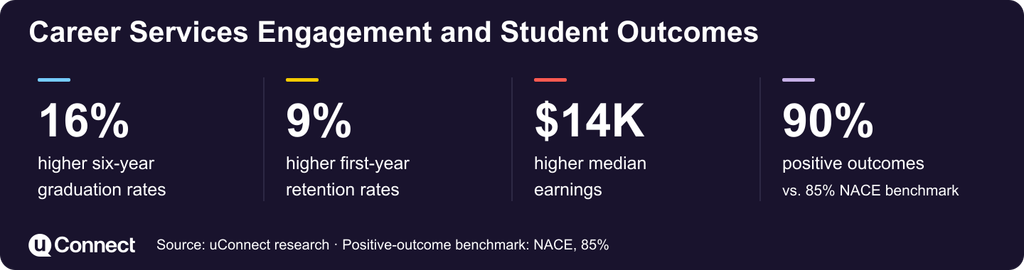
- uConnect’s analysis links career services engagement with 16% higher six-year graduation rates and $14K higher median earnings.
- Yet only about 30% of career services professionals say their office is a top institutional priority.
- 49% of career services searches across 156 institutions were classified as after-hours.
- What happens when a student gets curious about their future at 9pm tonight?
I’m David Kozhuk, founder and CEO of uConnect. I started uConnect over a decade ago driven by the conviction that engagement with career services has a disproportionate influence on student success and the social and economic mobility that motivates so many students to enroll in higher education every year.
Ten years later, that conviction has led uConnect to build a Virtual Career Center platform that more than 300 colleges and universities use every day to scale the impact of career services and guide more students toward rewarding career outcomes.
Today, with the topic of career outcomes and student ROI more important than ever across higher ed, that same conviction is also the inspiration for the launch of the Leading Indicators newsletter.
My perspective is straightforward: student engagement with career services is the most overlooked opportunity to improve the return students realize from their education – more so than their major, the courses they take or even the grades they earn.
In our 10+ years of working with career teams across higher ed, we’ve found a direct correlation between investment in career services and student outcomes: Schools that intentionally invest in career services engagement see, on average, 16% higher six-year graduation rates, 9% higher retention, $14K higher median earnings for graduates, than those who do not, as well as a 90% positive outcome rate—5 percentage points above the NACE benchmark.
A degree gives students knowledge and capabilities. Career development helps them identify where those capabilities are valued, articulate what they bring to an employer, and transition their experiences into meaningful lives and careers. A conversation with a career advisor or an alum can reveal a career path a student never knew existed. A mock interview can sharpen a student’s communication of everything they’ve learned and be the difference between launching an amazing career and hoping for an offer – any offer – to justify their degree.
While these experiences can have a transformational impact on student’s lives and careers, most institutions leave participation optional and even ignore career services when it comes to budgeting and enablement.
In uConnect’s 2025 Career Services Strategic Needs Survey, 63% of career services professionals said their leadership viewed first-destination outcomes as their office’s responsibility. Yet only 30% said career services was a top institutional strategic priority, 50% described their office as under-resourced or severely under-resourced, and 44% reported non-personnel budgets below $50,000.
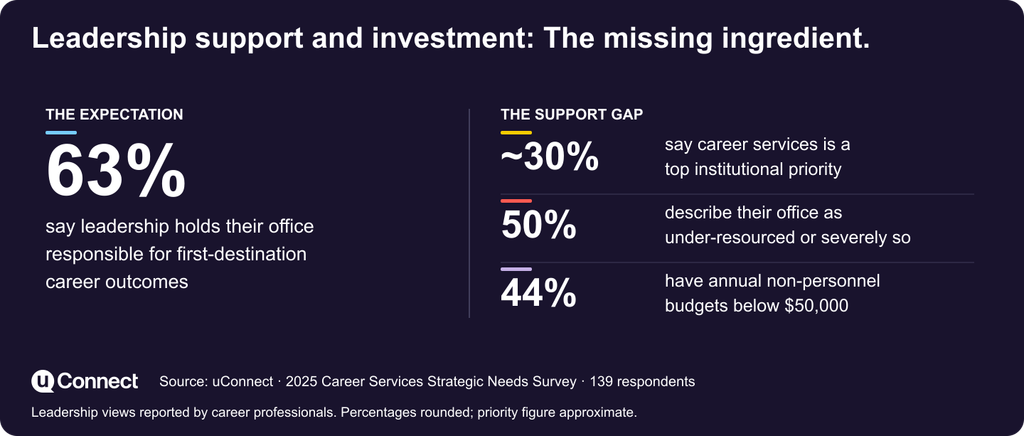
For campus leaders who want to improve outcomes, that’s a strategic gap: you can’t scale career readiness through an office that’s not an institutional priority for campus leadership. For those who are investing in career services capabilities, continue to do so as it will soon surface as a differentiator for your institution, if it hasn’t already.
What’s ahead
In Leading Indicators, I’ll share data from our 300+ Virtual Career Center implementations, the patterns shaping outcomes across higher ed, and real examples of institutions innovating to deliver better ROI for their students.
Here’s a first look:
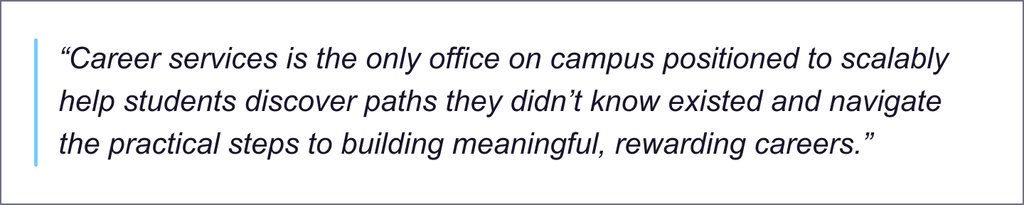
As AI makes both intelligence and agency more abundant, the most precious commodity for young people is a clear and strong vision for their future. Higher education’s biggest opportunity is to be a source of inspiration and motivation for students and, through their resources, programming and connections, career services is its biggest lever, and a lever that must be pulled.
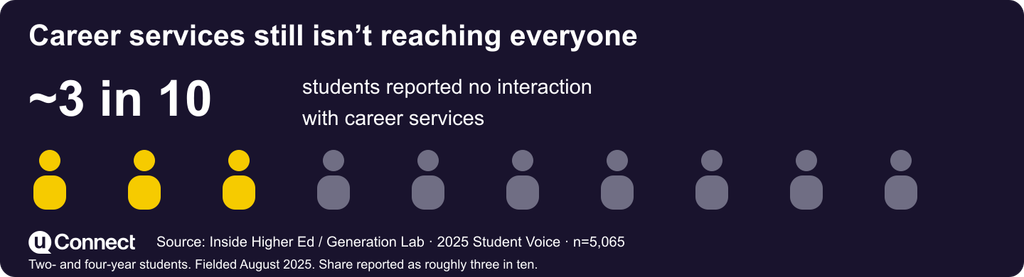
Unfortunately, far too often, the career office is overlooked as the answer to scaling career readiness and outcomes. In 2025, Inside Higher Ed’s Student Voice survey found more than three in ten students said they hadn’t interacted with career services.
Is the lack of engagement because students don’t find career services valuable?
In October 2026, Strada Education Foundation released a qualitative study that, in part, helps explain the engagement gap. It drew on in-depth interviews with both full-time undergraduates and career services leaders.
Among 23 students, roughly three-quarters reported limited engagement with career services. Only three described career services as a valuable and sustained source of both individualized guidance and career and labor market information that enabled them personally. All three held insider roles, such as career center ambassadors or federal work-study positions.
Should students need to work in the career center to discover the guidance available to them?
One clear opportunity to improve equitable access to career services comes from tracking usage of a conversational AI, built on top of uConnect’s Virtual Career Center platform. Analyzing thousands of career searches, across more than 150 colleges and universities, we found that 49% of the time, students had a question outside of office hours. That means half of the time students were moved to engage with career services, the office was closed, either landing at night, over the weekend or on a holiday.
For me, this gets at something increasingly important, and foundational for every institution: there may only be a few moments where a student takes a leap of faith to engage with their career office – each one is a precious opportunity to turn their curiosity into ambition. Every time a student is moved to engage with career development and we’re not there is a missed opportunity that cannot be measured or quantified.
For campus leaders, here’s a practical place to start: ask your career team to walk you through what a student encounters when they explore career services for the first time, outside office hours.
Then ask: If a student gets curious about their future at 9pm tonight, how easily could they discover a pathway they hadn’t considered on their own—and take a first step toward it?
David Kozhuk
Founder & CEO, uConnect
Follow me on LinkedIn for career data in between newsletters.
Career outcomes, including employment rates and earnings, matter more than ever. They already have a significant influence on enrollment decisions, persistence, completion, rankings, and program funding, and that will only grow in the coming years. Career development deserves the same institutional commitment to systems, tools, and support that we’ve made to support degree completion.
Institutions have long invested in Learning Management Systems to organize academic resources in one place and make them accessible to students, but career resources are scattered across fragmented websites and portals, making it difficult for students and staff to even know what’s available, nevermind put it to use.
Schools have built early-alert systems to identify students who are at risk of not completing their degree and intervene before it’s too late. Career development needs comparable visibility: who is engaging with career services, who is missing out, and where support is needed.
uConnect’s Virtual Career Center platform simplifies access and engagement with career services and gives leadership visibility into the data that shapes career outcomes.
Learn more about what an early alert system for career outcomes looks like.
Access the white paper
Subscribe to Leading Indicators: Data-driven insights shaping career outcomes and student ROI in higher ed