We just launched Leading Indicators, a new monthly newsletter from David Kozhuk that brings data-driven insights on career outcomes and student ROI to the leaders accountable for whether college pays off. You can subscribe to receive each new issue here.
In this issue:
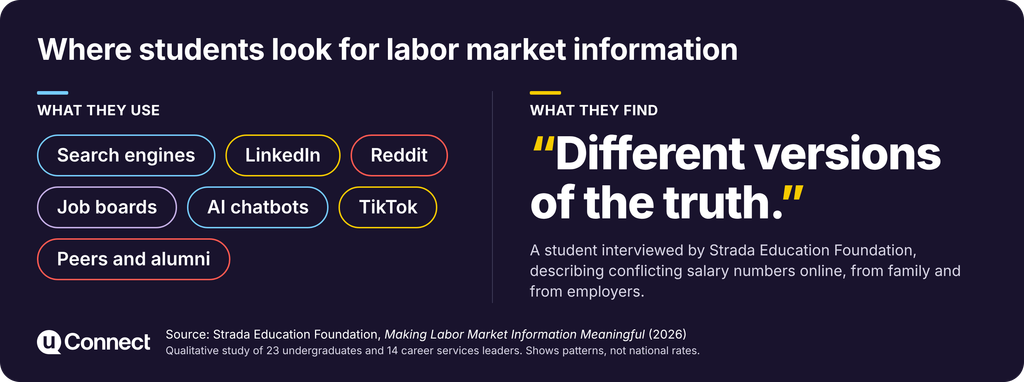
- Students are piecing together their picture of the labor market from Google, AI chatbots, Reddit and TikTok, and they are finding “different versions of the truth.”
- Faculty, advisors, alumni and admissions teams all make better decisions with trusted labor market data, but at most institutions few of them have access to it.
- The opportunity for presidents and provosts: embed labor market data into the institution’s identity, the way a research university is the authority in its field.
- What it looks like when labor market data is always on for every student, how Wentworth Institute of Technology did it, and how to see it for yourself.
Last month I shared data supporting that student engagement with career services is the most overlooked lever for improving the return students get from their education. This month I want to focus on what we find to be a key ingredient of student engagement with career development: labor market data.
Every student and family is asking some version of the same questions: Will I get a job? What will it be like? What do I need to do to get there? Labor market data answers the last two questions, showing which careers are growing, what they pay, who is hiring and which skills employers want. And it gives students the confidence and motivation to pursue the first question.
My perspective is straightforward: the institutions that integrate labor market data into the daily student experience will realize better career outcomes for students and develop the authority and positioning that will lead to stronger enrollment.
Students who don’t have a vision for their career lack confidence and are less likely to engage in career development and build the skills and confidence they need to transition into a rewarding career post graduation. Helping students develop that vision is critical to their motivation, not to mention persistence towards a degree.
Said otherwise, a student who doesn’t have a clear picture of how their degree translates to a career is likely to start to wonder whether it’s worth continuing. The institution that gives them that answer earns their trust, sparks their motivation, and gives them reason to stay the course.
If students are already researching the labor market, why aren’t they looking to their institutions?
Strada Education Foundation’s recent study shows that independent online research is the most common way students find labor market information. Nearly every student interviewed was looking on their own, using search engines, LinkedIn, Reddit, job boards, ChatGPT and Copilot. Some followed nurses on TikTok and Instagram to compare pay and training costs.
While they were resourceful, they were often left frustrated. One student said salary figures online ranged from inflated to unusually low and conflicted with what her parents and her employer told her. She kept seeing, in her words, “different versions of the truth.” Others said faculty advice felt out of date, with one describing pathways that “don’t exist anymore.” The students who made the most of what they found leaned on near-peers and alumni to interpret it, but that typically only works for the confident and well-connected students.
What would it mean to be the authority?
Think about why research institutions are trusted on certain subjects. It produces specific, measurable knowledge, stands behind it and makes it part of their brand. The opportunity is to apply that model to the question students and families care about most: what are the careers I am preparing for really like, and what is the market for them, and how to pursue them successfully?
The problem is that most institutions don’t make this data accessible to students in a way that supports career planning. When schools do license labor market data, it tends to sit with one office, accessible only to staff and admin, and sits behind a login or in a report few people read. It’s used mainly for curriculum design or advancement strategy, not for career advising and student support. The institutions that make it available to students, and all the stakeholders that support them every day, are those who will become a trusted source for economic and social mobility.
What does it look like to make labor market data available to everyone?
Schools like Wentworth Institute of Technology, Clemson University and the University of Florida are great examples of institutions putting labor market data at the fingertips of every student, family member, advisor and faculty member. Here’s how:
They curate real-time data about projected demand, earnings, top hiring companies, and related, in-demand skills for nearly every occupation. Then, they integrate that data directly into their career services experience, segmented by academic programs so it’s easy to find and easy to digest, by students themselves as well as faculty, staff, parents and mentors.
They are also making the data available through a conversational AI so students and stakeholders can easily ask questions about the labor markets using natural language. The reality is that soundbites aren’t enough to inform pathways and an 80-page labor market report isn’t accessible to most. However, a conversational AI can open up the data to anyone by simply asking questions like: “What do data analysts earn in Denver?” or “What skills should I develop if I want to be a management consultant?”
The next step is to put this same labor market data inside academic program pages, so prospective students can see what career pathways look like for the academic pathways they’re considering, before they apply and again when they’re making their final decision.
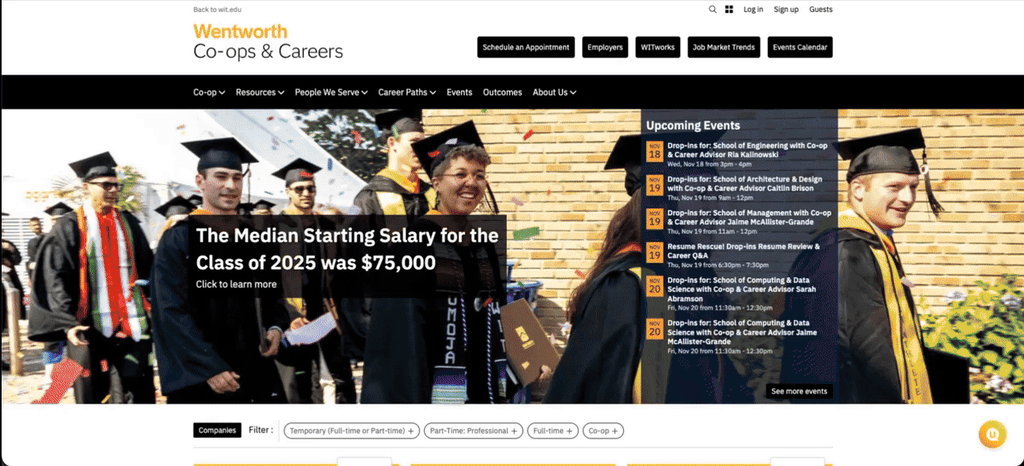
Together, they close the gaps Strada describes:
- Always on. One student told Strada she turns to AI because she does not want to wait three business days for someone to get back to her.
- Always consistent. Strada’s practitioners cite how difficult it is to train staff to deliver personalized labor market information, not to mention hard to sustain with large caseloads and staff turnover. Built into the technology students already use removes that complexity.
- Shared, with context. The answer reflects students’ interests, background and academic pursuits, and arrives alongside other resources that help them make sense of it.
- Baked in. Students encounter labor market data as they explore, even when they did not come looking for it. That is the difference between publishing data and embedding it.The result is organic exposure and utilization of labor market data. Looking at Virtual Career Center™ implementations across more than 300 institutions, 43% of questions students asked in AI Search were ones labor market data could answer or sharpen.
The result is organic exposure and utilization of labor market data. Looking at Virtual Career Center™ implementations across more than 300 institutions, 43% of questions students asked in AI Search were ones labor market data could answer or sharpen.
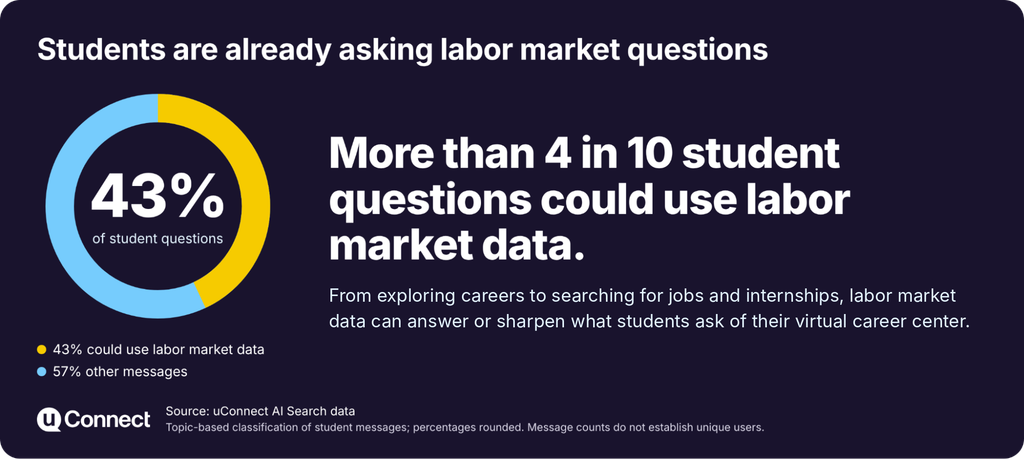
This matters because students rarely ask neat questions. A student who types “Help me explore career paths” is not asking for job postings. They are asking whether there is a future out there for someone like them. A report cannot answer that. A conversation grounded in the data can.
One data source for all stakeholders
When we, at uConnect, first partnered with Lightcast in 2021 to bring labor market data into our Virtual Career Center™ platform experience, we started having conversations with higher ed leaders about the opportunity to leverage this data to support career planning and development. While many schools were quick to tell us that they already had licensed the data, it wasn’t long after that, together, we uncovered that they were using it primarily for curriculum design and to inform alumni giving campaigns, and inexplicably not to support their students’ career pathways.
Key to a successful implementation is making this data easily available and accessible to all stakeholders, at any time. The result is that students can ask questions about the future of work at 10pm on a Tuesday. Faculty can use skills data to inform how they plan out the syllabus for next semester. Academic advisors can walk students through career prospects, aligned to academic interest areas, ahead of major selection. Enrollment marketing teams can showcase labor market insights as part of open house presentations to build credibility and authority about the questions top of mind for most prospects and families. Alumni engagement can easily add value to their alumni base by offering labor market insights that could help their alumni throughout their careers. The use cases are endless and the value institutions can realize are enormous.
Who’s doing this well?
Wentworth Institute of Technology is one of the best examples I know of an institution who has successfully implemented this data into the culture on campus. Labor market data is easy to reach for every student, family and faculty member. It’s delivered natively through their Virtual Career Center™, tightly integrated into their career services and academic advising experiences, and even embedded into their academic program pages. It is part of how the institution recruits, teaches and advises, and has been core to its identity going back to 2022.
And the results have followed. Student engagement with career development has grown over 22% year over year. In Fall 2024, Wentworth welcomed the largest incoming class in its 120-year history, an 11% increase in new first-year students. And across its last five graduating classes, 71% of Wentworth’s bachelor’s graduates were employed full time six months out, about 15 percentage points above the national average for the same years. Counting graduates who went on to further education, 92% landed a positive outcome, compared with 85% nationally. Their median starting salary was $70,700, about $9,500 above the national median. That is what it looks like when students can see the market clearly before they enter it.
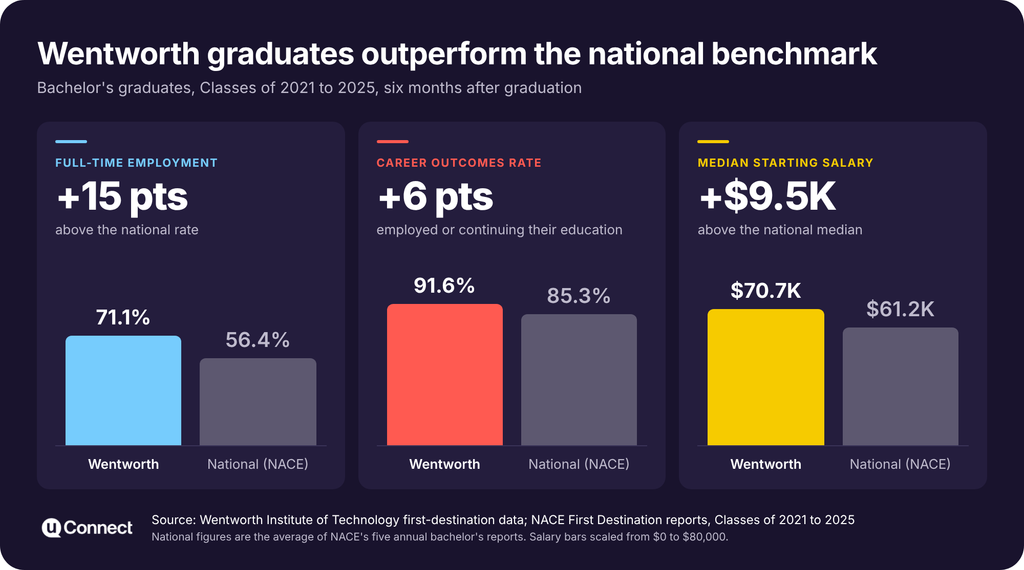
Sources: Wentworth Institute of Technology first-destination data, bachelor’s graduates, Classes of 2021 to 2025. National figures are the average of NACE’s First Destinations reports for the same five classes.
A practical place to start For senior leaders across higher ed, my recommendation is to, first, understand whether your institution has licensed any form of labor market data. If so, what office owns the license? What are the main use cases? Is it available to students directly? Can faculty, staff, advisors or enrollment teams leverage it to support current and prospective students? Can you, yourself, access the data? Align with your campus leaders about how the data is being used today and how it could be used more broadly, and intentionally, to support career pathways.Want advice on how to leverage Labor Market Data for career planning and development on your campus? I’m talking with senior leaders across higher education every day about improving support for better outcomes. Schedule a quick chat with me here.
David Kozhuk
Founder & CEO, uConnect
Follow me on LinkedIn for career data in between newsletters.
Subscribe to Leading Indicators: Data-driven insights shaping career outcomes and student ROI in higher ed