Scaling career readiness across an entire campus takes more than good intentions—it takes shared language, faculty buy-in, and a whole lot of infrastructure.
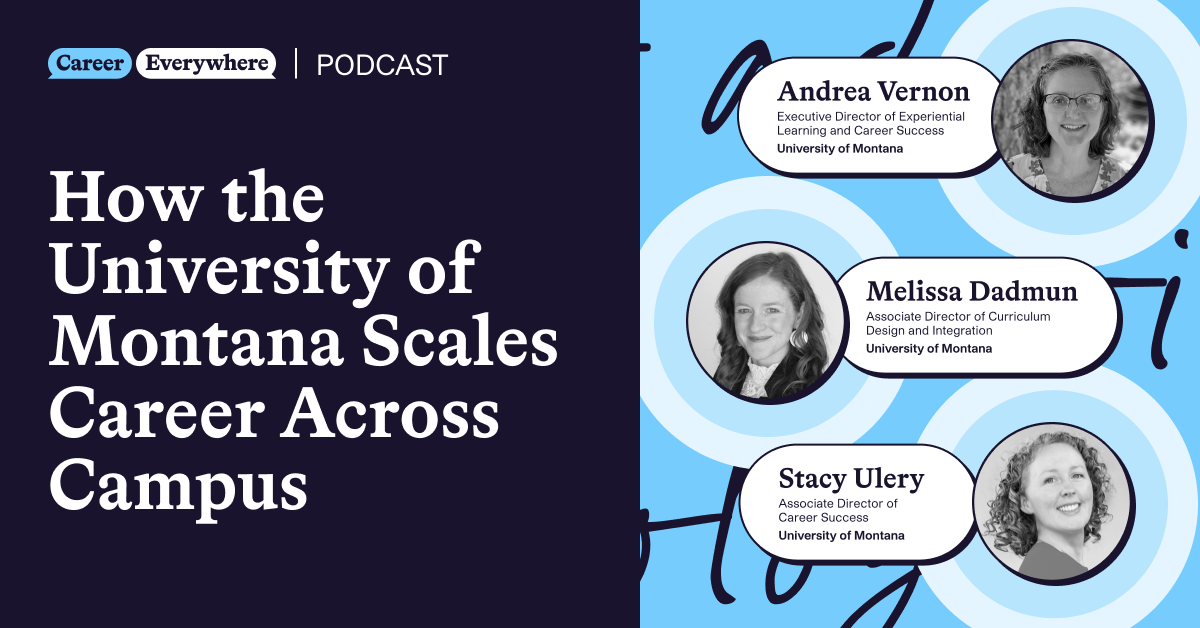
In this episode of the Career Everywhere Podcast, host Meredith Metsker sits down with three leaders from the University of Montana’s Experiential Learning and Career Success (ELCS) office: Andrea Vernon, Executive Director; Melissa Dadmun, Associate Director of Curriculum Design and Integration; and Stacy Ulery, Associate Director of Career Success.
Meredith first learned about UM’s work through a Chronicle of Higher Education case study on how the university is closing the gap between the classroom and career readiness—and this conversation digs into how they’ve actually built it.
Andrea, Melissa, and Stacy walk through the origin story of ElevateU, UM’s signature career readiness program, including how a provost mandate and blunt alumni feedback (nearly 40% said they weren’t happy in their careers) sparked the merger of three separate offices into one (ELCS).
From there, they explain how UM landed on 10 shared career competencies—the eight NACE competencies plus two homegrown additions, community and global engagement and creativity and innovation—and how those competencies now show up everywhere from syllabi to a custom AI curricular integration assistant built in ChatGPT.
The conversation also covers UM’s Career Champions program: how it grew from a pilot to 240 champions in about a year and a half; the three engagement tracks (Faculty Fellows, Summer Institute, and Community of Practice); and the mix of stipends, recognition, and grassroots trust-building that’s driven faculty and staff buy-in.
Andrea, Melissa, and Stacy also get candid about some hesitation they faced early on, how they’re measuring success, and what’s next as UM welcomes a new president.
Key takeaways:
- Career readiness needs a mandate—and a coalition. UM’s work took off when a provost merged three separate offices into one and a new president challenged the team to build a signature career readiness program. But policy alone wasn’t enough—early “design sprints” with 12 faculty and staff leaders built the buy-in needed to make it stick.
- A shared language changes everything. UM adopted the eight NACE competencies and added two of its own—community and global engagement, and creativity and innovation—to reflect its liberal arts mission. That common language now runs through faculty syllabi, classroom presentations, and career coaching conversations alike.
- AI can lower the barrier to curriculum integration. UM built a custom “Career Readiness Curricular Integration Assistant” in ChatGPT Edu, trained on years of faculty co-created resources. Faculty use it to align syllabi and assignments to career competencies—one faculty fellow used it to build a 60-page departmental framework.
- Career Champions works because it’s not a training program. Rather than requiring faculty and staff to complete formal training, UM built a low-barrier community that celebrates work already happening—complete with a signup form, digital badge, Canvas resource hub, and monthly newsletter. It grew from a pilot to 240 champions in under two years.
- Stipends and recognition both matter. Foundation-funded stipends (ranging up to $3,000-$4,000 for Faculty Fellows) compensate faculty for their time, while letters of commendation to deans and CV-worthy language in departmental promotion standards help faculty see the work as valued and career-advancing.
- Start small and let success build on success. UM’s team emphasizes piloting, starting with early adopters, and continually gathering feedback (through steering committees, surveys, and focus groups) rather than waiting for a fully polished program before launching.
- Measure both the classroom and the outcomes. UM is investing in a data and assessment coordinator and exploring a “student engagement scorecard” to connect career champion engagement, classroom exposure, and post-grad outcomes—with special attention to first-gen, Pell-eligible, and other underserved student populations.
About the guests:
Andrea Vernon is the Executive Director of Experiential Learning and Career Success at the University of Montana, where she oversees the operations, programming, and staffing behind ElevateU, the university’s campus-wide career readiness initiative. Her own experience with practicums and internships as an undergraduate continues to shape her commitment to experiential learning as a driver of career opportunity for students.
Melissa Dadmun is the Associate Director of Curriculum Design and Integration at the University of Montana. She came to the work through curriculum and program development, and as a first-generation student herself, she’s driven by the belief that students shouldn’t have to figure out the connection between college and career on their own.
Stacy Ulery is the Associate Director of Career Success at the University of Montana, bringing more than a decade of career services experience across multiple institutions. She leads UM’s Career Champions program and the Griz Career Skills digital badging initiative.
Resources from the episode:
- Andrea’s LinkedIn profile
- Melissa’s LinkedIn profile
- Stacy’s LinkedIn profile
- Chronicle of Higher Education case study: Embedding Career Readiness—the report that inspired this episode
- UM’s Experiential Learning and Career Success virtual career center (powered by uConnect)
- UM’s Career Champions program
- Griz Career Skills Program—UM’s asynchronous digital badging program for career readiness competencies
- UM’s Career Readiness Competency (CRC) Course Attributes
- Public-facing version of UM’s Career-Ready Course Designer GPT
Andrea Vernon:
We knew it was really important to have this work led by faculty and staff voices. We couldn’t be the only champions sort of pushing this through. We really needed that collaborative spirit to make advances in the work that we knew was so important to campus and for our students. Early on with a design sprint that Melissa alluded to, we were able to pull together 12 different faculty and leaders on campus to begin the conversation and better understand where do faculty see themselves in this work already. They also really wanted to see the whole conversation around the purpose and role of higher education, especially at a liberal arts institution like the University of Montana. Are we here to create workers or are we here to create big thinkers? A lot of those early conversations focused on that duality. We can do both. Our students deserve, need, and want both.
And we don’t do one at the expense of the other necessarily.
Meredith Metsker:
Hey everyone. Welcome back to the Career Everywhere Podcast. I’m your host, Meredith Metsker. And today I am joined by Andrea Vernon, Melissa Dadmun, and Stacy Ulery, all from the University of Montana. Andrea is the Executive Director of Experiential Learning and Career Success. Melissa is the Associate Director of Curriculum Design and Integration. And Stacy is the Associate Director of Career Success. Thank you all for being here.
Andrea Vernon:
Thanks so much, Meredith. We’re really excited to be here and honored to be guests on your podcast.
Meredith Metsker:
Yeah, I am so excited to have you all. And I have been looking forward to talking to you today about how you’re all scaling career readiness across campus there at the University of Montana. I know you all are doing a ton of innovative work to engage faculty and staff, build a career champion program and integrate career competencies into curriculum. In fact, I first heard about a lot of this work through a recent Chronicle of Higher Ed case study. So I’m excited to dig into the details of what you’re doing, how you’re making it all work, how you’re measuring success, and maybe hear a little bit about what’s next. Before I get into my questions, is there anything you all would like to add about yourselves, your backgrounds or your roles there at the University of Montana?
Andrea Vernon:
Sure. I can just say a few more words. Yeah. I mean, part of what really drives my work here in career at the University of Montana is that importance of the huge impact of experiential learning for students. In my own undergrad experience, things like practicums and internships really help to pave a pathway of career opportunities for me. And so that’s something that we’ve been really intentional about here as we’ve grown our career readiness programming at the University of Montana.
Melissa Dadmun:
Yeah, just a little bit more about my background. I came into this work through curriculum development, curriculum design and program development. Also though, with the deep rooted belief that students should not have to figure out the connection between college and career on their own, I myself being a first generation student. And so I really work at the intersection of those two pieces and it’s really exciting to be able to partner with faculty and staff and be able to make skills more visible in the classroom.
Stacy Ulery:
Hi everyone. I’m Stacy Ulery and I’ve been in this position here at the University of Montana as associate director of career success for the past four years. And prior to this, have over a decade of experience in career services at multiple other institutions. And I just wanted to take a minute before we get started to acknowledge that I’m very grateful to work at an institution and as part of a team here in ELCS that really values creativity, innovation and working together. And we’ve had a lot of freedom to try out new things, which I’m really grateful for and wanted to acknowledge that everything that we’re going to be sharing today was the result of efforts of a whole community of people within our department and beyond. And just acknowledge that this was a shared effort that extends beyond the three of us.
Meredith Metsker:
Cool. Thank you all for sharing that context. It sounds like you all have a really great team there in Montana. So now I would love to kick us off with a question that I ask all of our guests here on the podcast. And that’s what does Career Everywhere mean to you?
Stacy Ulery:
Yeah. So Career Everywhere for us, I think really means that every student, no matter their family background, socioeconomic status or specific degree program should have equitable access to high quality career readiness support. And that’s really the philosophy that’s been the driving force behind the development of the ElevateU career readiness ecosystem and our career champion programming that we’re excited to talk about today.
Meredith Metsker:
Yeah. It sounds like, I mean, what we’re going to talk about is a perfect example of Career Everywhere. So I’m excited to dig into that, which is a good segue into our topic today. So again, I want to dig into how you’re all scaling career readiness across campus. So let’s maybe start with the big picture. What prompted the University of Montana to make career readiness a campus-wide priority?
Andrea Vernon:
Thanks. Yeah, it’s interesting to think back to the beginning of this work here at our campus. And it really began back in 2019 with our provost at the time who decided there was a need to really streamline career readiness activities across campus. And so we merged three separate offices on campus, our former internship services, our former career services and our former civic engagement office into one entity now called Experiential Learning and Career Success with the idea that it would really help students see those connections around career readiness, both in and out of the classroom. And then we had our new president came around the same time and one of my first meetings with President Bodnar was when he sort of issued a mandate, a challenge for our new office in saying he wanted to see us build a signature career readiness program at the University of Montana.
So my team and I got to work, as Stacy mentioned as well, partnering with our colleagues across campus to really dig in and see what should career services, what should career readiness look like at the University of Montana? And so we were able to identify some key activities early on in terms of policy that we wanted to focus on that would really embed this in and out of the classroom, faculty and staff partners. We gained some alumni feedback that really helped to drive some of this work as well, recognizing that, I think it was at the time upwards of like 40% of our alumni indicated they were not happy in their current careers. So it’s like, we need to be doing better at the University of Montana. We can be doing better on behalf of our students. So those were some of the initial pieces that sort of prompted these changes across campus.
In addition to that, more recently, the response of public opinion polls, looking at the value of higher ed, what’s that ROI? And again, focusing that effort really on how our students are building career confidence, becoming career ready and graduating into those professions that they’re really excited about and feel fulfilled with.
Meredith Metsker:
Yeah. So it’s definitely an interesting time in higher ed right now with a lot of discussion around ROI of a degree and even what the purpose of higher education is. Of course, there’s always that push and pull between career side of things and then the education, the growth, the more faculty oriented side of things. So I’ll be curious to dig into that a little bit more when we talk about how you’re working with faculty.
Andrea Vernon:
Yeah. I think that’s really important because it really helped us to propel some of this work early on as well to really recognize higher education needs to change in many ways. And so it did bring on partners that I think maybe were initially hesitant, but then came to realize we need to be adapting and evolving as the world is evolving. And this was one strategy among many, but that was another important aspect early on in building out ElevateU, this career ready ecosystem here is really embedding it in the priorities of our institution and have it connected to our mission as well. So career readiness has been part of our strategic planning now, a process we call our priorities for action here on campus for the last six years. So that’s really, again, helped as one of those benchmarking foundational pieces that’s allowed us to be able to create this variety of partnerships across campus.
Meredith Metsker:
Yeah. I’m excited to hear more because it sounds like there’s a lot going on there and I appreciate how responsive you all are being to your students’ needs, your alumni needs, and just honestly trying to be proactive versus waiting for things to get really tough. So it’s very commendable. So now I would love to dig into some of the specific initiatives you’re all working on to scale career readiness across campus. So why don’t we start with the curriculum integration? I know that’s a big one that’s top of mind for a lot of our listeners. So can you share more about how you’re working career into the classroom?
Melissa Dadmun:
We’re doing it through multiple pathways of programming and you can all probably jump in, share a little bit about specific initiatives, especially with the career success team and experiential learning team for the faculty and staff. And early on in those conversations, a big piece was to create some consistent language to bring into the classroom. So if we think about that shared language again, that’s one of the opportunities we saw through our early conversations with different groups of people is like, what is a shared language? And that’s where we landed on the NACE eight. But then our group in the beginning, they were talking about those and they really appreciated the extensive research. They appreciate the coverage of diverse industries, all of that those eight provided, but they worked to identify two more competencies, which I think is really unique and special that I wanted to bring up first so that as we talk about 10 competencies here at the University of Montana, we know what those other two are.
It includes community and global engagement as well as creativity and innovation. And so those two are meant to really reflect our institutional mission, that strong liberal arts background that our foundation here at the University of Montana, and also just the kind of graduates that we want to send out into Montana and out into the wider world. So it’s rooted in those 10 competencies in a shared language. And so we try to bring that in across all the programming. If it’s faculty integrating it into the syllabus or if it’s a career coach going into a classroom presentation, we are all using the same language so that our students are receiving that and able to start mapping things together.
Meredith Metsker:
I’m curious, how did you kind of get everyone using the same language? Was it one presentation you gave to faculty? Is it just ongoing communication? Did you give them some kind of materials to look at? I’m just curious how you distributed all the information to faculty.
Melissa Dadmun:
It was earlier on. It began during the sprint design process of having conversations with faculty as we’re going back to the days that Andrea was talking about of when given this mission and this priority to bring forward, the conversation started there and we found that there was a really good opportunity to work with our faculty senate and even within the faculty senate to work specifically with the general education committee. And so it was faculty having these conversations and figuring out is this a good fit and identifying maybe we need a couple more and really getting set. And then from that experience, even student voice coming into the general education committee was really big and really got those individuals on board to make sure that this was passed. So the language around the 10 competencies, the definition, all of that is part of an actual motion that got passed and there’s procedures attached to it.
Meredith Metsker:
Okay. That’s really cool. That’s helpful to hear how here’s buy-in kind of from the top down here and it’s more of a mandate versus a suggestion.
Melissa Dadmun:
But it’s rooted in faculty voice,
Meredith Metsker:
That
Melissa Dadmun:
Mandate. So it makes a difference for our faculty and staff.
Meredith Metsker:
Yeah, that’s really cool. Okay. Well, that’s a good foundation with the competencies. I’m curious, what are some of the other ways you’re embedding career into the curriculum and working with faculty?
Melissa Dadmun:
I can talk a little bit about going back to my earlier intro of being grounded in curriculum design. I come from the field of special education where I’m deeply rooted in universal design for learning and I apply that within program development work. So what that includes is multiple ways of representation, engagement, action and expression. So we try to create a lot of different ways that faculty can enter into this work. And one of those ways was to create a curricular integration assistant. So this is something that faculty can grab a hold of if they’re working on a syllabus at midnight, two weeks before the semester start. Not that I’ve never done that, but it’s a way that they can have that resource, have that tool readily available to them, be empowered to make the decisions and the choices that meet their specific course and something that really creates relevant and meaningful information.
So the information that’s generated, they then review and they get to choose what goes in, but it’s built around the procedure, the motion, the intent of all of this work. And it has some really good ways that they can tweak really related activities, assignments, tweak them pretty low lift, like maybe it’s adding a reflection question or making a connection to an area of interest for the students, really small shifts that at the end of the day, it goes throughout the semester, they’re able to pick these things up along the way and carry them with them. So that’s just one strategy we’ve used this last year, which was pretty exciting.
Meredith Metsker:
Yeah, that sounds really cool. I’m curious, how did you build that? Is that the AI tool? I know you mentioned in the Career Everywhere Community presentation last week.
Melissa Dadmun:
That is. So we call it, it has a really, really long name. It’s like the Career Readiness Curricular Integration Assistant, and it’s built in our ChatGPT EDU account. And that was also a really big piece. So we built this based on the feedback we were getting from our programming of fellows work, community of practice work, all of that. It was years of discussion around what’s needed, where are there barriers to enter into this work and what could be helpful. So as that technology became available, we saw room for it and we built it in a way that is rooted in all of the information and resources we co-created with faculty over the last three years.
Meredith Metsker:
Okay. Yeah. I remember hearing about that in yours and Angie’s presentation in the Career Everywhere Community last week or the week before, and it sounded like a really cool way to scale the work that you’re all doing so that all faculty have access to this information, to basically an assistant. That’s really interesting. And it sounds like the reception has been pretty good so far from faculty.
Melissa Dadmun:
It’s been great for those who have used it. And I also reckon this isn’t going to be used by everyone. It’s not going to be of interest for all faculty and staff. And so knowing that, for those who have used it and are ready to jump into an AI tool like that, it’s worked really well. It can change a course on the individual course level, but then as those same faculty kind of come back and do more work, they’re actually mapping across the curriculum. So they’re doing more degree mapping with it and then able to upload multiple syllabus and ask it to do things. And then they’re bringing that work to their curriculum committees and they’re making decisions based off. It’s like a launchpad. It doesn’t replace their expertise. It just helps maybe get that conversation going to then have these groups get work done in a really efficient way.
So what might take like a year of meeting is now taking them like two to three meetings.
Meredith Metsker:
That’s amazing. Considering all the things that faculty have on their plates, do you have like a favorite example or story of a faculty member who has used this tool?
Melissa Dadmun:
I just received a really exciting email earlier this week from a fellow that has been working us. He was a fellow this whole previous academic year and he started joining us as a community practice participant. And we’ll talk a little bit more about those programmings. And so he was kind of in the first cohort of faculty fellows engaging with this tool during their design series. And he started at the course level and then he was kind of thinking, actually he was at the Summer Institute. At the Summer Institute, he was telling his team members like, “This is what I was doing as a fellow. Here’s how I see you could work for our department.” And then he just sent me this pretty extensive 60 page document of a framework that he created that covers their entire degree. And it gives the department information and resources and tools, but it also helps those learning assistants that are teaching in the classroom.
It has student facing languages and insight on how they can engage. It has considerations for committee work to continue to think about what’s next.
Meredith Metsker:
Wow. What a cool success story. Thank you for sharing that. It’s like everybody is aligned around careers. Chef’s kiss. Well, Melissa or Andrea or Stacy, is there anything else you wanted to add about any of the curriculum integration work that you’re doing before I move on to the Career Champion program?
Stacy Ulery:
I do. I wanted to share also some work that our office has been doing and it didn’t start as a curricular integration piece, but it’s moving in that direction. And that’s with our Griz Career Skills program. The Griz Career Skills Program is an asynchronous program through which students can earn digital badges for each of the career readiness competencies. And it started and is primarily integrated with student employment on campus as a way to just really integrate career readiness into that high value student experience. But what we’ve also done is promoted the Canvas Shell, which is our LMS that we use here to faculty and offered that as an opportunity for them to integrate those assignments and reflections directly into their courses and that students can then through other courses, participate module by module and still earn these digital badges through the Griz Career Skills program.
And we’re exploring options right now for offering a credit bearing version of the Griz Career Skills program so students could also receive academic credit for it. That’s a goal on the horizon. And kind of along a similar note, I don’t know if Melissa was more involved in this and she may want to share a thing or two, but in terms of creating content that faculty can incorporate into their classes on Canvas, she worked really hard on a commons course for career courses across campus. And we also have one for internship courses. So creating a lot of the content in Canvas that then faculty can just easily integrate into their own courses has been a successful endeavor.
Meredith Metsker:
Man, you all are doing a lot. Okay, that’s really interesting. I’m glad you brought that up, Stacy. So the badging program, the assignments, Melissa, that you built, are those associated with the Griz Career Skills? Are the assignments connected to the badges?
Melissa Dadmun:
They are not. This is more for, there could be potentially something we can talk about doing in the future, but as of now, the intent of those, it’s about, it follows our ElevateU model and it’s helpful for those who are teaching those intro to career courses that professors can go in and import that into their course shell and modify and adapt those lesson plans according to their discipline. So it follows ElevateU of Explore, Enhance, Embark, and then there’s four lessons under each of those. So a total of 12 lessons that they can offer and depending on if it’s a one credit to a three credit course, they may choose all of it or they may choose a few pieces of it. So we had an intro course from our College of Humanities and Social Sciences try this out this last year. They just imported all 12 and it was a credit, no credit bearing course.
So they made their own rubrics to fit the needs of that course, but it really helped provide some solid lessons that would take that class through a sequenced activities across the semester.
Meredith Metsker:
Okay. This is all really comprehensive and fun to hear about. So just to kind of summarize, it sounds like the way you’re embedding career into curriculum is the competencies. So the NACE competencies plus the two that you’ve added there, the ChatGPT tool for helping faculty kind of align their syllabi to skills, the Griz Career Skills program, the badging program, and then these sample assignments that faculty can plug and play. Did I miss any? I
Andrea Vernon:
Think you’ve got the basic gist, yes.
Meredith Metsker:
Cool. Okay. Yeah, that’s –
Andrea Vernon:
Nice summary.
Meredith Metsker:
Thank you. Yeah, like I said, that’s really comprehensive and exciting to hear about. And it seems like it’s something that other career centers could try to emulate. So I know we’ll get into some advice at the end of the interview, but I’m sure folks will probably have questions for you on how they can implement those on their campuses as well. Now I would love to move on to your career champion program. I know you have done a ton with this, so can you just share a little bit more about what your version of a career champions program looks like?
Stacy Ulery:
Yeah. So our career champions program, we launched it as a pilot program about a year and a half ago now, and we’re entering our second semester as a fully launched career champions program. And before I talk specifically about what our program looks like, I wanted to start with just some of the philosophy and mindset that we had as we decided what structure would make the most sense at our campus. I think it’s just a helpful baseline to have. So what we found is that we had a lot already going on, a lot of different ways to engage staff and faculty in our work. We had a lot of really strong collaborations, but every program was kind of its own separate thing. And we actually took initial inspiration from the University of Connecticut’s model and thought this would be a great way to just create some clarity for campus around the ways that everyone can jump in and get involved in this to create a brand that people would be excited to join and raise their hand and become a career champion.
So it wasn’t about creating a whole new program on top of everything we were already doing. It was really like, how do we just package what we’re already doing in a way that will be easily accessible by the most people on campus? So that was kind of the initial framework going into it. And we also wanted to make sure kind of along those lines that there would be a really low barrier to entry. We wanted a program that anyone could do regardless of how much time they were able to commit to a program. And we wanted to avoid, similarly to the University of Connecticut model, avoid having a formal training program that people would have to go through in order to earn the title of career champion. Instead, we really wanted to celebrate the work that was already happening and that people were already being champions of students’ careers and kind of celebrating that fact and providing support and resources, learning opportunities, and also platforms for people doing this great work to share with each other best practices.
So it’s not really necessarily a training program, it’s more a community and a collection of support resources that we provide to the champions that they can engage with at the level that makes sense for them at any given time. I think that’s pretty much all the context I wanted to provide. And in terms of how we’ve structured it then, taking all of this into mind, is they just have a signup form that they fill out. They sign up to become a career champion and we just want to know from them how are they supporting student career readiness through their role? What are they looking to gain from being a member of the career champion program? And also what can they contribute to the community? We add their information into a public career champions directory that staff and faculty and students on campus can use to find champions in a given department.
And then we welcome the career champions with a mug and a sticker. We just want to make it visible in classrooms and in offices all across campus that there are supports here in every single corner of campus. And we also provide them with an electronic. Thank you Melissa. Yeah, she’s
Meredith Metsker:
Modeling our. For those who are listing Melissa’s holding up a career champion mug.
Stacy Ulery:
It’s been quite popular, I’ll say. People want that mug. And we also provide a digital badge that they can put on their email signature and on their online profiles. In addition to kind of just that visibility piece, they also gain access to a really comprehensive Canvas shell that Melissa spearheaded the development and multiple people contributed content to it. And it has just a wealth of resources. We heard from them that they wanted just easy kind of plug and play resources, templates, scripts. So it’s very practical. We have sample language they can include in their syllabi, information about the career competencies, tips on facilitating career conversations, information about our various resources and a lot more. But that’s just, they have access to utilize that Canvas shell and they also receive a monthly newsletter targeted toward career champions where not only will we let them know about upcoming events or a cool resource they should check out, but we’ll also spotlight other career champions and some best practices of what’s going on across campus just as a way to kind of build that community and that sharing aspect that I talked about earlier.
With the career champions newsletter, we also attach a student facing newsletter and encourage our champions to forward that onto their students or copy and paste the content from that into their own newsletters or course shells. And then we invite the champions to different events and training sessions that we offer throughout the year. But as I said, there’s no requirement for them to attend a certain number or anything in order to earn status as a career champion. It’s just kind of keeping them in the loop and making them aware of these opportunities to deepen their knowledge.
Meredith Metsker:
That’s so interesting. And I appreciate that you took inspiration from UConn’s program. Nancy Bilmes is a friend of the podcast and I think I had her on, man, back in season one. So 2023 talking about their career champion program. And so that’s cool to hear that you’ve drawn inspiration because theirs has been really successful.
Stacy Ulery:
Yeah. And I can talk a little bit more also if it’s helpful about kind of how we started it out. And right now we’re at 240 career champions. So it actually, it took off really quickly, I think quicker than we might have been expecting it to. We did start with a pilot, but I think even in our pilot year, we exceeded the 200 participant mark. People were eager for it and I think we had already laid a lot of great groundwork across campus in kind of elevating career readiness for faculty and staff. So people were just hungry to kind of jump on board with it. But I think starting with a pilot year was a really smart move and it gave us a chance to slowly establish the brand awareness while we continue to build out the resources to make sure that we were really being responsive to the needs and the input of the audiences we were seeking to reach without Feeling that we had to have everything 100% complete and ready to go before we launched.
So calling it a pilot gives some of that wiggle room to still grow and change and adapt as we move along. And one of the things that we did during our pilot year and that we’re continuing on with is we assembled our career champion steering committee, which is a group of, I don’t have the exact number, but it’s somewhere between eight and 10, I think, staff, faculty and students that we kind of hand selected in some way and very intentionally sent invitations to these folks who represent different areas of campus that we wanted to make sure their voice was heard and that they were able to really guide the direction that we take the career champions program in to make sure that we’re really being responsive to staff, administrators, students, and faculty in all different types of roles. So it’s a diverse group of people.
And we meet with this group about quarterly over lunch and we ask them some big picture questions and just really facilitate a conversation. And that buy-in and support from that group, it’s really helped us proceed with confidence that we’re developing something that people want and that they’ll engage with. And it’s also helped further establish those relationships with the steering committee members who have become some of our champions of champions and raise their hands to help be involved in some of our events and initiatives because it’s something they’re invested in and have helped shape. So I just wanted to share that as a great best practice for anyone who might be thinking of launching something similar.
Meredith Metsker:
Yeah, that’s a great piece of advice. I’m glad you touched on that steering committee angle because I mean, that’s a good point is how, I mean, it’s just a faster way to know for sure that what you are producing is what is needed. Very cool. I know Melissa, I think you had other elements of either the career champion program you wanted to add or some of the other engagement tracks that you all have going on.
Melissa Dadmun:
Yeah, thanks. So those engagement tracks kind of all fall under the champions program. And so we were devising those, having those in motion already before we launched the pilot, always with the intention that this will be part of something greater with a more comprehensive approach. So we have three different kind of deeper levels of engagement that faculty and staff can opt into, and that would be our faculty fellows program, our summer institute, and then also our community of practice. So there’s a lot of different ways, as Stacy mentioned, of the newsletter, the campus learning hub, there’s immediate access to things. And then for those who are ready with the time and if it’s within their course load or their workload can also choose to go a little deeper in this work. And a lot of this is devised in a cohort model because a big thing from the beginning of hearing and listening to these different groups is that they really crave knowing what’s going on in other departments and colleges.
So to learn from each other is a really big piece of our career champions program. So once you opt in, there’s different opportunities to engage and the faculty fellows is like a deeper individual level. You join a cohort of fellows, but you might be the only one from your department. Maybe there’s another person from your college, but we really try to hit at least one fellow from each college and try to create an environment that has a series of professional learning opportunity where they’re actually devising their own project that’s based on their own needs from their department. So they’re charged with going back and having conversations with colleagues and chairs and deans and trying to understand what does it look like for us? What are our student voices? What do they have access to? Where are their barriers? And work within their department to devise a project that looks a lot of different ways and implement that.
And then we have the summer institute that’s more team based. So there might be a team from one department that come together. Sometimes it’s interdisciplinary teams and they come together and they work together to identify those, do a gap analysis and devise a project or multiple things that need to be implemented over that next year. So it’s a lot of focus time, but a lot of team based activities. And then we have the community of practice, which is kind of that ongoing connective tissue piece that if you’ve participated in any or none of those other things, it’s an opportunity to come back in and reengage with the work, hear from other people across campus. And it’s more of like two times a semester we’ll meet up and have conversations and discussions. And all of that programming has changed each year depending on where the needs are.
And so we’re heading into some really cool directions. And even this last May for our summer institute where it had previously been really faculty department teams, we made it open to also offices and support other groups, other unit groups that could come together. So we had academic advising had a team. We had TRIO Upward Bound program was a team. And then we had a split team between the Writing Center and the Mansfield Center who also work on curriculum and student support. They were also a team. So really exciting ways that we can continue to grow and think about that campus-wide structure, that model of everyone having a role.
Meredith Metsker:
Yeah. And what a cool opportunity to help different departments get to know each other too. Yeah. I appreciate that it’s not just siloed within individual departments. It’s encouraging people to share across departments or different degree programs. And I just imagine it makes it a lot more effective when they can hear what each other are doing and what’s working, what’s not.
Melissa Dadmun:
It’s so great for especially someone maybe who feels maybe a little alone in the work or they have a really small department and it might only be a few colleagues in there and they’re just hungry for what’s happening across campus and in other groups. And so if you’re coming into the work in a different experience or background, even if you’re focused in one direction that makes sense for your group at that time, you’re hearing what might be happening for departments who are maybe three years into this work or four years in. So there’s just so much rich idea sharing and yeah, it’s fun to watch their eyes light up when they learn from one another.
Meredith Metsker:
That’s why we do it, right?
Melissa Dadmun:
Yeah.
Meredith Metsker:
All right. Well, now that we’ve kind of covered what you all are doing, I would love to dig into some of the how and specifically getting faculty and staff buy-in because I know again, that’s something that many of our listeners struggle with or it’s kind of intimidating when it comes to getting started. So I’m curious, did you all see any hesitation early on from faculty and staff? And if so, how did you work through that?
Andrea Vernon:
Yeah, I think that’s a really important part of this conversation because yeah, we’ve had a lot of trial and error. Like Stacy said earlier, we’ve been given some latitude to experiment and some of those experiments failed and many have succeeded. But yeah, early on, we knew it was really important to have this work led by faculty and staff voices. We couldn’t be the only champions sort of pushing this through. We really needed that collaborative spirit to make advances in the work that we knew was so important to campus and for our students. And so early on with the design sprint that Melissa alluded to, we were able to pull together 12 different faculty and leaders on campus to begin the conversation and better understand where do faculty see themselves in this work already. And this was four years ago now that we started that conversation.
And so we were able to really learn a lot in those early conversations before a lot of this work was kind of comprehensive across campus. And from those conversations, really surfacing the fact that faculty obviously have very busy workloads like we all do, there really wasn’t a reward structure and incentive structure for faculty to engage in this work. They also really wanted to see how the whole conversation around the purpose and role of higher education, especially at a liberal arts institution like the University of Montana, are we here to create workers or are we here to create big thinkers? And so a lot of those early conversations focused on that duality. We can do both. Our students deserve and need and want both. And we don’t do one at the expense of the other necessarily. So those were really critical, important early conversations that, again, helped us learn from the faculty perspective, what do we need to keep in mind as we collaborate and build out these different types of programs like our career champions and faculty curricular engagement work.
A lot of what helped, I’ll be very transparent about this. We have a grant from the Dennis and Phyllis Washington Foundation that brings funding to support faculty and staff who participate in some of these programs with a stipend. So they do receive some monetary support to engage in some of this programming with us and help us move that needle every single semester as we’re doing programming and implementing resources and support systems for our career champions and beyond. So that was another critical piece. And I recognize many campuses just don’t have a resource base like that. So we’ve been very fortunate here and it has really helped move that needle a little bit farther faster in terms of engagement. But I think even beyond that, our ability to welcome and invite input and dialogue has been very well received because that has been the glue, that ability to find common ground.
And we may not agree perhaps with specific approaches, but we can all agree that we care about student success. We care about student outcomes after they graduate at the university. So those were some of the things that we tried early on to help with that hesitation. It doesn’t mean that all faculty are completely bought into this. They’re not. In my experience here, I’ve been at the university a long time and we work with those early adopters. That’s what those early years were all about gaining that early adoption of input and buy-in and now mainstreaming it more comprehensively through all of the things we’ve mentioned here. And even so, welcoming those critical conversations. Is this really the role of the campus as a faculty member? When I mention the word career, this is what I’ve heard from some faculty, students just cringe. We have many students who are here who really, they want to sort of combat those traditional norms about what a college education is all about.
And they really want to look at community impact post-grad and even when they’re in their undergrad experience here. So kind of like Melissa said earlier too, we worked very hard to create a common language so that we better understand different types of terminology that resonate with certain colleges or departments on campus so we can adapt and change. But when you boil it down, it’s all about that student success and students feeling really confident as they graduate and move into that next step after graduation.
Meredith Metsker:
That’s really helpful to hear. And I wanted to ask a follow-up question on the incentive program. So is it, or the stipends I should say, is it like different monetary amounts depending on what engagement track they’re involved in or how does that breakdown work?
Andrea Vernon:
Yeah. We’ve kind of experimented over the last three, now four years with the stipend model. And so yes, our faculty fellows, like Melissa said, they’re taking a really deep dive. They work with us typically for about six months out of the academic year. So their stipend is the highest and that ranges anywhere between in the past three to $4,000. The next layer of stipends has been with our community of practice. And those are people that, faculty and staff colleagues that attend events or pop in and pop out. So those stipends have fluctuated in the types of engagement that we’ve done with our community of practice practitioners. And then our summer institute is the other one that we provide stipends. So like we explained, that’s a team model. So there are team stipends for people to participate. It’s a day and a half long institute that we do about a week, a week and a half after graduation in the spring.
So we want to honor the fact that a lot of our faculty colleagues are off contract at that time and we’re asking them to come back to campus and engage in this deep dive work with us. So those are the ways that those stipends have been structured more or less over the last few years. And again, we kind of tweak this as we go, as we learn more and as we get that feedback from our participants, the kinds of things that are most impactful for participation and engagement and really valuing our colleagues’ time as they help us, again, move that needle forward.
Meredith Metsker:
Yeah. I was going to say the valuing their time angle I’m sure is really meaningful for faculty. As we all know, they have a lot going on. And so I imagine they appreciate that there’s some monetary acknowledgement of that as well.
Andrea Vernon:
Yeah. We definitely hit home on that. We also provide letters of commendation for faculty to send to their department chairs and their deans. So the deans understand who from my college is participating and who are the leaders in my college in this work. With this year, we have three new deans this summer starting on campus. And so part of our outreach is helping those deans understand who are the career champions in your college? Who can you turn to as you’re new to campus in this work and get excited about what we’re doing? I think another aspect of that has been really better understanding the faculty reward structure on our campus. Each individual academic unit has their own unit standards by which faculty are measured for promotion, merit and raises. And so we’ve had success with a few departments now who’ve taken leadership in adapting their unit standards to include language around career readiness in the classroom so that faculty are recognized maybe in addition to or in lieu of monetary, they realize, hey, by integrating career readiness in my courses, I am going to be able to put this up in my CV as I go up for promotion and tenure in my department because my department values this work.
So there’s a few different angles that we’ve been able to work with. Again, using our partnerships with our colleagues and faculty senate and the general education committee, for example, to really help, again, sort of diversify the way in which we can engage people and get them excited about the work.
Meredith Metsker:
Yeah, that’s huge that they can put that on their CV. And I was thinking too, once again, it all comes back to that shared language that we started the conversation with, with those competencies. Is there anything else, Andrea, you wanted to add about faculty buy-in? Any other advice?
Andrea Vernon:
Well, I think the advice is start early with these conversations, invite partnership very early on. And those conversations are incredibly valuable to help drive direction and allocation of resources and staffing, et cetera. Part of what’s been really great is hearing some of the feedback, some of the success stories. Melissa shared one earlier from faculty who’ve been through our programs and the faculty who come to our community practice meetings or the fellowship meetings and say, this has transformed the way my students engage in my class when they are now seeing the relevancy, the direct relevancy of the type of academic content they’re learning in class and how it relates to career skill development. Just by doing small things in some ways, tweaking a discussion forum prompt or adding some language in a course evaluation at the end of the semester to ask students, how do you think you’ll use some of these skills and knowledge that you’ve built in this class in your future profession?
And one of our professors said that was just an immediate game changer in the way that students provided information at the end of the semester. So it’s that kind of feedback that helps us realize, okay, we think we’re on the right track here. Obviously we’re always learners, but that’s the kind of feedback that really, again, sort of drives our energy and our excitement about the work.
Meredith Metsker:
Yeah. I love that you’re able to gather that feedback, but then also going back to Stacy’s point about the newsletter, it sounds like you’re sharing that too with other champions so that they can see examples of how they can implement it.
Andrea Vernon:
Yeah, that’s a really good point. Each time the newsletter goes out, we have a spotlight, a crew champion spotlight. So we do a little shout out to one of our champions and provide an example of what they’re doing as a crew champion. So it’s fun to be able to recognize people in multiple ways.
Meredith Metsker:
Yeah. You’re just like creating a flywheel of success stories here. Love it. All right. Well, now I would love to move on to a very important element of this discussion and that’s measuring the success of these initiatives. So I’m curious, how are you going about trying to measure success both for the students, faculty, and just the larger institution too?
Melissa Dadmun:
Sure. I’ll just jump in on the faculty end of it since we’re there and then we can move into other parts of our office and data collection. But I mean, Andrea, you mentioned so much of it already. Really, it’s both quantitative and qualitative. Those stories, those use cases are just very, very critical that we get those and they come out of the blue. You’ll be heading one direction and then an email pops up from work you did six months ago. And we try to make sure that we’re gathering those stories and reaching back out to those individuals and asking how can we more broadly share, can we post your lesson that you wanted to share? We now add it to our Canvas shell. Can we put you as a quote, a testimonial for the Career Champions program? Can we highlight your career scores in our newsletter?
There’s just so many ways that it helps us keep users, keep members engaged. We track participation data and all of that, pre and post surveys on our programming. We send end of the year surveys out to our champions hoping to help inform the next iteration of the work and doing all of that. And what we’re really excited to move into, and Andrea has some more to share around increased staffing and capacity of our office to be able to do some of these things, but to really start understanding the correlation between the work we’re doing for career champions and faculty and staff and then how that shows up in the classroom for students and that impact. So does it increase students requesting career coaching appointments or does it increase the amount of classroom presentations that are being offered in a department? Where are these points and how are they continuing to grow in their engagement and participation and then student outcomes?
Andrea Vernon:
Yeah, I can jump in and expand on that as well. Thanks, Melissa. Yeah, we have been fortunate, like I mentioned with our grant funding, one of the newest positions we’ve added is a data and assessment coordinator to our staff team. And so this is a specialist who works with our institutional research office to better understand the impacts of the variety of ways that students engage in career readiness activities across campus. And so we’ve learned through forums like this and conferences, et cetera, from colleagues out in the field across the country about something called the student engagement scorecard. So that’s one of our perspective things that we’ll be working with now with our new data person to be able to better understand what are those key ingredients of the recipe for student success and post-grad outcomes. Is it being in a class taught by a career champion?
Is it appointments with a career coach? Is it attending different events that we offer? What are those key ingredients of success that have some predictive ability to help us better understand and see that full thread from undergraduate experience to first job post-grad through our FDS surveys and then into three years, five years, seven years and beyond post-graduation. So those are some of the things on the horizon in terms of our data and ways that we measure impact is trying to really be more strategic about where we invest our resources, not only from our office, but from our colleagues across campus to in the high impact practices in and out of the classroom that have really meaningful impacts for our students. So another way that we have really assessed impact and measured success is looking at our historically underserved student populations on campus. Is an institution that has a third of students who are first gen.
We have a third of our students who are Pell eligible. And so we know that a lot of our students aren’t just going to naturally walk through the door. Many of our colleagues experience this across the country as well. So part of how we’re measuring success is how are we reaching those harder to reach populations that don’t take the initiative or don’t have the awareness to walk through the doors of our office and meet with a coach. And so we’ve been able to partner very carefully and closely with a lot of our colleagues across student affairs and academic affairs to be present at lots of different types of events that bring students from all types and backgrounds and can get some initial exposure to who we are, what we do, what are the resources and programs that we have to offer. So that’s been an important part of our programming and outreach and our measuring of how we look for impact and success.
Meredith Metsker:
Cool. Stacy, anything to add?
Stacy Ulery:
Yeah. I could add a little bit about how I think Andrea and Melissa covered a lot of it really, really well. I did want to share just specifically one way in which we are working to identify, draw the correlation between outcomes and career champion engagement that could be something others consider doing is that we have a question on our first destination survey, which if there were any staff or faculty at that helped support their career readiness and we’ve been able. Actually the information that we gathered from that helped launch the pilot. The people that were named by students were the first ones we reached out to, to invite to the pilot and say you were recognized by a student as making an impact on their career. So again, that celebrating and recognizing the work that’s already happening, but then we can also, with the help now of our data and assessment coordinator, be able to see, okay, is that person a career champion and does that correlate at all with the outcomes that the student is experiencing?
So just wanted to elaborate on that piece a little bit. And then I can also talk briefly about the Griz Career Skills Program going back to that particular one and that we have
Had a very intentional assessment mindset. And I think we do across the department as you’ve heard. And with that program in particular, every year we’ve had either one or two focus groups with supervisors of student employees or with students and/or with students who have participated in the program to really dive in and understand what is the value that people are seeing from the program, what are barriers to participation, and we’re constantly evolving it. And we have a mixed methods approach. So in addition to focus groups, we’re also surveying students at the end of every module to get their feedback on that. And we just recently conducted a survey of students who have not participated in the program to understand why and also what do they think about it? Because one of the barriers that we learned from our focus group with supervisors is that some of them were hesitant to engage with the program because they didn’t think their students would be interested and they didn’t want to add something more to their student’s plate that would be seen as just more work
And we learned from that survey of non-participating students, 80% of them said that they would be interested in participating in something like this if it was supported by their supervisor. So now we can use that data. So I just wanted to share those pieces as well.
Meredith Metsker:
Yeah, that’s really helpful to hear all the different ways that you’re measuring success, you’re getting feedback. And on that note, with the experience you’ve had over the last few years with this feedback that you’re getting, what’s next for these initiatives? What’s on your vision board as I like to say?
Andrea Vernon:
It’s a big vision board, Meredith. This team does not lack ambition, I’ll put it that way. In addition to sort of honing in on some of these evaluation assessment pieces, I think we’re also really interested in. We have a brand new president that just started a few weeks ago on our campus. So this will be as with any big leadership change on a campus, we’re eager to better understand his vision for this work and help him understand where we’ve come, where we hope to go and get input of course from him as well. So that’s sort of a TBD at this point, but it’s exciting to have so much to share of our previous experience in this work with him on campus. Also, there continue to be so many platforms in our space in higher ed career services. And so we are really proactive about vetting a lot of those platforms as they come across as we become aware of them.
And more and more, we’re really looking at how AI is being integrated into those platforms. We have a very big emphasis on AI and how we work with AI and our students and the programs and services we provide. And so that’s a key piece of how we’re looking for new technology and new tools to help support our work. In addition to that, it’s very important for us to see how platforms talk to each other. Shout out to uConnect. I mean, that’s a great example of how we can integrate multiple platforms and really amplify the impacts of how the user interface works in those platforms when we can connect different ones for more seamless user experience. So those are some of the things on the tools and technology side in addition to just big presidential change on campus and eager to learn more about how that can help us shape our work.
Meredith Metsker:
Yeah. I’ll be excited to follow your journey as you kind of figure out what he’s looking for and how to adapt the program. But yeah, that’s a big change. All right. Well, as we kind of start wrapping up, is there any advice any of you would like to share for other career leaders who want to build something similar on their own campuses?
Andrea Vernon:
Well, I can kick off, but I know Melissa and Stacy have input too. I think as we’ve stated several times, definitely engaging with your stakeholder groups on campus early on, better understanding where they’re at with this work, what it currently looks like, what are their hopes and aspirations? Are they even thinking of this work? And then through that type of collaborative partnership development, really surfacing some initial steps that you can take together. We always sort of start small and build from success. So that’s always been our mantra with the programmings and the programs and resources that we build. So I guess that’s been a good sort of key sort of flagship post that we commonly come back to. Like I said, we have a very ambitious team here and we have great colleagues across campus who are eager to partner. And sometimes we have to take a minute to pause and think through, okay, what about in terms of our resource availability, staff capacity, all of these things.
So that intentionality is really important too. So the information, gathering the intentionality, and then sort of identifying those initial small steps to begin to work together and move the work forward. Those are some of my insights from the work. Melissa, do you have anything to share?
Melissa Dadmun:
Oh, you did such a good job. It was so thorough. I love it. A lot of similar things. So let’s see. I would say with, as maybe you’re approaching faculty for the first time or maybe you’ve already started and are a little ways in, I think we really try to let them know this is not meant to add more, like what are you already doing and how can such simple tweaks to the language we’re using help just make it more visible to students? So I think that we lead with that in a lot of our environments of what are you already doing in the classroom and having conversation on that. It’s such a simple discussion prompt that kind of helps, I think, people put their guard down a little bit of like, oh, this is about us designing it together and welcoming in feedback and things that are already happening in the classroom.
Because we know that there’s a high, high majority, over 80% of classrooms are already incorporating some kind of career readiness in there. So it’s just trying to tease it out and make it more visible.
Meredith Metsker:
Stacy, any advice from you?
Stacy Ulery:
No, I think Andrea covered kind of what I was going to say as well, just the value in piloting and being nimble.
Meredith Metsker:
Perfect. Well, before I close this out, is there anything else any of you would like to add that we didn’t touch on?
Andrea Vernon:
I
Melissa Dadmun:
Think
Andrea Vernon:
We touched on a lot.
Meredith Metsker:
All right. Perfect.
Melissa Dadmun:
There’s a lot of resources on our uConnect site if you want to jump in and check us out and we’re happy to follow up and provide additional information or have conversations. We’d love to hear what other people are doing, as you’ve heard. And so we would love to continue the conversation.
Meredith Metsker:
Yeah. And for those watching or listening, I’ll be sure to include a link to the team’s virtual career center through uConnect. And on that note, if people would like to connect with you or learn more from you, where’s a good place for them to do that?
Andrea Vernon:
Yeah, absolutely. Our website, all of our contact information is available there. We’re all on LinkedIn as well. So yeah, please do reach out. I mean, that’s how we have learned and grown. We have benchmarked with so many great campus partners across the country. As we hear of cool ideas, we follow up and we ask them, “Hey, can we take 20 minutes to learn more about how you did this?” So it’s such an incredible field professionally when we have such great colleagues across the country who are willing to share and just hop on a phone call or a Zoom and say, “Yeah, let’s talk about what we’re doing and learn together.”
Meredith Metsker:
Perfect. Well, I will for sure include links to your website, to your contact info. But now I would love to close us out with this answer question, leave a question thing I do at the end of every interview. So I’ll ask you a question our last guest left for you, and then you will leave a question for the next guest. So our last guest was Josh Domitrovich of Pennsylvania Western University, and he left this question for you. What book have you read recently that was inspiring to you and what did you take away from it?
Andrea Vernon:
I’ll jump in here again, I guess. I’m currently reading a couple books, Yesteryear and Red Rising. They’re both a little dystopian. So the things I’m taking away from it that might have relation to career on campus is sort of individual agency, individual choice in those career path decisions. Sometimes I think students can feel like maybe they don’t have a lot of choice or there’s external factors that are influencing them. And I want to believe that there is choice. And through exposure and exploration and talking about ideas and passions with people like career coaches and career champions, it’s a great way to really broaden people’s horizons about career paths and opportunities. And so I think those books are, again, a little dystopian in that context, but making that little connection about our work here, I think it’s really important. And that’s what we work hard to do with our students who come from very rural places oftentimes, come to the big campus here at the University of Montana and can feel a little intimidated.
And how can we engage with them, welcome them and really provide that support network to help them flourish and grow and prosper in everything career.
Meredith Metsker:
I’m going to have to read Red Rising because I’m pretty sure Josh mentioned that as well when he was asking this question. So I think it’s a sign to me.
Andrea Vernon:
It’s a long one. I’ll give you that.
Meredith Metsker :
Yeah. Let’s see. Melissa, how about you?
Melissa Dadmun:
I’m reading an interesting book, The Immortal Life, a Henrietta Lacks. And so she’s the story behind medicine’s most important scientific contribution. And I wanted to learn more about her. And it brings up a lot of really important topics, bioethics and race and consent and who we recognize in the scientific process and pretty powerful. And I’m not sure how it relates to career readiness, but it’s a powerful, powerful read. So I recommend it.
Meredith Metsker:
It’s another one I’ll have to add to my list. Stacy, how about you?
Stacy Ulery:
I haven’t been reading lately. Don’t know. Maybe someday I’ll find the time to do such a thing. Give
Meredith Metsker:
Maybe some of the books we’ve talked about today.
Stacy Ulery:
Yes. Yeah.
Meredith Metsker:
All right. Well, what question would you like to leave for the next guest?
Stacy Ulery:
Well, we wanted to ask the next guest to share who was your career champion during your undergrad years and what did they do that really made a difference in your life?
Meredith Metsker:
Oh, I love that question. I love questions like that where someone gets to tell a story. It’s always a good story. All right. Well, perfect. Thank you for that question. And just thank you for taking the time to join me on the podcast today. This was a great conversation. We covered a lot of good tactical information, so I just really appreciate you all making the time and for sharing your wisdom. So thank you.
Andrea Vernon:
Thank you so much, Meredith. Appreciate it.
Melissa Dadmun:
Thank you.