



What if the single biggest predictor of a student’s success after graduation isn’t their major, their GPA, or even their school’s brand name—but simply whether they engaged with career services?
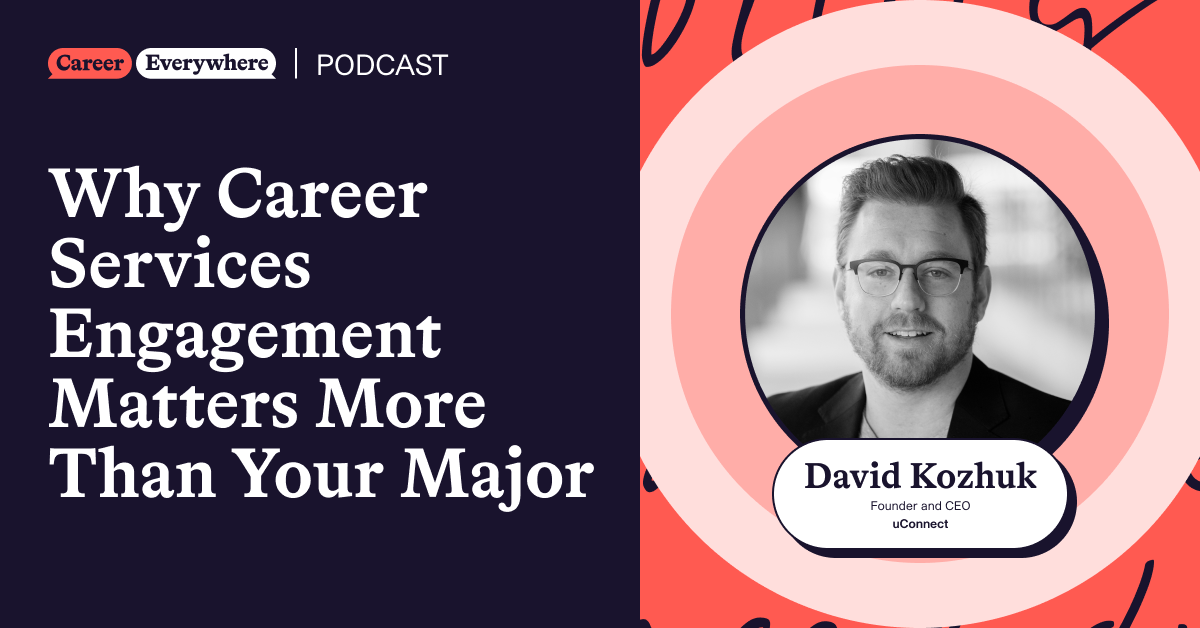
In this episode of the Career Everywhere Podcast, host Meredith Metsker welcomes back David Kozhuk, Founder and CEO of uConnect, for his second appearance on the show. David makes the case that career services engagement is the most important thing a student can do during college—more influential on outcomes like retention, graduation rates, and earnings than the major they choose or the classes they take.
David traces this conviction back to his own experience as a finance student at UMass Amherst, where regular use of the career center helped him land multiple internships and his first full-time job.
He also shares the story of how he returned to campus several years after graduating to recruit top-performing students for a few open roles at his company. Despite the marketing and promotion, a great venue, catering, and the whole nine yards, only three students showed up to his presentation. That gap between what career services offers and how few students actually engage with it inspired David to start uConnect and build the first-ever Virtual Career Center platform—now trusted by hundreds of institutions across the country.
From there, the conversation turns to the data. David unpacks:
- Why so many institutions are sitting on a goldmine of outcomes data they aren’t using
- How uConnect is helping schools connect career services engagement to outcomes data and real-time labor market trends
- How AI is now making it possible to deliver personalized, trustworthy recommendations to students at scale (no matter your career team size)
He also gets candid about what’s at stake—for students, staff, and institutions—when career readiness stays a talking point instead of a funded priority, and offers concrete advice for both career leaders and senior higher ed leadership on how to close that gap.
Key takeaways:
- Career services engagement is the No. 1 influence on student outcomes. David points to data showing that students at institutions with strong, scalable career services engagement see meaningfully higher average earnings, retention, and completion rates than the NACE national average—across hundreds of institutions and hundreds of thousands of students.
- Small amounts of engagement can have an outsized impact. An hour spent in a mock interview or talking with an alum about a career path they’d never considered can do more for a student’s trajectory than almost any other hour of their college experience—largely because it builds confidence, and confidence compounds.
- Non-engagement is rational, not a motivation problem. Students who don’t know what they want to do often assume the career center can’t help them until they do—a branding and positioning gap David sees as one of the field’s biggest opportunities, especially for reaching underserved and unengaged students early.
- Outcomes data is one of higher ed’s most underutilized assets. Most schools collect rich first-destination survey data but rarely operationalize it. It sits in a spreadsheet rather than informing real-time recommendations to current students or messaging to prospective ones.
- Reframe outcomes data as inspiration, not judgment. David encourages senior leaders to stop treating outcomes data as a referendum on institutional effectiveness and start using it—even a small sample size—as proof of what’s possible for students in a given major or pathway.
- Intentionality is a career leader’s edge. David points to other podcast guests like Barbara Zerillo (Post University) and Josh Domitrovich (PennWest) as examples of career leaders who used data to earn a seat at the table. Josh manually tracked correlations between career services engagement and institutional KPIs for years before career became part of PennWest’s strategic plan.
- The stakes are institutional, not just individual. David connects career services engagement directly to enrollment, persistence, completion, and ultimately institutional revenue—arguing that as other funding sources shrink, delivering on the ROI promise of a degree becomes existential for many schools.
About the guest:
David Kozhuk is the Founder and CEO of uConnect, the all-in-one Virtual Career Center platform used by hundreds of institutions across the country. He started uConnect over a decade ago after a formative experience recruiting on his own college campus, where he discovered how few students were engaging with the career center that had shaped his own path from student to full-time offer.
David built an early prototype of the Virtual Career Center concept to help make career services more visible, accessible, and personalized for students—and has spent the years since working directly with career leaders, provosts, and presidents to connect career services engagement to measurable student outcomes.
Resources from the episode:
- David’s LinkedIn profile
- David’s article: The Answer to Higher Ed’s ROI Problem is Hiding in Plain Sight
- uConnect website
- Barbara Zerillo episode (Post University)
- Josh Domitrovich’s episode (PennWest): Coming soon!
David Kozhuk:
Higher ed is in a more vulnerable position than they’ve been in the past. I think the stakes are higher, the consequences are higher, and the world of employment and the world of work is changing faster than maybe it ever has changed since the Industrial Revolution. There are new roles that didn’t exist months ago, nevermind years ago. Companies have radically different hiring and resourcing plans than they did months ago. And so I think with change comes opportunity. And I think if you’re in a higher ed leadership role and you’re thinking about what students actually need and want, and you’re thinking about how your curriculum, your experience leads to opportunity in the workforce, then I think it becomes a no-brainer to lean into how can I optimize the work that’s happening in the career center and elevating the impact of the people working in the career office and making sure that they have the resource they need to succeed.
Meredith Metsker:
Hey everyone. Welcome back to the Career Everywhere Podcast. I’m your host, Meredith Metzker. And today I am joined by David Kozhuk, the founder and CEO here at uConnect. Thank you for being here, David.
David Kozhuk:
Yeah, thanks for having me, Meredith. Excited to be part of the conversation and for my second podcast interview.
Meredith Metsker:
Yes, I’m excited to have you back. It’s been a couple years now, I think, since your last appearance. And a lot has changed since then in the career services field, in higher ed, the world in general, and of course here at uConnect. So I’m excited to catch up on all of the things and to dig into a hot take that we have really leaned into at uConnect over the last year or so, and that’s this concept of career services engagement being the most important thing a student can do during their college journey, even more important than the major they choose, the classes they take, the extracurriculars they’re involved in, and so on.
So in career services engagement, the most important thing they can do because as we found through anecdotal and data-driven evidence, it’s the number one influence on positive outcomes like retention, graduation rates, earnings, and so on. And yet so many institutions are still failing to invest in career readiness properly. They’re not staffing, they’re not budgeting or giving their career leaders seats at the table, and they’re just not making it a priority in strategic planning. So career readiness has become a popular talking point as we’ve seen, but it’s not necessarily being backed up across the board.
So anyway, I will get off my high horse here, David, so we can dig into all of this from your perspective as well. You’ve worked with career services teams in higher ed for what, well over a decade now. Is that right? Yeah. So you have seen a lot of things, including what does work well and then what doesn’t work well. So before I get into my questions, David, is there anything else you would like to add about yourself, your background, or your role or history here at uConnect?
David Kozhuk:
Well, I think as probably as mentioned, I’m the founder and CEO of uConnect and started the company, as you said, over a decade ago. This sort of concept of career services engagement being so critical to outcomes I think is just deeply rooted in our founding story at the company. I mean, just to go back a little bit, I went to UMass Amherst as an undergrad almost 20 years ago at this point, and used career services all the time when I was in school. It was just part of my understanding, maybe a combination of how I was raised and just my understanding of the purpose of college was go there, have a good time, obviously learn new things, but it is also a transition into a career. And so to me, using career services just felt like an obvious part of the student experience. And I was in the career office from first semester, freshman year, all the way through graduation.
I was a fine student, but was far from setting any records in the classroom. And at the end of my four years, I had three or four internships, but more importantly, I had a really good understanding of what the career pathways were that were interesting to me, what really captured my excitement, my enthusiasm, and my competitive spirit. And when it came time to find a full-time opportunity, I had a bunch of different opportunities that I could pursue. And I really attribute a lot of that to just the time that I spent thinking about the career pathways that I could pursue, networking with alums, learning about what it’s like to work in those fields, building the skills that are important to be successful. And I think that translated directly into the search for a full-time opportunity and my success as a result of that. So I think that’s been part of the fabric of why we started the company, to increase career services engagement, to help more students be more thoughtful, better prepared, and in a position to succeed upon graduation.
And so it continues to hold true, and that’s something that I’m really proud of as it relates to what we’re doing as a company. So I’m excited to talk more about it, but that is very core to why we started the business and what we’re doing today.
Meredith Metsker:
Yeah, you’re a great success story and an example of what is possible when you do engage with career services. And I’m curious, when you were at UMass Amherst, how did you hear about career services? Did your parents tell you about it or your older sister? Yeah, what led you there?
David Kozhuk:
It’s funny that you ask because I was just on a call. So I was at the business school at UMass Amherst, [inaudible 00:06:40] Isenberg School of Management. I was just on a call with our head of CS and the folks at Isenberg who were asking about our product roadmap. And so I was asking them about their office and their team, which has grown considerably. And I said, “Well, are you still in the office that you were in when I was there?” which was right when you walked into the business school, it was the first office right in front of you. They’ve subsequently moved because they’ve, I think, 3X the size of their team, but it was impossible to miss.
And so I ran into it just walking into the business school and going about my day-to-day. But I was also in what was called the Finance Society back then, which is a student club for students who were interested in finance. It was also part of the culture of that club where all of the students that were members of that club were professionally ambitious, networking. And we were going in New York City on weekends and sleeping on the couches and floors of recent grads while we were learning about what their day-to-day was like, hanging out with them, learning about what it’s like to live in the city and being a professional and all that sort of stuff.
And it just always occurred to me that to continue on that journey, the career center had the resources that were going to help fuel that evolution. They had a directory of alums who were working in different fields. They had connections to employers in the fields that I was interested in. They had advice for interviewing in the finance field, preparing your resume to stand out for finance roles and all that sort of stuff. And so it just was always a natural pullback to that office because that office has the resources that were going to help me make that transition. And frankly, no other office does.
And so looking back, it sort of felt natural, but I think what was a big part of it was just, I think the advice that my parents and my father in particular gave me, and definitely my older sister was a big influence on me when I was going to college, that have a good time and do the things you’re supposed to do, but make sure that you get off to a great start with regard to your career. And this holds true in the data today, that the first job that you get is going to have a big influence on the rest of your career. So it was maybe a little bit of a scare tactic, but it worked.
Meredith Metsker:
And your first job was in finance, right?
David Kozhuk:
Yep. Yeah.
Meredith Metsker:
So I’m curious, I’ll get into our other questions here in a second, but I want to talk about what led you to start uConnect. So for those who don’t know uConnect, we have built a all-in-one virtual career center platform. So I’m curious, what problem did you see that led you to want to take this leap into entrepreneurship and start uConnect?
David Kozhuk:
So I was working for a private equity fund, a small private equity fund in the Boston area. We’re making investments in lower middle market companies operating in what was called underserved credit markets. So companies that were doing well, but in parts of the country that didn’t have a lot of access to credit. So Northern New England, Detroit, Michigan, Albuquerque, New Mexico. I was going to places like that where there were, again, healthy companies, but just not a lot of access to capital. And so we were focused on finding that arbitrage opportunity, if you will, where there were good companies, but we could stand out as lenders and investors because there just weren’t that many others around.
And the firm started to grow. We had raised the second fund, and the partners had come to me and said, “Hey, we want to hire a couple of junior analysts as we launched this new fund.” And there were three partners. One was from Cornell, one was from Harvard, and one was from Dartmouth. And I was like, “Yeah, I’d love to, but I’m going to go back to my alma mater because obviously partial to my alma mater.” And also I was like, “Hey, those state school kids have more grit than the average [inaudible 00:11:15]”
Meredith Metsker:
Yep, agreed.
David Kozhuk:
So I’m going to go back to my alma mater. And they were like, “You know what? Just get us some good talent. We trust you.” And so I called the head of career services who I had a good relationship with because I was in and out of her office so many times as an undergrad, even though it was probably four-ish years after I had graduated that this came about. And I said, “Hey, the firm I’m at is growing. I want to come back to campus. I want to talk a little bit about my journey from college to career. I want to talk a little bit about the work that we’re doing at the fund that I was at, and I want to get in front of some of your best students because we actually have a couple of open roles that I think would be great opportunities for students.”
And so she was fired up to hear from me. She was excited to have me on campus. They had scheduled a big auditorium for me to do my thing, have my spiel, talk to students, and then scheduled a block of four or five hours for interviews afterwards. So I got there that day. They had the dean of the business school who was there to introduce me. They had catering, they had the whole thing. They honestly made a big production out of it, which was a little flattering. I was excited. And it got to the time of the beginning of the event, and there was literally three kids at the event.
Meredith Metsker:
Oh, no.
David Kozhuk:
It’s a big campus too. There’s a lot of students. It was at the business school, but it was open to all students. And so it was 25,000 students on that campus and three kids showed up. It was really the first time that I had though about, do other students not use career services? Is this something that was unique to maybe me and the students that were in some of the clubs that I was in?
And so I had a shortened spiel and very few interviews afterwards. And so I spent time with the head of career services after the session, just to really answer some curiosities that I had, which was like, “Hey, why weren’t students there? Is this your experience with other types of events? Or was it specifically the event that we were hosting?” And she was saying, “Hey, it’s one of my biggest challenges, getting students to engage.” Students don’t really think about career services. It’s an optional part of the student experience. And so we got students who are highly motivated who come in, but for the most part, students are either overlooking our office and our services or coming in second semester of senior year saying, “I need a job. Can you help me?”
It was the same time where there was a growing conversation around the return on investment in education, value of a degree, underemployment and unemployment after college. And to me, it was like the bar’s not that high. These students are trying to get entry level jobs, and so you don’t need to go in there with some massive portfolio and all these references about all the impact you’ve had. You just really have to be, I think, thoughtful about what you want to do, able to articulate the value that you add and be able to differentiate yourself versus other candidates, which really just comes down to spending time exploring these different pathways, using some of the resources that career services offers, mock interview tools, resume and e-portfolio tools, experiential learning opportunities.
And so it just occurred to me that I think a solution to this bigger looming question around the sustainability of higher ed was not so complicated. There was all these conversations around the cost and how to subsidize the cost and things like that. And what occurred to me is that if students were just spending more time thinking about career pathways, preparing to make that transition, gaining the experiences and the skills that are required to build that confidence, that they would be better positioned to realize an ROI on their investment. And that would, in a lot of cases, solve for a lot of the macro challenges that were facing higher ed.
And so I ended up spending a little bit more time with her to understand how she promoted her resources, how she got students engaged in the programs and events that they were hosting and found it to be extremely inefficient and, her words, tedious and ineffective. And so I started spending some time just nights and weekends thinking about how I could support a better process for her and ultimately built a prototype for the virtual career center that is a shell of what it is today, but the concept is very similar, a single place for all the things that are happening around career development and the opportunity to personalize that based on students’ interests and goals and things like that. I wish I had AI back then. I probably would’ve gotten a little further than I did.
But yeah, so I did that and I shared it with her. She thought it was amazing and would be sending me screenshots of the engagement analytics on the back end. At that point, I was not trying to leave my job. I was really happy in my job and getting paid well and fulfilled and all that sort of stuff. I was definitely not trying to leave and do something else, but I think my conversations with her were really encouraging and it was something that I had a direct experience with and had a personal connection to and felt like it would be in some ways an answer to the sustainability of higher ed, which I think has a really big impact on just people and society in general and is really important to continue to support. And so I thought that I had a unique perspective on that. And so about nine months after that event, I quit my job and started the journey.
Meredith Metsker:
And the rest is history. I know I, for one, I’m very glad that she started uConnect. And I know so are the hundreds of institutions that we work with now. And I appreciate you sharing that context and the story of why you started uConnect, why we built the virtual career center, because I think it lays a lot of groundwork. And our listeners will see some of those themes pop up in the rest of our conversation today.
But before we get into that, I do want to kick us off with the question I ask all of our guests here on the podcast, and that’s what does Career Everywhere mean to you?
David Kozhuk:
Career Everywhere to me means that it’s just baked into the culture and into the student experience, that there’s a appropriate match of what students experience when they enroll in higher ed and what their expectations are. And I think the data will tell you that students’ expectations are really commonly rooted around economic and social mobility. And so to me, Career Everywhere is the resources, services, and opportunities that lead to economic and social mobility to be just a core part of that student experience. Doesn’t have to be in the career center, could be in the classroom, could be in student clubs, could be part of academic advising appointments, wherever it is, it hopefully is unavoidable. And that to me is so much of what Career Everywhere is all about.
Meredith Metsker:
Yeah, I love that. And I especially love your use of the word “unavoidable” and like it being baked in because it’s also an equity issue too. It’s not just career services, it’s not just for the students who know it exists or have the time or the physical ability to get into a career center. It’s for everyone. It should be for everyone.
David Kozhuk:
Yeah. And I think what we’ve also realized in our journey is that equity is, to your point, a huge part of it. I think when you talk to students directly and you ask them why they don’t engage in career services, I think you’ll get a really honest and logical response, which is like, “I’m not really sure what I want to do for a career. And so what am I going to do with the career center?” There’s a perception that the career center is going to connect you with a job or connect you with an internship. And first of all, it’s the wrong perception, so there’s this whole branding and positioning opportunity for a lot of career leaders that I think is really important. But when you think about it with empathy around why a student would have that perspective, it makes it really rational why students don’t engage.
And so I think focusing on students who are much earlier in their journey, much earlier in their evolution of what career might make sense for me, I think, is also just a really big opportunity for career leaders because that is the biggest part of the funnel. And then if you focus on those folks, you’re going to get everybody else. So yeah, I think that’s a just meaningful part of thinking about engagement, is thinking about those who are underserved and unengaged and what leads to that because it’s not motivation. They want a great job. They want ROI on the dollars that they spent or borrowed to go to college, and they want to get their career off to a great start. So thinking about what is the true blocker is important to making sure that all are engaged.
Meredith Metsker:
Yeah, agreed. And I think that’s a great segue into our topic today, which is again, all about how and why career services engagement is the most important thing students can do for their own success. We know they want to engage, but like you said, there have been some barriers, there have been some blockers. So let’s just jump right in.
David, why is career services engagement so important? I mean, you have said that it matters even more than your major.
David Kozhuk:
Yeah. I mean, I think that if you really spend time thinking about some of the services that a traditional career center would offer, not some spectacular career center with outsized resources, just a traditional career center, I think a lot of them help students really think about what career pathways are out there, which ones are relevant for them, and then provide really practical advice on how to pursue those career pathways. And that is, I think, a huge blocker for a lot of students just to get off the starting block.
And if you compare, let’s say an hour of a student’s time, if they spend an hour in a classroom learning a particular topic, even developing a particular skill, which is I think farfetched in an hour of time in the classroom, or you spend an hour doing mock interviews for a finance internship that you might be pursuing, that hour practicing questions and answers and positioning yourself in front of that hiring manager, in front of that company is going to have such a significant impact on your success getting that internship or getting that job probably more so than an hour you’d spend doing almost anything else. Same thing as if you were unsure of what you wanted to do for a career and you connected with an alum who went to your institution who’s doing something that you didn’t realize was an actual occupation, you didn’t know what that job looked like, and you hear them talk about it and it sparks your curiosity, it sparks your enthusiasm, that can drive you all the way to your first job and beyond.
And so I just think small amounts of time with the resources that career services offer have a disproportionate impact on understanding motivation and just the pursuit of success upon completion. I don’t think it’s particularly close. So I think the more students engage. And we’re seeing it in the numbers, I think you alluded to, that schools who are engaging in scalable career services engagement see, something like $15,000, higher average median earnings, better retention rates, better completion rates, higher outcome rates than NACE national average. And these are across hundreds of institutions and hundreds of thousands of students. And so the data’s pretty clear. I just wish more senior leaders had the notes in front of them to be able to respond accordingly, but that’s a different topic.
Meredith Metsker:
Yeah. Yeah, for sure. And I think it’s like I talked about at the top of the podcast, a lot of senior leaders, it seems like they talk the big talk about ROI and outcomes, but too few are investing in the career center in order to back that up. Actually resourcing the professionals whose entire job it is to engage students, help them with career exploration and readiness. And then also importantly, bringing that to the rest of campus, to faculty, to staff, alumni, employers, and so on. But we’re working on it. We’ll make progress.
David Kozhuk:
We certainly are, and we are seeing progress. I think I’ve always said from the very beginning, we, still to this day, don’t price uConnect based on full-time enrollment. And I think it’s changing a little bit, but there’s historically been very little connection between enrollment size and funding for the career center. It really depends so much on leadership’s perspective about how important career development is. And so when we first started the company, I saw small institutions with 3,500, 5,000 students enrolled have a budget that was twice the size of a big state school. And so I think it continues to this day that leadership’s perspective about what’s important has arguably the biggest impact on where the dollars are spent and where the dollars are allocated. So yeah, we are seeing more and more schools recognize that, but it’s certainly the exception rather than the norm.
Meredith Metsker:
Yep, for sure. I think to, again, lay down some important foundation for the rest of this conversation, it would be helpful if we defined career services engagement from our perspective. So how do you define engagement with the career center, particularly in this Career Everywhere era that we’re in?
David Kozhuk:
Yeah, I mean, I think it’s spending time utilizing the resources, services, programs, opportunities that career services offers, right? Most of the time that is out of the career center, I think there is more of that is being baked into the classroom and being baked into other parts of the student experience, which is good and which is great. But I think it’s anything from advising appointments to career workshops to networking with alumni mentors or upperclassmen who are mentors, doing assessments, participating in building a profile in your job board and starting to build out your digital persona around professional development, whether it’s on LinkedIn or somewhere else. I think any of those activities are what I would consider career services engagement. And a lot of those tend to snowball. Once you start going, get off the starting line, like I said, it can be a huge motivator to just continue to pursue more and more opportunities, more and more services to build your understanding, build your confidence.
A lot of it is about confidence. And I think just like anything else, the more you do it, the more you practice, the more confident you are. So I think that that’s a critical part of the career services engagement story. I was just playing golf in my backyard the other day with my little girl who’s seven years old and she’s like, “Oh, I’m not that great at it.” And I’m like, “This is literally the fourth time you’ve ever swung a golf club. There’s no way that you could possibly be good at it without continuing to practice.” And it’s the same thing with so many other things. You just have to put in the time. And so I think putting in the time builds confidence, and that results in ultimately more success.
Meredith Metsker:
Yeah, that’s great. Also love the story about the golf club. I feel like I need to tell myself that because I tried playing golf when I was a preteen and just didn’t do well. I got so stressed out and I haven’t tried it again, and I need to.
David Kozhuk:
Yeah, you can’t be good when you first start.
Meredith Metsker:
Yeah, exactly.
David Kozhuk:
I’ve been playing golf for 20 years. I still have very, very bad days. So you can’t expect somebody who’s just starting to be great. So it’s a journey just like anything else, yeah.
Meredith Metsker:
Exactly. Well, David, as the founder and CEO of uConnect, you have worked with higher ed career services teams for, like we’ve said, well over a decade now. And I am curious, what have you seen in these last 10 years, particularly around engagement, around this ROI conversation? And what has changed to make you so passionate about career services engagement and then in particular, the influence that it has on outcomes?
David Kozhuk:
Yeah. I mean, I think one thing that has changed, particularly in the last, call it 12 to 18 months, I think, is the clarity that we have internally around the ability to understand career services engagement in a way that will lead more students to better outcomes. We’ve always had this conviction around, “Hey, career services engagement leads to better outcomes.” Now we have data that proves that. I think the opportunity here going forward is to understand that engagement more intimately, to guide students in a just more intentional way towards where there’s opportunity.
I think in higher ed, there’s always been a sort of goalpost around graduation, right? When I first started the company, I think this still exists to some extent, there’s all these sort of tracking early alert systems where advisors and administrators are getting alerts that Meredith and David are not on track. And so go grab them and engage them and make sure that they get back on track. But as the sort of desired outcome of higher education has evolved from, “Hey, I’m just trying to get a degree” to “I’m trying to get a great job” and realize that economic and social mobility, I think there’s more of an opportunity to take some of the elements that go into early alerts for students graduating on time to early alerts for students who may not be on a path towards a great outcome.
And so I think we are in a unique position where the virtual career center is sort of this objective aggregator of all the different resources that career services offers. And its job is to make recommendations to students based on what is most appropriate and most impactful for that student at that moment in their journey. I call it sort of like the Switzerland of career services tools. We want to recommend other resources and we don’t have competition. We want all other vendors to see more engagement, more utilization. And so being in that position where we can make those recommendations, I think, allows us to have a stronger use case for understanding what the trends and patterns are around career services engagement and seeing historically what has led to better outcomes. And in part, use that to make better recommendations for students in the future. Because even if students are engaging with career services, a lot of times the recommendations that they get can be random, can be based on who they ask, can be based on how they ask.
But I think with everything that’s happening in the technology world, the way that we think about data, the way that we think about leveraging data to build insights, unique insights, I think there’s just a real opportunity to make sure that those recommendations are rooted in what has worked in the past and where there’s opportunity in the future. And I think that that’s a huge opportunity for us. I think it’s a huge opportunity for higher ed, so we’re excited about that.
Meredith Metsker:
Yeah, I’m glad we’re kind of touching on the data element of things. And I want to dig in a little bit further because as we have talked about, career services teams sit on a gold mine of data. They have all this data about how students are engaging, what they’re engaging with, especially if they have uConnect’s virtual career center. They’re seeing all of that backend engagement data from our platform, but they also have their first destination survey data. They’re seeing where students are going. But I think sometimes we have missed that connection point. What does the engagement have to do with the outcome? How does it influence it?
So I know you’ve recently published an article talking about this connection, this shift towards focus and outcomes, and then how we’re approaching it here at uConnect. And I would love if you could share more about that.
David Kozhuk:
Yeah. For most of the time that uConnect has existed, there’s always been this sort of, I think, under utilization or underappreciation, I would say, for how valuable the data is that career services teams have. Most career services teams are collecting first destination survey data, but what students have done upon graduation. What companies did they go work at? What roles did they have at those companies? How much money did they make? What did they do during their journey? Did they have an internship? Did they participate in experiential learning? Were they enrolled in particular student clubs? What majors did they have? What courses did they take? All of that data, especially at scale, can provide a tremendous compass for institutions to be able to guide students in a direction that has sort of repeatedly and predictably worked for students in the past.
I think what we have found is that far too often that data sits in some system that isn’t really accessible to students directly, isn’t really being used to inform recommendations, isn’t really being used to advise students. Sometimes it just sits on someone’s desktop. And that’s just, I think, a big opportunity for schools to look at that data and understand, “Hey, how can I use that not only to understand trends and patterns, but actually to inform the advice that we give to students around career development and career planning?”
And so I think we’re seeing a lot of opportunities with our product to be able to bring that data into the product and then have students engagement with the virtual career center, which is home to all the different resources, having that data inform what we recommend to which students, again, based on what’s worked in the past. So if I’m a first generation student who’s interested in nonprofits and I’m majoring in marketing, most schools actually know whether they realize it or not, they know what students who identify as first gen majored in marketing and entered into roles in the nonprofit space, what that formula looks like. And again, if you do that at scale, seeing tens of thousands, hundreds of thousands of data points around what student journeys look like in the past, it can develop a really clear picture of what success looks like.
I think on the other side of that, a lot of schools are accessing labor market data as well, structured labor market data that looks like the BLS data or coming from companies like Lightcast or other companies that have been in the data collection business that can show where there’s opportunity in the future. What are the trends and patterns and what industries are growing, what roles are growing, what skills are in demand, especially now that’s changing rapidly. And so I think the ability to have real-time labor market data to understand where there’s opportunity combined with what has worked on your campus is a tremendous opportunity and one that hasn’t been quite operationalized. So one that we’re excited to help schools leverage and make the most of. And so we’ve started on that journey and our schools are leaning in as they do, and so we’re excited to see what comes of that.
Meredith Metsker:
Yeah, at least from my perspective, it’s been exciting to see some of these updates we’re making, the foundation that we are laying to really help our customers. And just career services teams in general make better use of the data they have, because like you said, so many times it’s just in someone’s Excel spreadsheet on their computer. Or it’s just like it’s divided by year. It’s not necessarily pulling the trends year over year across all different majors and engagement rates and things like that. And oftentimes it’s not even used for recruiting students, just getting them in the door of your institution.
So I know we work with a lot of institutions who use our platform to just kind of publicize their outcomes data, make it front and center, work with admissions, put it on the departmental or major webpages so students in their families can see, “Okay, what have business students in the past gone on to do? Who are their top employers?” Because I think in addition to helping existing students or current students figure out what they want to do next, it’s also important to help recruit students into the institution in the first place.
David Kozhuk:
Yeah. And there’s a big difference between having the data and running reports and sharing it with leadership and actually operationalizing it. Like you said, using it as a way to give perspective students and families insight into what are the opportunities if I enroll in this institution? Using it as a way to inform what are the recommendations that I’m going to make to this student given where they are in their journey, what their interests are, what their academic pathway looks like. There’s a very big difference between operationalizing it and passing it around at a board of trustees meeting and talking about it without a student in sight.
And so I think it’s one of the most underutilized, underappreciated data sets in higher ed. And again, I’m really excited about the work that we’ve done to help schools just more effectively put that to use, not only to recruit new students, but most importantly to advise and support current students to find opportunities to realize their potential.
Meredith Metsker:
Yeah, absolutely. It’s exciting that a lot of the work we’re doing is really contributing to that full funnel. It’s like imagine in the ideal scenario, career services is, again, partnering with admissions, they’re sharing outcomes data, labor market data before a student even enrolls and providing recommendations, like you said, especially those who partner with us. Imagine if a student steps foot on campus and is immediately able to get recommendations on when to engage with the career center, what type of programming to engage with, what extracurriculars, what alumni to talk to, what classes to take. And all of that starts from day one. Imagine the difference we would see for all of college students if they just had that information right from the get-go.
David Kozhuk:
Yeah, it would make their experience so much more intentional.
Meredith Metsker:
Yes. Yeah, that’s a good way to describe it.
David Kozhuk:
Rather than random, like, “I’m supposed to take this class,” right? Or, “A friend of mine said that this class was interesting.” But if you have the benefit of enrolling with a vision of what you want to do for a career or just early in your journey, first semester, freshman year, second semester, you start to think about different career pathways, you talk to upperclassmen, you talk to alumni, you even do your independent research and find a career pathway that really resonates with you and sparks your motivation and enthusiasm. That could then lead to just really intentional engagement with all the things that you do. And that intentionality not only creates more meaning and fulfillment in your journey, but better outcomes. And I just think that there’s a huge opportunity for that to be normalized.
Schools have the data. The tooling is actually not that difficult to build, especially now. The way that AI can take data and synthesize it in a way that really meaningfully informs activity and engagement I think is… All the pieces are in place. I think it’s just whether leadership realizes that it is relatively low-hanging fruit and whether they provide the support and resources to the people who are doing the hard work and have their boots on the ground to be able to execute on it. So we’ll see, but it’s exciting that we are as clear as we are about what the opportunity is.
Meredith Metsker:
Yeah, because like you said, we are seeing this every day. We’re seeing a need for it. You kind of mentioned that, of course, uConnect is we’re working on some things to help our customers and just help career services teams not only gather the data, but make sense of it, use it to tell a story, connect it to outcomes. Do you want to share a little bit about what exactly it is that we’re doing?
David Kozhuk:
Yeah. Sure. So the virtual career center, again, is designed… Initially, the reason that we built the virtual career center the way that we did is because there’s so many different resources, tools, technologies in a higher ed digital ecosystem. I think because the academic side of the student experience is a requirement and has always been seen as core, appropriately so to the student experience, everything is nicely packaged in the LMS. Most academic technologies either have an integration with the commonly used LMSs or they have some way to integrate it into that experience. On the co-curricular side, that’s just not the case. Everything is fragmented, lives all over the place. It’s hard to figure out what resources exist, where do I go to find it. There’s a lot of redundancies. It creates a pretty suboptimal student experience.
And so we created the virtual career center to bring everything together in one place just like it is on the academic side with the LMS. I think what we’re doing now is basically extending the recommendations that the virtual career center makes beyond a student’s personal interest and academic path. It’s always been, “Hey, the virtual career center will make objective recommendations to use different tools and resources based on my personal interests, what major I have, what career goals I have. But the opportunity to now infuse real data about what has worked in the past and where there is opportunity, I think, is a significant evolution in the potential impact that they can have on students.
We’ve layered on a sort of ChatGPT/Claude-like conversational interface on top of the virtual career center. So students can come in and in their own natural language, ask questions about careers, learn about different career pathways, access different resources, learn about opportunities that they can pursue or programs that they could participate in. And all of that is layered on top of what the career center offers and what’s available at that institution. So it’s sort of like the modern experience you would get on Claude or ChatGPT, but instead of generic resources across the web, it’s specifically what is offered at that institution and rooted in the data that has been collected by that institution and that encompasses what success has looked like in the past. And so I think that’s probably the biggest evolution.
I think one of the other big pieces is giving career teams the opportunity to import what engagement looks like in all their other systems into uConnect. And so we can not only deliver recommendations based on a student’s personal interests, but based on what has worked in the past, where the labor markets are going, but then also where there are gaps in a student’s experience. So instead of just sending you recommendations because we think you’ll be interested in this, where are the actual gaps in what they’ve done, what they’ve not done, and making sure students are making use of the full scope of resources and opportunities that are available to them.
So you have a heat map now in uConnect where it’s clear what students have engaged, what students haven’t engaged. And then the ability to make those intelligent recommendations I think is a very significant evolution for the student experience and for us in particular at uConnect in terms of what the virtual career center can deliver on. So we’re excited about leaning in and I think using AI to basically tell students where the recommendations are coming from, which is also I think a really important part of it. Trust, confidence, transparency are all core parts of how we’re building the next level student experience on uConnect.
If you’re using Claude or ChatGPT and it tells you what it’s doing as it’s going through its process, you’re like, “Wow.” So it provides credibility. It’s like, first of all, it would take me forever to do this on my own. Second of all, I trust the recommendation more. And so especially for students who are unsure about their career path, trust and credibility is really important. We have the opportunity to put that to work with a lot of the new technology that’s out there.
Meredith Metsker:
Yeah. To me, it seems like it’s a much more scalable version of the work that a lot of career centers have been doing for years. It’s through one-on-one engagements with a career coach. And as we know, you can’t always do that when you have a handful of career coaches and 40,000 students. And like you said, the new conversational interface in our virtual career center, it’s pulling from resources in the virtual career center. It’s not just random advice from the web. It’s resources that have been thoroughly vetted and reviewed, maybe even created by the career center staff that these students know and trust. Just a total game changer on that front in terms of credibility.
David Kozhuk:
Yeah. Yeah. Like we say to our partners, it’s like a perfectly trained career advisor that’s available 24/7/365 because it’s only trained on your resources, your content, your philosophies, the advice that you give to students. All of that is published through the virtual career center. And so that’s the knowledge base that it uses. So it’s perfectly trained, available 24/7/365, and allows career teams to spend their precious resources on the things that are uniquely value-add and AI can’t do, which is a lot of important things that the humans who are working in career offices should be hopefully spending their time doing and leaving the sort of tedious, repetitive stuff to robots because robots are really good at that.
Meredith Metsker:
Yeah, for sure. So we’ve been talking a lot about engagement, why it’s so important. And knowing that engagement is so critical, what do you think career services teams can be doing right now?
David Kozhuk:
To drive more engagement or…
Meredith Metsker:
Yeah, drive more engagement, connect it to outcomes.
David Kozhuk:
Yeah. I mean, I think a career services team should be thinking about two things. I think one is the student experience, just having more empathy for how students engage, what is the user experience that we want to provide to them. One of our data engineers just shared in Slack before this call that I think 63% of engagement with the virtual career center’s AI search tool is outside of office hours, outside of the, I think we called it 8:00 to 6:00 or something like that. And so really deeply understanding what are the barriers of engagement? How do I create a user experience that is akin to the user experience that students get everywhere else on the web and in their day-to-day? I mean, you can press a button and have lunch delivered to you in 25 minutes, and that’s not a great user experience, that is an expected user experience. And so how can we deliver a similar user experience to students?
And then I think, like I said, I think really understanding what data you have, what insights you have to be able to share with senior leadership colleagues across campus to support what is hopefully everybody’s common goal, which is better outcomes, better ROI, more fulfillment from their experience in higher education, better student satisfaction. And so that outcome data in and of itself, the ability to really understand what are the trends, what are the patterns, what has worked, what has not worked, where are there gaps? I think that in and of itself is something that career teams can be uniquely an authority on, that if they take the time to educate their colleagues and senior leadership about what that looks like and what we can learn from that and how we can use that to better support students, I think that’s going to, A, highlight their credibility, and B, I think show people across campus that the career center can have an absolutely critical role in student success.
And then I think just understanding what other perspectives they have that others across campus don’t. They’re the only ones on campus who spend time engaging with employers, understanding what employers are looking for, what skills they’re looking for, how is that different than it was last year? Faculty aren’t doing that. Academic advisors aren’t doing that. VP of student life isn’t doing that. Certainly people in the president’s cabinet aren’t doing that. And so they’re the ones that are uniquely positioned to take those insights and use them to support students. And so the more that you as a career leader can package that up and use it as a way to inform and support your colleagues and hopefully a more collective strategy around student success, I think the more likely you are to be part of the conversation. Bringing something that nobody else has is I get a seat at the table.
Meredith Metsker:
Yeah. It almost makes me think of, it’s like the advice that a lot of career services professionals give to their students in terms of translating their skills, telling their story, marketing themselves. It’s a lot of the same work that career services leaders have to do to get in front of senior leaders and tell the career center story.
David Kozhuk:
Yeah. I think that a lot of senior leaders know… Obviously they know they have a career center, but I think a lot of them don’t feel like continuing to invest or increasing investment in career services is the answer to career readiness and outcomes. I honestly think that that’s a shortcoming of the career teams on that campus. The career leaders should be thinking about advocating and positioning their unique insights, their unique experiences, the data that they have as critical to the puzzle that is sort of coming together to create a better experience and better outcomes for students. And I think the absence of that, you get overlooked.
And so I think that’s probably one of the biggest opportunities is to just not take for granted that senior leadership knows what you know or that you know what you know, or that you have the ability to support outcomes in ROI the way that you do. And I think if you take that for granted, you’re going to overlook a lot of opportunities to make that case. And I think the ability to make that case results in better resources and more impact.
Meredith Metsker:
Yeah, absolutely. I’m thinking of a couple podcast guests we’ve had on recently that have done this really well. One was Barbara Zarrillo from Post University. She has really leaned into data to tell her career center story. And career is now a pillar of their strategic plan. And later today I’m talking to Josh Domitrovich, one of our biggest Career Everywhere champions.
David Kozhuk:
No doubt.
Meredith Metsker:
Over at Penn West. And he has done the same thing where he has figured out… I think he describes it this way, he has figured out how to make career services the center of the spiderweb to be the indispensable team and to really leverage the data that they have. And I think he has used it to show the impact on persistence. If I’m recalling correctly, Penn West students who engaged with the career center, they had a 14% higher persistence rate than those who didn’t. And so he’s been telling that story, beating that drum, and now he has a seat at the table. And career is part of their strategic plan that’s I think about to be launched. So we’re seeing it work. It just takes a lot of time and intentionality with the data. And hopefully with some of the updates that we’re making here at uConnect, that will be a little bit easier to get access, all of that data and connect it together into a story.
David Kozhuk:
Yeah, Josh is amazing, as is Barbara. Josh has been collecting that data and been drawing correlations to institutional KPIs at Penn West between institutional KPIs and career services engagement for several years manually, pulling exports out of these systems and synthesizing it manually in Excel. So he’s done it the old-fashioned way, the hard way. I think in a lot of ways, some of the work that he’s done has been an inspiration for some of the product development that we’ve been doing just to make it easier because not everybody’s, A, has the skillset that Josh has and the resources to be able to do that.
And so yeah, I think what you said is right. It’s about intentionality. Barbara, Josh, they have purpose. They come them into their job every day like, “I’m going to be here from 9:00 to 5:00, no matter what. So I might as well make the most of it and try to maximize my impact.” And I think for career leaders in particular, you’re right there. And I think some of the keys to student success, outcomes and ROI are right under their nose. And hopefully that provides a little bit of a blueprint for how career leaders can spend their time and how they can sort of maximize their impact.
And so I think that it’s a lot about the mindset, wanting to being focused on making the most of your role, the most of your opportunity, and hopefully funneling that towards why you work at the institution is for students to succeed. I doubt career leaders are in it for the money. So if you’re in that role with students’ interest in mind, I think just being intentional about how you spend your time and what you and your team are focused on is probably the difference between one-off impact and really scalable impact.
Meredith Metsker:
Yeah, for sure. So we’ve talked about all of the things career leaders can do and many are doing these days. But like you were saying earlier, it also really depends on your president, on your provost, your senior leaders and what they’re focusing on, what they’re prioritizing.
So from your perspective, having worked with hundreds of institutions at this point, I know you have worked with presidents and provosts in addition to career leaders. What do you think senior leaders in higher ed should be focusing right now? How can they walk the walk when it comes to actually improving outcomes and ROI?
David Kozhuk:
I think as a starting point, understanding what the status quo is. What does our career office do? How do students engage with those resources? What does the data look like about student outcomes in the past?
I think if you talk to career leaders, I think you’re going to find that if you tell them the career center is either the key or even a big factor in student outcomes and ROI, you’re probably going to get some scoffs and smirks and “Yeah, right.” I think the challenge to leadership is to lean the other way and lean into curiosity about, “Hey, is there something here that we’re overlooking?” And I think spending time understanding what the career office does, how it’s working, and how that is showing up in their outcomes, I think is probably step one, to be just really informed about what’s happening there and what’s happening with the outcome data that has been collected. If it’s not being collected with significant resources and support, then I think investing in more data collection is hugely valuable.
I think a little bit further to the point is I think we find that a lot of higher ed folks in general, higher ed administrators, think about their career outcome as a judgment of like, “This is a synopsis of what is a summary of what that institution is able to do in terms of student success and outcomes.” And I think if you look at it that way, you’re going to be inherently limited. If you look at it like these are data points about what success could look like, then I think you can look at it from a much more aspirational angle to say, “Hey, how can we use this to inform what we tell students, how we advise students, how we make recommendations to students, how we show them what’s possible at this institution?”
All the time we hear schools are like, “Oh, well we only have 40% of students who have filled out the survey and the data doesn’t look as good as we think it should or as it really is. And so we’re hesitant.” And it’s like, well, if the point was to use it as a judgment on the institution, then you’re just thinking about it the wrong way. But if you’re a philosophy major, if you’re genuinely interested in philosophy and you also realize that you need to find a job after graduation, even 20 data points about what philosophy majors have done upon graduation is in and of itself enough inspiration for students to realize that there are so many outcomes, so many pathways that are right in front of me that are attainable because the students who have come before me who also love philosophy have found these outcomes.
And so thinking about it as inspiration, motivation, and guidance for students rather than some indication of whether that institution is effective or not, I think, is really important. And it’s easy to feel that way because there’s policy now that is in fact judging the schools based on what those outcomes look like and making federal and state funding decisions based on what those outcomes look like. But you can have the same set of data and you can use it for multiple different purposes. I think just the opportunity to use it as a way to inform how you guide students going forward is an underutilized one and one that I would encourage all senior leaders to spend time thinking about.
Meredith Metsker:
Yeah. It makes me think of the famous Ted Lasso quote. It’s like, “Be curious, not judgmental.” It’s like be curious about your data, not immediately judgmental about it.
David Kozhuk:
Yeah, I love that. Being curious is so important. And for senior leaders who are far away from I think sometimes what happens on the day-to-day, it’s even more important.
Meredith Metsker:
Yeah, absolutely. So from your perspective, David, what do you think is at stake if institutions don’t prioritize investing in career services engagement or connecting it to outcomes?
David Kozhuk:
A lot is at stake. I mean, most immediately I think students’ success is at stake. Revenue, dollars are at stake. If a student doesn’t feel like there is an outcome at the end of their journey or the juice is worth the squeeze every time they get a new bill for the next semester, I think the question is going to loom, “Is this worth it?” So there’s revenue at stake, there’s student success at stake. I think from a broader perspective, there are jobs of your colleagues at stake. We’ve seen a number of institutions have to make difficult decisions about cutting staff, cutting programs, cutting departments in entirety. And so I think there’s a really big role that career services can play in not only career development, but in persistence, completion, ROI. I think those things are going to directly translate to revenue for the institution, which I think appropriately so a lot of senior leaders are spending time thinking about because I think as a matter of fact, a lot of funding sources have been cut off or have been diminished.
And just look at what the data says about why students enroll. If you can clearly make that case, then I think you’re going to have more students coming in the door paying tuition and they’re going to continue to persist to completion so they can do that over four years. And as other funding sources dissipate, that is your lifeblood as an institution. So these stakes are pretty high.
Meredith Metsker:
Yep, they are. And it’ll be interesting to watch how institutions respond in the coming years.
David Kozhuk:
Yeah. And I think you can see community college enrollment is growing in certain pockets. And I think that’s because there’s a strong association with community colleges and vocational opportunities. And so I think there’s a lot of cases where schools will rest on their brand and the way it’s been. And at the end of the day, students are going to make practical decisions. And so I think being really intentional about making sure you’re delivering on the promise and delivering on the need that students have is going to lead to growth and sustainability and avoidance of the consequences that we just talked about.
Meredith Metsker:
Yeah. Yep. Agreed. Well, I think that’s kind of a good place to start wrapping up. But David, is there anything else you would like to add before I start to close this out?
David Kozhuk:
No, I mean, I think there’s as big of an opportunity as there ever has been given some of the changes. I think we started this conversation with a lot of the changes in higher ed and beyond. Higher ed is in a more vulnerable position than they’ve been in the past. I think the stakes are higher, the consequences are higher. And the world of employment and the world of work is changing faster than maybe it ever has changed since the industrial revolution.
I mean, there are new roles that didn’t exist months ago, nevermind years ago. Companies have radically different hiring and resourcing plans than they did months ago. And so I think with change comes opportunity. And I think if you’re in a higher ed leadership role and you’re thinking about what students actually need and want and you’re thinking about how your curriculum, your experience leads to opportunity in the workforce, then I think it becomes a no-brainer to lean into, “How can I optimize the work that’s happening in the career center?” and elevating the impact of the people working in the career office and making sure that they have the resource they need to succeed.
Meredith Metsker:
Yeah, for sure. Well, I think that’s, like I said, a good place to start wrapping up. David, if people would like to connect with you on this or learn more from you, where’s a good place for them to do that?
David Kozhuk:
I think LinkedIn is probably an easy place. I’m sure the spelling of my last name is on the podcast episode, but I can be reached on LinkedIn and it’s probably a good place to start.
Meredith Metsker:
Cool. And for anyone who’s watching or listening, I’ll be sure to include a link to David’s LinkedIn profile so you can go connect with him there.
All right, David. So at the end of every interview, I do this, answer a question, leave a question thing. I’ll ask you a question our last guest left for you and then you leave a question for the next guest.
David Kozhuk:
Okay.
Meredith Metsker:
So our last guests were Nicole Hall and Christian Garcia of the University of Virginia. And they left… Yeah, great folks, customers, we love them.
David Kozhuk:
Yeah.
Meredith Metsker:
And they left this question for you. Imagine you retire and you decide to do a job just for fun. What would that job be?
David Kozhuk:
I would probably want to be a coach for either a basketball coach or a golf coach for young kids, probably 10 to 15. I think that there’s so many parallels between just being successful in athletics and just being successful in the world. I find a lot of enjoyment and fulfillment being around competitive and driven young people. Gives me a lot of hope. I haven’t really spent any time thinking about it, but I think if I was to come up with an answer, I think that’s probably how I would want to spend my time.
Meredith Metsker:
That sounds really fun. And what question would you like to leave for the next guest?
David Kozhuk:
Question for the next guest would be, let’s see, if you were to be appointed the president of your university, what would be your first order of business?
Meredith Metsker:
Oh, that’s a good one.
David Kozhuk:
I’m excited to hear whoever’s next. I’m excited to hear their answer.
Meredith Metsker:
Yeah, that takes some thought. I’m curious, if it was you, what would you do?
David Kozhuk:
I would collect as much data as possible.
Meredith Metsker:
I’m shocked.
David Kozhuk:
Honestly. About what is working and what is not working on my campus. I’m probably coming into a role where there are limited resources. So being really thoughtful and strategic about where I spend my resources is probably going to be critical to my success. And so understanding the lay of the land is probably the first thing I would do. You don’t want to leave it up to chance. And so it seems like a stage answer, but that’s honestly what I would do.
Meredith Metsker:
No, it sounds very reasonable to me. Yeah. All right. Well, David, thank you so much for taking the time to join me on the podcast today. This was a fun conversation. I feel like we covered a lot of really important ground. And I know I, for one, am excited to see where uConnect continues to go and just where career services and higher ed continues to go. So just thank you again.
David Kozhuk:
Awesome. Thank you. You’re amazing, Meredith. I appreciate being on the podcast. I appreciate the conversation with you. It’s always easy and delightful having conversation with you.
Meredith Metsker:
I’m glad.
David Kozhuk:
So appreciate that. And I look forward to hearing it when it goes live.