



What does it look like when a small career services team thinks big—and then actually builds the systems to back it up?
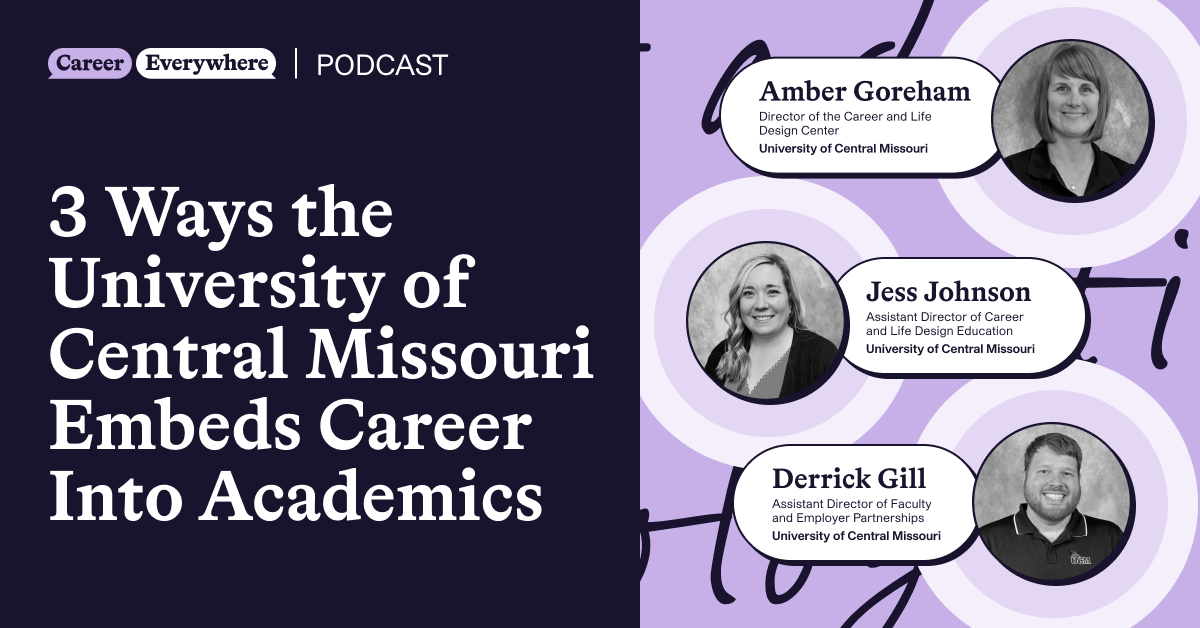
In this episode of the Career Everywhere Podcast, host Meredith Metsker sits down with Amber Goreham, Jess Johnson, and Derrick Gill from the University of Central Missouri to talk about how their six-person team is scaling career education across a campus of nearly 9,000 students.
UCM’s Career and Life Design Center has spent years building a strategic framework rooted in three pillars: exploration, career readiness, and connection. Now, those pillars are powering three concrete initiatives designed to embed career into the academic experience—meeting students where they already are, rather than hoping they’ll find their way to the career center.
Amber, Jess, and Derrick walk through each of those initiatives in detail:
- A milestone-based roadmap that tracks student career development from freshman to senior year
- A faculty resource hub that gives instructors plug-and-play career content
- A Career Champions program that’s turning faculty into career advocates across campus
The early reception has been overwhelmingly positive, and the team is just getting started.
If you’re looking for a practical, scalable model for embedding career into academics at your institution, this episode is full of ideas you can take back to your team.
Key takeaways:
- Start with a framework, then build out from there. UCM’s three-pillar model—exploration, career readiness, and connection—gave the team a shared language and structure from which everything else (milestones, the resource hub, Career Champions) naturally flowed.
- Milestones make career development tangible for students and faculty alike. By mapping specific, achievable career actions to each academic year under each pillar, UCM created a roadmap that’s flexible enough for faculty to adapt to their own programs while remaining consistent across the institution.
- Turnkey content is the key to faculty buy-in. Rather than asking faculty to figure out how to incorporate career education on their own, UCM is building a faculty resource hub in Brightspace with ready-to-use assignments, video lectures, and activities—making it as easy as possible for instructors to embed career into their courses.
- Career Champions can scale your reach across campus. UCM’s Career Champions program is designed to train department chairs and faculty on the Career Everywhere philosophy, their pillar framework, and how to embed milestones into their specific programs—sending them away with a concrete action plan, not just a training certificate.
- Scalability is a strategy. With six staff members serving nearly 9,000 students, UCM is intentional about building systems and content that work even when the career team isn’t in the room—from recorded video lectures to the LMS-based resource hub.
- Timing and visibility matter. Getting in front of academic council, presenting at institutional summits, and adding a role dedicated to faculty and employer partnerships all helped UCM’s career center gain momentum and inbound interest from departments who are now coming to them.
- It’s okay to start small. Amber’s biggest piece of advice: don’t wait until everything is perfect. Take manageable steps, reflect on progress, and trust that the pieces will come together over time.
About the guests:
Amber Goreham is the Director of the Career and Life Design Center at the University of Central Missouri, where she has worked for 18 of her 22 years in higher education. With a background in management and human resources, Amber leads a centralized team committed to making career and life education accessible to all of UCM’s nearly 9,000 students. She is passionate about equity in career services and has spent years building the frameworks and partnerships that are now coming to fruition through UCM’s academic integration initiatives.
Jess Johnson is the Assistant Director of Career and Life Design Education at UCM, where she has worked alongside Amber for nearly 11 years. A first-generation college student herself, Jess oversees curriculum and student-facing career education programming. She was the primary architect of UCM’s milestone framework and is the driving force behind the faculty resource hub—both of which are central to the team’s strategy for scaling career education across campus.
Derrick Gill is the Assistant Director of Faculty and Employer Partnerships at UCM, bringing a background in business internship coordination and media to his role. In his year and a half on the career team, Derrick has helped UCM build visibility with academic leadership and has been instrumental in developing the Career Champions program, which is designed to equip faculty to champion career education within their own departments.
Resources from the episode:
- Amber’s LinkedIn profile
- Jess’ LinkedIn profile
- Derrick’s LinkedIn profile
- University of Central Missouri Career and Life Design Center (powered by uConnect)
- uConnect—Virtual Career Center platform
- Designing Your Life by Bill Burnett and Dave Evans (referenced as the foundation of UCM’s life design approach)
- The Career Everywhere Ecosystem by Jeremy Podany (mentioned by Derrick as a team reading the career center used to gather faculty input)
Jess Johnson:
I think right now is a pivotal moment in higher ed where retention means everything. And I’ve heard one of our faculty members say this numerous times to all of us. He’s in our communication digital media department. Now he keeps saying we have to have life design exploration, we have to have crew readiness, we have to have all these different things. And so I think that crew readiness is a hot topic right now. Life design is a hot topic. All the great things that we do in our center is finally getting noticed, I think, on campus. And so us hitting with the milestones and the faculty resource hub and the crew champions, just the timing has just all went just perfect.
Meredith Metsker:
Hey everyone. Welcome back to the Career Everywhere podcast. I’m your host, Meredith Metsker, and today I am joined by Amber Goreham, Jess Johnson and Derrick Gill, all from the University of Central Missouri. Amber is the director of the Career and Life Design Center. Jess is the Assistant Director of Career and Life Design Education. And Derrick is the Assistant Director of Faculty and Employer Partnerships. Thank you all for being here.
Amber Goreham:
Absolutely. Thanks so much for having us. We’re so excited.
Derrick Gill:
Thanks for having us.
Jess Johnson:
Yeah, excited to be here.
Meredith Metsker:
Yeah, likewise. I’m so excited to have all of you and to talk to you today about how you’re embedding career into academics. This is something that’s obviously top of mind for a lot of career services leaders right now. And it’s always interesting to me to hear how different career centers approach it. So I’m excited to dig into all of your strategies today. But before I get into my questions, is there anything else any of you would like to add about yourselves, your backgrounds or your roles there at UCM?
Amber Goreham:
Sure. So yeah, I can kick that off. Well, like you said, I’m Amber Goreham. I’m the director of our current life design center here. I’ve been in higher education going on 22 years. Of the 22 years I’ve spent the last 18 in career services, so I’ve been in this landscape for a while. Here at UCM, we’re a centralized center. So we have about 9,000 students. We have just over 6,400 undergrad and around 2,600 grad. And so we’re a staff of six. We’re a centralized center trying to do all the things for all of our students. And in terms of how I got into career services, for me it was just happenstance really. I did both my degrees here. And my background was in management and human resources, and I always had this interest in HR and recruiting. And so when the opportunity came open in career services, I thought, oh, well, I could pivot that direction and that would help me get closer to HR and recruitment. And then I never left. And here I am still doing the thing.
Meredith Metsker:
I love that. I always love hearing how people get into career services. Because it is never the same story.
Amber Goreham:
Yeah.
Jess Johnson:
You want to go next, Derrick?
Derrick Gill:
Sure, sure. So my name’s Derrick Gill. I’m the newbie, at least from least us three when it comes to being in career services. I’ve been in our office now for about a year and a half as our assistant director of faculty and employer partnerships. Prior to this role, I did business internships for our Harmon College of Business and Professional Studies here at UCM for about six years, I think I was over there five or six years. I was over there with Harmon. And what kind led me into higher education was right after graduation I spent about six years working in media, doing events, radio sales, the full gambit of it. And wanted to take those relationships that I built and bring them back to my institution. And that’s how I got started in higher ed and moved over here to career services.
Meredith Metsker:
Nice. Love that. Thanks for sharing. Let’s see, Jess, I’ll have you go last here.
Jess Johnson:
Yeah, last but not least. So Jess Johnson. Like Meredith said, I’m assistant director over our career and life design education side. Really what I do in my role there is just helping students prep for what’s next, my whole team. I got into career services actually, so I’m first gen student, so college was a little bit more difficult for me to navigate. And I will also say that I worked in the career services center at my undergrad. So I got started way early on in my career, seeing what career services centers look like and how they navigate. And so when I got out of college, I did something outside of higher ed. And realized how much I missed it and I’ve done student activities, I’ve done admissions, I’ve worked with Greek Life. And then made my way back to career services about 11 years ago. And I’ve worked with Amber and this center for ending my 11th year this year. So really excited.
Meredith Metsker:
Wow. And you’re, just guessing here, clearly a Kansas City Chiefs fan. For people who are listening-
Jess Johnson:
[inaudible 00:05:03].
Meredith Metsker:
Nice. Yeah, for those who are listening and not watching, there is a lot of Chiefs paraphernalia behind Jess in her office.
Jess Johnson:
Yes, yes.
Meredith Metsker:
I love that. I like to say my accent wall is orange, my couch is blue. I’m in Denver, Broncos country. So I also am representing in that way.
Jess Johnson:
Yeah.
Amber Goreham:
There you go.
Jess Johnson:
We feel bad for you, Meredith.
Derrick Gill:
Yeah.
Meredith Metsker:
I’ll get over this playoff incident soon, but not quite yet. All right, well, before I get into my more specific questions about our topic today, I do want to kick us off with a question I ask all of our guests here on the podcast, and that’s what does Career Everywhere mean to you?
Amber Goreham:
Yeah, for me, I see it as that collaboration. I see it as an opportunity for us to collaborate with our campus community and our partners to really try to provide all of our students access to career and life education. That’s something that has just been really passionate for me. And thinking about even back to 2018 when I was doing some work in my master’s program around it, that’s when it became eyeopening for me, then not everyone necessarily had the same experience. And so I would say that was the pivotal moment for me in my career of how do I make that better, and how do we grow that and make that better at our institution? So yeah, I see it as a way to provide all students access to career and life education, and everything that may mean. And really embedding it into the student experience so that it’s not left up to chance.
Derrick Gill:
I think it’s a little bit of my role, but I view it as really working with our faculty and working with our employers, and making those kinds of connections happen. And meeting our programs where they’re at, helping them where they need it and meeting our employer partners where they’re at, and helping them get connected where they need it as well, to make sure every student on our campus gets the experience, the opportunities that they need post-graduation.
Jess Johnson:
And for me, working on the education side, I just think it’s about making any kind of opportunity for a student in a variety of different modalities, whether that’s getting it through a faculty classroom experience, a workshop, a presentation, a class, maybe it’s one of our classes, coming into our walk-in studio experience. So any way they can, they can get it anywhere on campus.
Meredith Metsker:
Nice. I love that. Those are all three good variety of answers there. All right, now I would love to dig into our topic today, which is again, how you all are embedding career into academics there at UCM. So to set the stage a bit before we get into your specific strategies, can you talk about why this is so important and then how you approached the planning process?
Amber Goreham:
Yeah, absolutely. So I think in terms of why it’s important, just goes back to a lot of what we said in terms of how we see Career Everywhere. I think we see it very essential for all students. And I think over the time that I’ve spent in career services, embedding it into academics just makes a lot of sense, because that’s why they’re here. They spend a lot of time either in curricular or co-curricular things. And so I think being able to find ways to embed career into those opportunities just makes it more valuable for the student. And then we’re not asking them to do this extra thing in terms of doing these extra career-related things on the side. It’s already into the spaces that they exist. I think from a planning perspective, the work that we’ve done over really, probably in the last five years I think has all led up to the moment that we’re really at today.
A lot of it started way back when we had to start assessing ourselves as a non-academic unit. That was something that came from the university perspective. And at that moment, I think that’s when we really started looking at career learning outcomes. We created three career learning outcomes at that point in time, and then really started to look at what is the work that we do in our center? How do they align to those career learning outcomes and how can we start assessing what we’re doing? And so I think all of that work really led to the foundation and the creation of our model and our framework and our pillars, which have really been focused around career exploration and career readiness and then connections.
And so I think as we’ve continued to assess and have conversations around that assessment piece and just continuing to really think about what do we do day to day in these specific areas? And what does that look like? That helped us create those pillars. And then from there has helped us really think about, okay, what do we want students to do within these areas? And how can we take that information and those actions ,and start to think about where can we embed them? And how can we work with faculty and staff across campus to have more of that integrated approach? So I think that’s where it all started and how it’s framed into where we are today.
Meredith Metsker:
Yeah, that makes a lot of sense. And like you said, definitely fits into the Career Everywhere concept very well. And I think maybe you also touched on it, it just really hits the equity angle too. Not everybody can get to the career center during business hours or during the hours it’s open. And so meeting them in the classroom or educating the faculty on how to talk about career just makes it more accessible to everyone.
Amber Goreham:
Absolutely.
Meredith Metsker:
Okay. Well, so that’s really helpful context. And now I would love to dig into how you all are embedding career into academics, the big question. So can you share at a high level what you’re working on? And then we’ll dig into each of the strategies here in just a minute.
Amber Goreham:
Yeah, I think at a high level, it’s really looking at scalability. As a centralized center, we’re a pretty small team. We’re a team of six people, and then we also have our coaches that provide peer-to-peer support, which is going to vary anywhere from 8 to 12 given on the academic year. So I think for us, it really started to become a scalability of how do we get the work that we’re doing out beyond our center, knowing that really when you look at the numbers we see about 10 to 15% of the campus population. So how do we flip that approach to be able to serve the students that we’re not seeing? And so I think that’s a lot of what led to what we’re doing. And then I think just really thinking holistically, it’s interesting because as we talked later about the milestones, we used to have something very similar many years ago, but again, it was very much housed within the career center.
So it’s now interesting to look at, looking at milestones and way to embed these milestones, but thinking about it more from the academic side of the house. And so I think it’s a really cool opportunity for us to be able to scale, and for us to be able to create that equity piece so that students across our campus aren’t missing those pivotal milestones, and that they’re getting them at the right time, and that they’re all getting access to it. I think also just investment in our campus community. I think when you think through the different asks that either faculty or staff are being asked to do across campus, I think being able to support them, I think we see it very much as we are an office to help and support and how can we meet the various programs where they’re at and what does that look like?
And so I think we want to see ourselves in that framework of really being a supportive office and being able to provide them the content and the materials that they need in a way that’s easy for them to embed it into their academics. So I think being able to have that turnkey content, whether that’s ready to use assignments, whether that’s videos, whether that’s module based learning, I think anything that we can do to help our faculty be able to easily integrate these concepts into their courses is really where we’re at to try to reduce those barriers, make sure that everyone has access and create that more holistic and consistency across the student experience.
Meredith Metsker:
Okay. Thank you. That’s super helpful. So it sounds like there’s this milestones concept and then a couple of different things you’re doing to work with faculty and staff. So I want to start with the milestone strategy. So can you share more about what that entails and why you all are focusing on it?
Amber Goreham:
Absolutely. I’ll kick that off to Jess. Yeah.
Jess Johnson:
Yeah, that was my big project. So the milestones, what’s really cool about it is I’m a big connector. I want things to make sense. So as leadership, as we were going through and creating outcomes and looking at those pieces, it naturally created pillars. And so those were around exploration, career readiness and connection, which then was really easy for me and my career and life science advisor, Kendall, who was the co-creator of the milestones with me, to naturally make generalized milestones under each one of those pillars at the freshman, sophomore, junior and senior level. And so when we started working on those, we were trying to think, okay, how can we make these as generalized so we could use them in our walk-in studio experience if students pop into the center, if we want to embed them into our courses. But then also if we want to partner with faculty, how can they individualize these milestones to their own programs?
So we were thinking, okay, we can’t use language that only we understand. We have to make this vague enough to where they understand it as well. And so that’s where we started. And I will say it was a lengthy project. We went back and forth a few times on certain things, and second guessed. And Derrick and Amber were awesome. They looked it over for us and helped us and supported us through that project. But at the end of the day, we were so glad we created these because now we can already see where it’s heading, which is really exciting.
Derrick Gill:
Yeah.
Meredith Metsker:
Nice [inaudible 00:14:48].
Derrick Gill:
And I think from a partnership… Oh, I was going to say, I think from a partnership perspective, I’m excited to give it to our faculty and to get it in their hands and to present on it. Just yesterday, Amber and I presented it to a specific department, more than just high level chairs, and it was really well received, and I think it’s something we’re really excited at. Yeah.
Meredith Metsker:
Yeah, it sounds really interesting. And it will has a lot of potential there. So Jess, just to confirm again, can you remind me what the three pillars are? It’s readiness, exploration.
Jess Johnson:
Yeah. So the first pillar that we built around was exploration. It’s very life design heavy. Because we are a life design school, so we use that to help students explore careers and options. And then we also, the second pillar was around career readiness. So very job application, searching, maybe it’s a resume, interviewing, those typical things. And then the connection piece, we built it around a lot of what Derrick has on his team. So maybe it’s even building connections with your faculty, but maybe it’s employers, maybe it’s going to fairs, those types of things. So we tried to break it down to where students could see themselves in each pillar, at each year, and the things that mattered the most to them at that timeframe.
Meredith Metsker:
So there’s milestones under each pillar for each academic year?
Jess Johnson:
Correct.
Meredith Metsker:
Okay. Okay. And then remind me, is there a landing page on your virtual career center about the milestones?
Amber Goreham:
Not yet, but that’s coming. So under our faculty staff page, we have coming soon our faculty staff resource hub and our career champions program. So that’s where that information ultimately will be housed.
Meredith Metsker:
Exciting. Cool. Well, Jess, can you share what some of the milestones are and how do you know a student has hit them?
Jess Johnson:
Yeah, so like I said, some of the exploration pieces, it’s definitely very life design focused, but we did dial back the language a little bit because if you’ve never dived into life design, you might not know what prototyping or an Odyssey plan is. I’ll say we definitely showcase the freshmen level one first because it’s not as probably daunting or scary to show individuals on campus. So thinking about your career values is in the exploration part, maybe going to our involvement fair and seeing what’s available on campus. At the career readiness piece. We talk a lot about just initially building a Handshake profile, like registering your account and doing the basics.
Coming to our walk-in studio experience and meeting with a coach just to see what it’s like and see that our office isn’t scary. Connections, we have them even just going to a fair and walking around. As simple as that. You don’t have to network with anybody. So very basic things of the freshman year. And then as we progress through that sophomore, junior, senior year, we get a little bit more strategic in how we want them to navigate the milestones. And we also, in the senior year, the exploration side goes down less, and the core readiness and the connection piece ramps up. Because we want them more focused in those areas.
Meredith Metsker:
Okay. Yeah, that makes sense. I’m curious, what are some of the milestones maybe in the junior year. That’s a pivotal time.
Jess Johnson:
A lot of them sit around internships. On the connection side, getting them, I think we even have in there targeting your resume to a job description. So once again, you’re being more strategic in your job search. You’re hopefully have narrowed down your exploration. So you are being more specific to certain industries when you’re helping or helping you in our walk in studio experience, you’re meeting with an advisor, maybe you’re going to take on a leadership role on campus. So that’s going to help you with that leadership experience on your resume. We’re having you go to a fair, you are networking, you are in the thick of it, excited to meet employers and talk about yourself, and showcase all the things you’re doing here on campus. So I would say junior year is probably very heavy on all three pillars because you’re doing the things.
Meredith Metsker:
Yeah. At least you hope the students are doing the things.
Jess Johnson:
Yes.
Meredith Metsker:
Okay. Very cool. Well, I know it sounds like this is relatively a new initiative, but have you had any early results or any early lessons learned that you’d like to share?
Amber Goreham:
I think a lot of it is just excitement on campus. So we had the opportunity to put together a presentation for academic council. So me, myself, and then Justin, Derrick, we presented to our academic council, and talked about the history of where this is coming from and the understanding around the career ecosystem model and the framework. And how we’ve really adapted that to UCM and how we’re hoping to move forward from there. And so I will say the response was really positive. I think we’re at a pivotal moment where I think folks are just recognizing it more, and they’re seeing it more. Particularly around accreditation and things along those lines, I think too. So I think they’re really seeing our office as a resource. And now we’re being able to provide things in a way that I think just makes better sense for them and really meets them where they’re at.
I think from academic council, we’ve had the opportunity just to see results in terms of folks coming up to us directly. Like Derrick mentioned, we got the opportunity to go speak to a department yesterday. We’ve got a couple more departmental meetings coming up. So I think those results right now are just very much, we want to know more. How do we embed this in our program? We also have another program on campus that really wants to look at our milestones all the way freshmen through senior year. And actually think about how they can embed those into their program and has invited us to their faculty retreat. So I think things like that movement, that is what has gotten us really, and it’s been really seen very positively, and now we’re working through that implementation phase of some different pilot programs that we’re really excited about.
Meredith Metsker:
Nice. That’s awesome that they are coming to you now. Yeah, that’s huge. Okay.
Derrick Gill:
I think that’s been the fun part is seeing the faculty and programs that we may have worked with a little bit, but not a lot in some of these areas, coming to us and be like, “Hey, we didn’t know you could do this, and this is what you’re going in, and we’d love to adapt it.” And I think just the warm response to what we’ve put out there, and I think the recognition of the care and effort that we’ve put into it has been really well received across campus so far.
Meredith Metsker:
Yeah. That’s what keeps you going on the days where things are challenging.
Jess Johnson:
Yes. Absolutely.
Meredith Metsker:
Okay. Well, is there anything else any of you would like to add about the Milestone strategy before I move on to the next one?
Jess Johnson:
I would say too, just yesterday, Meredith, we got our proposal accepted to our Provost Success Summit, which is I would say a little mini conference that we put on campus. And Kendall and I’s proposal was around the milestones project. And we’re actually going to have the faculty that Amber was talking about who we’re working with directly to embed it individualized into his program. He’s going to co-present with us to share his strategies and his experience working with us to get there. So we’re doing that in April. So I think it was, yeah, yesterday we just got that news, so it’s exciting too.
Meredith Metsker:
Amazing.
Jess Johnson:
Yeah.
Derrick Gill:
Yeah.
Meredith Metsker:
Yeah. That’s awesome. Well, congrats you all.
Jess Johnson:
Yeah, thank you.
Derrick Gill:
Thank you.
Meredith Metsker:
Cool. Yeah, you’ll have to keep me posted. Might have to do an episode follow-up on how that went.
Amber Goreham:
Yeah.
Meredith Metsker:
Okay, cool. Well, now I would love to move on to your second strategy, which is the faculty resource hub. So I’m curious, what does this look like for York Career Center and then what all is included in it?
Jess Johnson:
So that’s also one of my projects. So the faculty resource hub, Derrick and I, it stems from our career champions program, which I know Derrick’s going to talk a lot about that with you, but it’s really just how we can take those milestones and then turn them into, like Amber was saying at the beginning, embedded projects or assignments, or maybe it’s video lectures or whatever that is that they can just plug and play. We were like, okay, how do we actually roll this out in the best way possible and the easiest way possible for faculty and staff to grab onto? And so we went with our LMS, which is Brightspace, and they made a community space for us. So we can add individuals on campus into it, and then they can take pieces out of it. So very much looks like if you have Canvas or Brightspace or Blackboard, whatever that is, like a landing page.
And then we’re going to have little, we call them widgets on Brightspace that they can go into for each pillar. I know Derrick’s got a lot of ideas around the connection side and how he’s going to put different things in there and definitely add into that, Derrick. So Kendall and I, once again, we’re working on that as that’s the start of the project. And then we’re going to just slowly add faculty in and then it will be a part of uConnect and all the different things. But that’s where we’re started right now. But I would say it’s very early stages right now.
Derrick Gill:
Yeah, I think we’re excited to get some examples of fun interactive activities that faculty can just embed right into a class experience that checks off that box form, that hits that milestone just by doing a simple activity in class. Or might knock off a couple of different of those milestone check boxes just by doing an activity in class, whether that’s around connections, exploration or career prep and career readiness.
Meredith Metsker:
I imagine they must really appreciate that, especially in conjunction with the milestones. You’re not just telling them this is more things you need to do some guidance, and also here’s an easy way for you to implement it.
Jess Johnson:
Yes, 100%.
Derrick Gill:
Yeah. I think we’re starting to look at ourselves as a resource, definitely for our students or a student service center, but also as a resource for faculty, letting them know, “Hey, you’re not alone in having to answer these career conversations. You’re not alone in career education for students or answering questions about career. We’re very much a resource for you all as well.”
Meredith Metsker:
Yeah, that reminds me of something one of my recent guests said in a past episode about how he’s trying to make the career center the center of the spider web at his university.
Amber Goreham:
[inaudible 00:25:16].
Meredith Metsker:
So with students, with faculty, with staff, with senior leaders, with employers, alumni and so on. So it sounds like that’s what you all are doing too.
Amber Goreham:
Yeah, I think we definitely envision the hub being something very similar to that. So that it is easy for anybody to access and gives them that autonomy to plug and play what they need when they need it.
Meredith Metsker:
Yeah, for sure. I’m sorry if you said this already, but are there already a bunch of assignments on there, or do you just have your framework and your structure built out?
Amber Goreham:
Yeah, definitely more framework structure. That’s the goal of the rest of spring into summer is to then start putting those pieces together, identifying what those assignments will look like, and then starting to roll that out. In a more smaller scale with the hope of being able to grow it down the road.
Meredith Metsker:
Cool. Do you have any ideas so far on what kinds of assignments you might put in there?
Jess Johnson:
Definitely video lectures. I think, honestly, I would guess Derrick and Amber would back me up on this, Meredith, that’s what we get requested the most. Come into our classroom and do this blank presentation, which we love doing. We get to be in front of students, we get to connect with faculty. It’s wonderful. But once again, there’s only four of us. And then Amber when she has availability to jump into classrooms and do those. So being able to maybe do low level presentations that we can just, hey, especially if it’s an online class or a hybrid type class, maybe we just do a video lecture that you could just pull right out of the faculty hub and embed into your Brightspace. Brightspace is great, because they can just literally copy things over directly into their Brightspace.
We also plan to use our wise coaches so they can even build big stuff off of there as well, which I think will be great too. I think definitely assignments is the route we want to take as well. So if you’re wanting your students to do a resume assignment, we can build that for you with a rubric, instructions, maybe even a lecture that you can put with it or slides that you can put with it. So it’s really easy for them to just plug and play and feel confident in what they’re giving to their students.
Derrick Gill:
I think from a connection standpoint, it’s really like how to prepare for a fair, how to develop that elevator pitch, what to do to prepare for a fair, how to utilize our office to do so. And we’ve got a great professional clothing studio. We’ve got great coaches who can help you get that resume ready to go. And just really making sure they know about that. I think a good example of this too, as far as the recorded content that Jess was talking about, it makes our content more accessible. If there’s a student who couldn’t make it to class that day, they don’t miss out on the presentation. They can see it, because it’s recorded.
If they’re available for it, same thing with online students. I did a presentation in a similar format for an online class just this week where I recorded the presentation, sent it to the faculty, she had her students watch it, and then I showed up for the presentation, but it was much more workshop-based. It wasn’t just me lecturing at students. It was, “Hey, let’s have a conversation about the questions that you have in the deeper experience around career education that you guys have.” And so it worked out really well.
Meredith Metsker:
Yeah, that’s a really smart way to approach it, especially you said you have a team of six total and how many students?
Amber Goreham:
Almost 9,000. A little over 9,000 students between undergrad and grad.
Meredith Metsker:
Yeah. So it’s quite the ratio y’all are dealing with there.
Amber Goreham:
Yeah. And I think definitely the milestones when you ask the question about assignments, I think the milestones will help drive that. I think now that we have a good solid foundation of what we want those milestones to be by year, it’ll help us frame what are those assignments that now we can put into Brightspace that match those milestones. So then as faculty look at how do I want to embed career in my program? What milestones do I want to adopt? Now here’s those assignments and that curated content that goes with it. And that way it’s easy for them just to go ahead and integrate it into their course, and into their curriculum.
Meredith Metsker:
That makes a lot of sense. And I was just thinking as you were talking, how much, or just how cool it is, how you’ve approached this whole planning process and how strategic you are, especially given how many students you need to reach with such a small team, and how there’s all of these frameworks in place between the pillars, your milestones, and then all of the things that feed up into those things. It’s just really strategic and is super cool to hear about.
Amber Goreham:
It took a lot of, I would say, what, a couple years of lots of talking and discussing. I think we’re finally at the point where the pieces are coming together and now we’re really starting to see it and things are happening, which is I think just really exciting for our team, our students, our university. So it’s been really interesting to see it come together, but it was a lot of planning there for a couple of years for sure.
Derrick Gill:
Yeah.
Meredith Metsker:
Yeah, there’s always a ton of work going on in the background.
Amber Goreham:
Yep.
Meredith Metsker:
Okay, cool. Well, anything else any of you would like to add about the Faculty resource hub before I move on?
Amber Goreham:
I don’t think so.
Jess Johnson:
I don’t think so.
Meredith Metsker:
Okay, cool. Well, now I’ll move on to the third and final strategy, which is your career champions program. So can you share more about what that entails and why you’re focusing on it?
Derrick Gill:
Yeah. So Jess and I have been working closely together on the Career Champions program. It’s something that I know Jess and Amber explored even before I got here. And then once I got here, Amber was like, “Hey, I really want someone that can give this a direction in what we want to do with it. So Jess and I did a lot of exploration around what we wanted our Career Champions program to look like. We know several institutions have different versions of career champions. And we really wanted ours to work again along with those milestones, to work along with our learning outcomes, to work along with that resource hub. And so what we’re looking at doing, we’re going to pilot our career champions program this summer. And we’ve divided it into four different sections where that first section is really going to be about Career Everywhere.
It’s going to be about a career ecosystem. It’s going to be why it’s important, addressing maybe those hard conversations and topics that faculty could be facing, either by parents, accreditation students, those types of things, and really diving into that holistic approach of Career Everywhere. And then after that, we’ll have a section that’s really on that exploration side of things and how to embed life design and how that works within, again, that specific department. We’re very much taking that approach of meeting them where they’re at. We’re going to give you the general overview, high level, big idea of it. But as far as really getting into the nuance of your program and what your students need, faculty know that. We’re not here to tell them what they know. And then there’s also going to be the career readiness piece of that. We’ll have another section on that connection side and how to utilize the connection opportunities that we offer, whether that is career fairs. Maybe that’s an employer panel, maybe it’s hall tables that employers are doing.
Really we’re open to that recruitment cycle looking however it needs to look to connect our students with those employers in appropriate ways. And so then really going into a section on that. And then what I think Jess and I are excited about, I know I’m really excited about, is that final piece and that final session, is where we’re going to say, “Okay, now you know about Career Everywhere, now you know about our pillars, you know about the resource hub, you know about these milestones. Now let’s integrate, right? Let’s put together a framework of how you think this could look for your program that you can now take to your program coordinators.” Because most of that pilot group is going to be department chairs with maybe a couple of program coordinators in it, but how do you take this back to your faculty and now really refine it, right?
And leave Career Champions with some actionable steps that you can away from it and a plan that you can go into it. And it’s not just a training that you attended and got lectured at, but really you’re taking away some great ideas of how you want to implement career education into your program and embed it into your program. And so that’s what we’re looking at doing with Career Champions. Right now we’re trying to figure out what those maybe fun incentives are going to look like for them as far as what they could get from it. We’ve kicked around some ideas, but that as far as the idea and the vision behind Career Champions and how we embed that looking, that’s what the direction that we’re going in for our pilot group.
Again, as Amber mentioned, we presented to our academic council last month, and so we put a QR code up there that was like, “Hey, are you interested in doing this Career Champion program?” We were looking for about eight. We got about eight who said we want to be in it. So we’re excited to have a good solid group there. And then we’re going to take the fall semester to assess how did that go within that pilot group, what worked, what didn’t, what needs to be refined, and then launch out that program for more than just those department chair partners to sign up for it as far as faculty partners go into that spring semester. So that’s our Career Champions program so far.
Meredith Metsker:
Nice. That’s really exciting, especially that you got so much buy-in right off the bat.
Derrick Gill:
Yeah. Yeah.
Meredith Metsker:
I’m curious, did you get any comments or feedback during that presentation aside from the folks signing up?
Derrick Gill:
Yeah, we had several different faculty members who came up to us afterwards. And I think it was a lot of excitement around what we’re doing, whether that was to come and present to their program coordinators or at their faculty meetings. Or coming and asking, “Hey, tell me a little bit more about Career Champions. Tell me a little bit more about this resource hub, asking about how to embed those…” We had several different great conversations immediately after our presentation, which was really awesome and reassuring. So yeah, that’s, I think, where we’ve been with that.
Meredith Metsker:
Yeah, that’s super encouraging. And I am just curious, with all of the work you guys are doing to engage faculty and embed in academics, does it feel like faculty are more interested now or does it feel like anything is different now versus maybe a few years ago in terms of faculty’s interest in working with the career center or their willingness? I’m just curious if you’ve noticed any changes in trends, especially Jess and Amber, with how long you’ve both been there.
Amber Goreham:
Yeah, we’ve explored, especially Career Champions, I think we looked into that even what, five years or so ago.
Jess Johnson:
Right around COVID.
Amber Goreham:
Yeah, right around. And so I do think things do feel different. I do think things feel different in a more positive way. I also think just we’ve been a little bit more strategic in getting ourselves out there. I think being able to add Derrick’s role a couple years ago has gotten us in front of academic council, which we hadn’t historically been in front of. So he’s had a couple opportunities to already present to academic council. And so I think that has helped. And then my boss was open to say, “Hey, I think you as a team need to come to academic council and talk about best practices around career.” So yeah, I think timing was part of it, of just the right time, the right people, the right place, just being intentional about where you get yourself in front of and what do you get to talk about.
Jess Johnson:
Yeah, I would add to that too, that I think right now is a pivotal moment in higher ed where retention means everything. And I’ve heard one of our faculty members say this numerous times to all of us. He’s in our communication digital media department. Now he keeps saying, we have to have life design exploration, we have to have crew readiness, we have to have all these different things. And so I think that crew readiness is a hot topic right now. Life design is a hot topic. All the great things that we do in our center is finally getting noticed, I think, on campus. And so us sitting with the milestones and the faculty resource hub and the Career Champions, and having Derrick’s new role, we were saying just the timing has just all went just perfect.
Meredith Metsker:
Yeah. Yeah. I was just curious what you’ve noticed. I have observed that from an outside perspective that it seems like career services is having a moment right now, and I’m just curious what that’s looking like in each institution. So that’s really interesting to hear. Cool. Well, is there anything else you would like to add about the Career Champion program?
Derrick Gill:
I think that’s all I got right now.
Meredith Metsker:
Cool. Well, I’ll be excited to hear more, just hear how the pilot goes and then hear how the launch goes. So you’ll have to keep me posted. I’m curious, just generally speaking across all of these different ways that you’re embedding career into academics, what results have you seen or what feedback have you gotten? I know we’ve touched on that a little bit, but I’m just curious across the board.
Amber Goreham:
I think what we’ve all echoed is really just a lot of that positivity. I think it’s created more in-depth conversations. I think Derrick had said, even if we already had relationships with some of the departments or some of the faculty within the departments, I think it’s created opportunity for some of those more deeper conversations around career, which I think has been really good. I was telling Derrick yesterday after going to a larger scale department meeting, I think having the opportunity to get in front of everyone at one time I think has been really helpful too. So I think just the openness to invite us into their spaces and into their opportunities to speak with their group has been really important from a result standpoint. And I think now we’re just excited to continue to do those things and to continue to see where it goes.
Meredith Metsker:
Cool. And I know this is all, you’re relatively early in a lot of these strategies, but I’m just curious, what are your goals for the future? What’s on your vision board?
Amber Goreham:
Honestly for me, I think it’s just continued growth. I think I’m excited about the opportunities that have already come from it. I’m excited to see where those conversations continue to go. And I’m excited to see that implementation phase. So back to Derrick’s point around the career champions of we get to the point of giving all this information and providing all these resources and having the faculty resource hub, being able to actually see folks implement it across campus and use it. I’m really excited for that and to see where that goes. But I’m also, I think at that point too, because like you mentioned, it is relatively new. So I think the other piece of that is feedback and assessment from folks using it, and how can we continue to refine it and make it better.
I’m also hopeful that, I think a lot of this came from just trying to streamline the work that our staff is doing. So I’m also really hopeful that we’re going to see opportunity in the fruits of those efforts of being able to streamline our workload within our center, but then also just for our campus community in that way. And I’m really hopeful that we see it as a flexible framework that people are excited to use, want to use, and that it does really meet everyone where they’re at in terms of embedding career into their program.
Meredith Metsker:
Yeah. Well, it sounds like you all have laid a really great foundation. Cool. Well, you all have offered a lot of really great insights already, but is there any additional advice you would give to other career services leaders who also want to embed career into academics?
Amber Goreham:
I think one thing that I’ve really learned through this process is it’s okay to start small. Especially our team, I think we’re a very innovative team and we like to think big and we’re not afraid to change, and we are okay doing lots of things. And I think sometimes in my head, I want to just change it all overnight. I want it to be for everybody all the time. And so I think one thing that I’ve really learned and advice that I would share is it’s okay to start small. It’s not going to all happen overnight. What are those small, manageable steps that you can actually take? Because looking at where we are today and thinking about maybe where we were three years, five years ago, we’ve made a lot of progress. And sometimes in the moment, in the day-to-day work, it doesn’t always feel that way. But giving yourself the autonomy and flexibility to really reflect on that, even those small things, can really make a difference.
Meredith Metsker:
That is great advice. Thank you, Amber. Jess, Derrick, anything else to add?
Derrick Gill:
I think from my end, it’s have conversations. I’m a partnership person, I’m a connection person. That’s why I’m in the role that I’m at. But it’s have those connections. I think a lot of this, our ideas as a team came from having those conversations with our faculty and getting an understanding of where are they at, what do they need, what would be helpful for their programs? Having those intentional conversations, having them be part of, we read the career ecosystem book and we brought in faculty to read that with us and ask them for their feedback. And we collect a lot of data from our events, and after meetings and after presentations and all that stuff to really try and figure out like, “Hey, how are we doing? What’s going on? How do people feel?” And I think just having those conversations, taking them seriously and looking to bridge those connections and meet people where they are, it’s important. And I think that’s part of what allowed us to make this flexible resource.
Meredith Metsker:
Very cool. And Jeremy Padani will be very happy to hear that you all are reading his book.
Jess Johnson:
I think for me, my advice would be, especially since I’m on the student education side, is always remember that it’s about the students. That at the end of the day, we’re here to support them and think about what’s best for their journey through college and their next steps after they receive the degree. And so I’m excited just to see where this all goes. Amber, with Sam, I’m excited to see how it directly affects the students in a really positive way. And so that’s the advice I would give is just don’t forget the student. They’re the reason you’re here.
Meredith Metsker:
Always good advice. Yep. We’re all here for the students. All right, well, is there anything else any of you would like to add before I start closing this out?
Jess Johnson:
I don’t think so.
Amber Goreham:
I don’t think so.
Meredith Metsker:
Okay. Well, if people would like to connect with you or learn more from you, where is a good place for them to do that?
Amber Goreham:
Definitely LinkedIn, email.
Derrick Gill:
Yeah,
Amber Goreham:
Absolutely. We’re definitely open to chat with anyone that might be interested.
Meredith Metsker:
Okay, perfect. Well, I’ll be sure to include links to all of your LinkedIn profiles and your emails in the show notes, so folks can reach out if they would like. And now I would love to close us out with this answer question, leave a question segment that I like to do at the end of every interview. So I’ll ask you a question that our last guest left for you and then you will leave a question for the next guest. So our last guest was Ashley Safranski of uConnect. She’s also my boss and a lovely person. And she left this question for you. What’s a common belief or a common practice in career services that you’ve changed your mind about over time?
Amber Goreham:
Yeah, so I really did love this question. As we talked about it, I was like, man, this is a really good question to ask. I think for me, one thing that I’ve really changed my mind about is the idea that career advising or career exploration, whatever the process may be, that it always had to be done with a professional staff member. I think we definitely live that time where that’s what staff members did. They spent eight hours of their day meeting and connecting with students. And so over time, I’ve really seen that the career studio model can really work and really work well. And having our students be trained as peers and being able to provide peer-to-peer support does provide a lot of value to our students. But it also then gives our staff the flexibility to do the things that we’re talking about today and really focus in on those larger initiatives. So yeah, I think it really changed mindset over time of that the career studio model actually really can work.
Meredith Metsker:
Nice. I love that.
Derrick Gill:
I’d say for me it’s around career fairs. Career fairs or career connection opportunities don’t have these big things where you have hundreds of employers and hundreds of students. You can have both of those and still have misalignment and not people connecting in the right spaces. So embracing that, hey, sometimes events can be smaller, it can be a few hall tables, it can be a panel, but if you’re connecting our students with valuable opportunities and meaningful opportunities, then that’s just as beneficial as a big fair that has hundreds of employers and hundreds of students at it. Instead, it can be 20 employers and it can have 50, 70 students at it. And if you’re getting those students, those opportunities that they need at the end of the day, and they’re meeting the employers that they need to meet with and employers are connecting with the talent that they need to recruit, then that’s meaningful and that does a lot for both parties.
Meredith Metsker:
Yeah, the classic quality over quantity thing.
Derrick Gill:
Yeah.
Meredith Metsker:
Okay, cool. Jess, how about you?
Jess Johnson:
Yeah, I think for me, I oversee all the curriculum in our center. And when we first started out with courses, it was all in person. And then COVID hit and we had to quickly restructure to online. And I think that a lot of our classes moving online has been a really game changer for our center, whether that’s they’re being accessible for all students, being able to generate maybe more revenue for our center, flexibility on our adjuncts who teach the courses. So I would say that even though in person is wonderful and super fun, I would rather teach in person. Online gives us that flexibility to meet everywhere where they are, the students, the faculty, the staff, everyone that’s helping with it.
Meredith Metsker:
Yeah, it’s nice to at least have the option.
Jess Johnson:
Yes.
Meredith Metsker:
Okay. Very cool. Well, what question would you all like to leave for the next guest?
Amber Goreham:
Do y’all want to say it or do you want me to? Go for it. [inaudible 00:46:34].
Jess Johnson:
[inaudible 00:46:33].
Derrick Gill:
I can throw it out there. I can throw it out there. We kick around some ideas. We wanted to leave you guys with a fun one. I think as you can see between mine and Jess’s backgrounds, we’ve got a little bit of the Kansas City civic pride over here. So we also think it’s the barbecue capital of the world, I guess I should say we know it is. And so we’re curious, does the next person think there’s any city or region that comes close? Or is Kansas City just king when it comes to barbecue?
Meredith Metsker:
It’s a good question. I feel like the people from Texas would have something to say, but we’ll see.
Amber Goreham:
And I grew up in Texas.
Meredith Metsker:
Oh, okay. So is it Kansas City?
Amber Goreham:
I would lean towards Kansas City now, but I’ve been here for going on 26 years, so I’m losing my Texas roots a little bit.
Jess Johnson:
[inaudible 00:47:21].
Derrick Gill:
Yeah.
Jess Johnson:
Yeah, yeah.
Amber Goreham:
Yeah, exactly.
Meredith Metsker:
Oh, I love that. It’s a great question. And now also I’m hungry for barbecue. I did get to try some Kansas City barbecue a few years ago and it was excellent. Can confirm?
Jess Johnson:
Mmm.
Meredith Metsker:
All right, cool. Well that’s a great question. Love it. I’m excited to pass that on to the next guest. And I just want to thank you all for taking the time to join me on the podcast. This was so fun. It’s a great conversation. I loved hearing about all the interesting things you’re doing. And like I said, you’re going to have to keep me posted and we might have to do a follow-up in another year or two, and hear how everything’s going. So just thank you all so much again.
Amber Goreham:
Yes, thank you. Absolutely. Thanks so much for having us.