

Ask most higher ed leaders which offices are central to their retention strategy, and you’ll hear about academic advising, financial aid, mental health and wellbeing, enrollment management, and student affairs. These are all important.
But there’s one office that often gets left out of that conversation when it definitely shouldn’t be: career services.
Here’s the thing: students don’t just leave college because of financial or academic difficulties. Many leave because they’ve lost sight of why they’re there in the first place, which is often to improve career prospects and earning potential. They leave because they can’t connect the dots between their major, their coursework, and their future. They leave because the investment stopped feeling worth it.
Career services teams have a direct answer to all of those problems, and they’re sitting on a goldmine of data, student stories, and resources that help students make those critical connections. The challenge is that in most institutions, career services isn’t part of the retention conversation. They’re called in after the problem arises. But they should be called in before it even starts.
This article makes the case for why career services leaders should be active, empowered stakeholders in their institution’s retention strategy—and what that looks like in practice.
First, let’s talk about what’s at stake
Retention isn’t just a feel-good metric. It’s a financial and reputational one. According to the National Student Clearinghouse Research Center, 37.6 million working-age Americans have some college credit but no credential—meaning they started college and didn’t finish. That’s not just a national crisis of unrealized potential; it’s a direct reflection of the scale of the retention problem playing out across every institution in the country. And every one of those students represents lost tuition, lost housing and dining revenue, lost alumni giving, and a reputational cost that shows up on every college comparison site.
Meanwhile, institutions are pouring more resources into recruitment at a time when the pool of traditional-age college students is shrinking. The enrollment cliff is here. And according to RNL’s Cost of Recruiting an Undergraduate Student Report, it costs private institutions an average of $2,795 and public institutions an average of $494 to recruit a single undergraduate student. Retaining the students you already have has never been more important—or more cost-effective—than replacing the ones who leave.
Career services teams can’t solve every retention problem. But they can address some of the most stubborn and underestimated ones. Here’s why.
1. Career uncertainty is a top reason students leave—and career services directly addresses it
When we think about why students drop out or stop out, we tend to reach for the obvious answers: financial issues, academic struggles, family emergencies, mental health. And those are absolutely real.
But research shows that career uncertainty is also a “significant predictor of students’ college enrollment status,” particularly for first-generation and underrepresented students. When students can’t connect their coursework to a future they actually want, motivation evaporates.

According to a Lumina Foundation-Gallup State of Higher Education study, emotional stress and personal mental health were cited as the top two reasons students considered withdrawing from school—and experts note that anxiety about the future and career uncertainty are deeply intertwined with those mental health concerns.
Career services exists precisely to address these gaps. When students engage with career services—exploring career paths, getting exposure to industries and employers, exploring real-time labor market data—they build a clearer sense of purpose and direction. That clarity is a retention mechanism, even when it doesn’t get labeled as one.
For example, students at Pennsylvania Western University who engaged with the career center in academic year 2024-2025 persisted at a 90.6% rate, nearly 14% higher than those who did not engage—marking a 6% increase from the previous year.
Positive impacts were also noted within specific student populations, including freshmen (16% higher persistence), underrepresented minorities (10% higher), and veterans (17% higher).
“The persistence lift we’ve seen at PennWest tells a compelling story: early, frequent, and integrated career engagement directly impacts student retention,” said Josh Domitrovich, Executive Director of the Career Center at PennWest.
“This exposure and consistency turn uncertainty into possibility and help students identify an achievable career action plan—one they feel motivated by and excited about. By providing students with a clear ‘why’ for their education, we aren’t just helping them find jobs; we are giving them a reason to stay. It’s time to stop treating career development as an elective and start treating it as a core component of student success.”
2. Students who engage with career services see better outcomes—and better outcomes drive retention
The data on career services engagement and student outcomes is striking. Students who use career center services are significantly more likely to graduate, find employment quickly, and feel their degree was worth the investment—all of which are deeply connected to whether they stay enrolled in the first place.
The data makes a compelling case. Students who feel like they’re getting their money’s worth don’t leave.
The 2024 Lightcast National Alumni Career Mobility Report makes the connection explicit: college graduates who scored high on “institutional career investment”—whether their college helped them understand career opportunities, make a career plan, and network with employers—were 2.4 times more likely to say their degree was worth the tuition they paid.
The catch? Only 23% of alumni reported receiving high levels of career support from their institution. That gap between what career engagement can do and how few students actually experience it is exactly what career services has the power to close.

NACE’s research adds even more: graduating seniors who used at least one career center service received an average of 1.24 job offers, compared to 1.0 for students who used none. And students who got career center help finding an internship were 2.2 times more likely to land a paid internship—which has its own downstream effect on retention, belonging, and motivation.
Similar trends can be found at the institution level, as well. For example, uConnect’s 2026 white paper, From Engagement to Outcomes, found that institutions with scaled career engagement infrastructure—like uConnect’s Virtual Career Center platform—consistently outperform peer institutions across graduation rates and median earnings. At private four-year institutions, for example, uConnect partner institutions showed average graduation rates of 76%, compared to 54% for comparable non-partner institutions.
The throughline is clear: when students engage with career services, they feel more prepared, more motivated, and more connected to a future worth working toward. That’s what keeps them enrolled.
3. Career services is uniquely positioned to reach students who are most at risk of leaving
Retention risk isn’t uniformly distributed. First-generation students, students from underrepresented backgrounds, and students who entered college undecided on a major all face disproportionately high drop-out risk. And research consistently shows that these are also the students who benefit most from career services—when they actually access it.
But the students who most need career services are often the least likely to seek it out on their own.
This is why career services leaders need to be part of the retention strategy conversation—not just the walk-in appointments conversation. Retention requires proactive outreach and scalable systems that reach students before they’ve decided to leave. Career teams that are empowered with the right tools and institutional support can do exactly that: proactively surface resources, trigger early touchpoints, embed career into the classroom, and reach students who would never think to walk through the door on their own.
4. Career engagement builds the sense of purpose that makes students want to stay
A lot of retention literature focuses on belonging—and for good reason. Students who feel connected to their campus are more likely to stay. But there’s a dimension of belonging that doesn’t always get enough attention: purposeful belonging. Feeling like you have a reason to be here, a direction you’re moving toward, and a future that’s being actively built.
Salesforce’s Connected Student Report found that students who felt well-prepared for the world of work were four times more likely to report having a great university experience. Four times. That’s not just a career services win—that’s a retention win. Students who feel prepared for what’s coming after graduation don’t bail before they get there.
Career engagement creates what researchers sometimes call “enrollment intent,” the internal conviction that staying in school is worth the cost. When students connect their coursework to real-world possibilities, when they complete internships that validate their investment, when they talk to professionals in fields they care about—the psychological math of “should I stay?” shifts in favor of staying.
Institutions that embed career development into the academic experience—through curriculum integration, first-year programs, and faculty partnerships—are building this sense of purpose systematically rather than leaving it to chance.
For several episodes about how to embed career into academics, check out the Career Everywhere Podcast.
5. Career services has the data to prove its impact on retention (and should use it)
Here’s where this gets practical for career services leaders: if you want a seat at the retention table, you need to show up with data. And the great news is, you have a ton of it!
First-Destination Survey (FDS) data is among the most powerful retention-adjacent data a career center holds. It tells the story of what becomes of graduates—and what factors shaped those outcomes. uConnect institutions that report FDS data show a positive career outcome rate of approximately 90%, compared to a national benchmark of approximately 85%. That’s not just a career services number—that’s a graduation rate story, a recruitment story, and a retention story all in one.
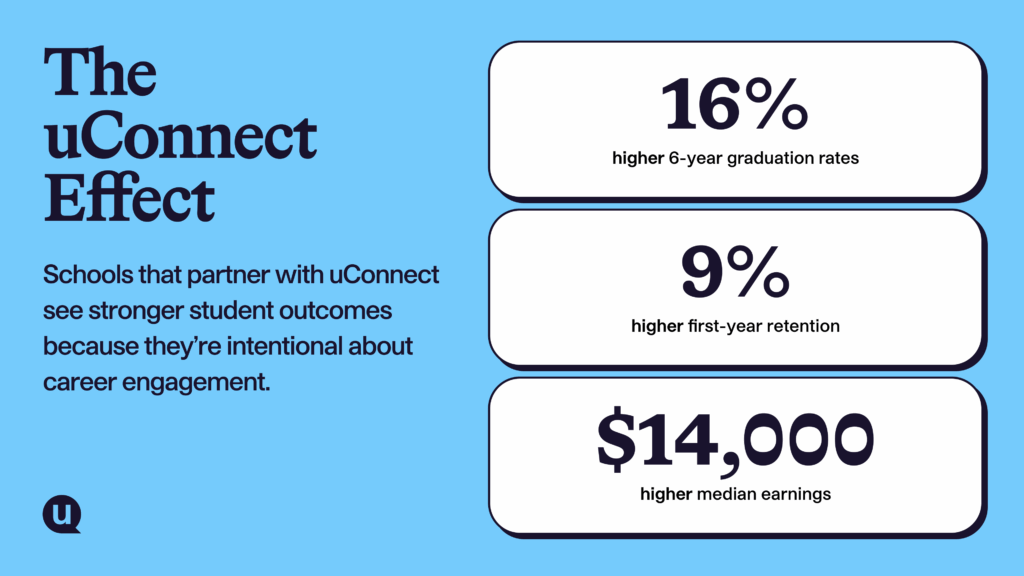
Career centers also hold engagement data—who’s showing up, who’s using resources, who’s participating in experiential learning. This data can be overlaid with retention and academic performance data to build a compelling institutional narrative: students who engage with career services are more likely to stay enrolled and graduate with stronger outcomes.
The challenge is that many career centers are still communicating their impact in career services language—job placement rates, employer partnerships, resume workshops delivered, number of coaching appointments—rather than institutional language. Retention leaders speak in terms of persistence rates, credit-hour accumulation, early alert triggers, and year-over-year enrollment. Career services leaders need to learn to speak both languages.
Practically, this might look like:
- Requesting access to institutional retention dashboards to overlay career engagement data
- Requesting inclusion in early alert processes so career advisors can be triggered when at-risk students are flagged
- Presenting a quarterly “Career to Retention” snapshot to student affairs or enrollment leadership that connects career engagement metrics to persistence data
- Building into annual reports a section that explicitly ties career programming to retention outcomes
Institutions that invest in career engagement infrastructure—platforms like uConnect that make it possible to reach every student, track engagement at scale, and report on outcomes—are better positioned to make this case credibly and consistently.
Read uConnect’s latest white paper, From Engagement to Outcomes, to explore data-backed insights proving that institutions that prioritize career services engagement achieve better outcomes.
6. Career services supports retention by supporting the whole institution
It’s worth noting that career services’ impact on retention isn’t just direct—it’s systemic. When career centers are embedded across the campus ecosystem—partnering with academic departments, student affairs, enrollment management, and advising—they contribute to a culture where students feel supported from every direction.
Career engagement reinforces the institution’s value proposition at exactly the moments students are most likely to question it. A sophomore who feels lost chooses to stay when an academic advisor or career coach make the connection between their coursework and a career they care about. A junior who’s questioning whether their degree is worth it stays when they land an internship that validates the investment. A first-generation student who’s feeling out of place stays when they connect with a professional mentor who looks like them and has their background.
None of those interventions happen by accident. They happen because career services is funded, staffed, and treated as a strategic function—not a peripheral one.
What this means for career services leaders
Long story short, the case for a career services seat at the retention table is strong. The research is there. The data is there. The student stories are there. The next step is more intentionally sharing all of that information with key stakeholders across campus.
Start by requesting time with your head of student affairs, your chief enrollment officer, or your provost. Come prepared with three data points and two student stories that connect career engagement to retention outcomes at your institution. Frame your ask not as “we need more resources for career services” but as “we have evidence that career engagement improves retention, and here’s how we can scale that impact together.”
Ask to be included in early alert systems. Advocate for career integration in first-year experience programs. Request access to institutional retention data so you can tell the story of what career engagement does for persistence.
And invest in the infrastructure that makes scale possible. Reaching a handful of the most motivated students through walk-in appointments isn’t a retention strategy. Reaching every student—consistently, early, and across their entire academic journey—definitely is.
The bottom line
Retention strategy has historically been owned by student affairs, advising, and financial aid. Which makes sense. But as institutions face mounting pressure to demonstrate ROI, reduce dropout rates, and justify the value of a degree in an increasingly skeptical market, the case for expanding that coalition has never been stronger.
Career services isn’t just a “right-before-graduation” function. It’s one of the most direct levers an institution has to answer the question every student is silently asking every semester: Is staying worth it? When career services answers that question with a resounding (and provable) “yes”—when students can see the path forward, feel the momentum of engagement, and trust that their institution is actively invested in their future—they stay.
That’s not a career services story. That’s a retention story.
Want to scale career engagement at your institution?
uConnect’s Virtual Career Center platform helps institutions make career services accessible to every student, at every stage of their journey—driving the kind of consistent, scalable, and measurable engagement that supports strong outcomes and retention. Learn more