
At this point, it’s safe to say AI is not going away. So when it comes to discussing AI in higher ed and career services, it’s not about whether to pay attention to AI, it’s figuring out what to actually do about it—and with it.
Because here’s the reality: the career services leaders who lean into AI right now—who learn it, use it, and teach it—are going to be the ones who come out ahead. They’ll save time on tasks that used to eat up their afternoons, communicate their impact more effectively to senior leadership, and show up as credible thought partners for faculty, employers, and students who are all navigating this shift in real time.
On the flip side, career centers that ignore AI or treat it as someone else’s problem risk being left behind. Not just technologically, but strategically.
So, where do you start? We’ve been talking about AI on the Career Everywhere Podcast for a while now. And we recently hosted a live session in the Career Everywhere Community with Logann Todd, career services director at United States University and co-chair of the NCDA AI task force, who walked us through how to integrate AI into career development practices the ethical way.
A few themes keep coming up across all of these conversations. Here’s what career services leaders are actually doing to put AI to work—for themselves, and for their students.
1. Use AI yourself before you try to teach it
This might sound obvious, but it’s worth saying out loud: you can’t effectively guide students through AI-assisted job searching, resume writing, or career exploration if you’ve never used these tools yourself.
Jeremy Schifeling—founder of The Job Insiders, formerly of LinkedIn, bestselling author, and former career services leader at the University of Michigan—made this point directly on the Career Everywhere Podcast. His advice? Start with something small and low-stakes.
- Write your next career center newsletter with AI’s help.
- Ask it to draft a workshop agenda.
- Have it analyze past workshop topics and make note of any content gaps.
- Let it generate a first pass at a social media post.
Even if the output is mediocre, you’ll start to understand what these tools can (and can’t) do.
“You will never learn a skill as well just by reading about it as by using it and doing it every single day,” Schifeling said.
Todd echoed this in our Career Everywhere Community live session.
“I really enjoy finding new ways to make our jobs easier, and I love sharing this knowledge with others,” she said.
Todd then proceeded to live-demo several AI tools in real time, inviting attendees to pull up their own accounts and follow along. Her point was simple: the best way to get comfortable is to just start.
The point isn’t to become a prompt-engineering wizard overnight. It’s to get comfortable enough with AI that you can talk about it knowledgeably with students and colleagues.
2. Align your work to institutional priorities faster—with AI’s help
One of the most consistent challenges career services leaders face is making the case for their work to senior leadership. You know your work matters (and we know it matters!), but translating that into language that resonates with institutional decision-makers can be time-consuming and hard.
Here’s a practical place to start: use AI to help you analyze your institution’s strategic plan, accreditation documents, state of the university addresses, and more.
Paste those documents into Claude, ChatGPT, or a similar tool, and ask it to pull out the key themes and priorities. Then ask it how career services might connect to each one. For better results, you might consider plugging in your career center’s strategic plan for additional context.
Within minutes, you have a starting framework for how to position your work—information that might otherwise have required hours of reading and synthesizing.
But the efficiency gains don’t stop there. Todd highlighted how AI can streamline all kinds of administrative tasks that eat up a career professional’s time, from automating routine communications to quickly analyzing data and identifying trends.
“If we’re automating tasks, we’re able to free up more time to communicate and work with our students and have that one-on-one connection,” she said.
This kind of strategic positioning is exactly what Rebekah Paré, founder of Paré Consulting and a former career services leader, talks about in her framework for measuring career center effectiveness. The career centers that are winning right now are the ones positioning themselves as drivers of institutional strategy, not just student services. AI can help you make that case faster and more persuasively.
3. Teach students to use AI the right way
Students are already using AI in their job searches. Widely. And often badly.
As we’ve all likely seen, a lot of students are using ChatGPT to write their cover letters and resumes, and the results are grammatically correct but painfully generic. Recruiters can spot them immediately, and it’s hurting the students who rely on them too heavily.
“The recruiter doesn’t want a generic, grammatically correct cover letter. They want one that’s full of passion, that’s full of personality, that shows me the true candidate,” Schifeling said.
And it’s not just cover letters. John Koelliker, co-founder and CEO of Leland, shared a striking data point on the Career Everywhere Podcast: his company recently posted a job opening and received 5,000 applications within 24 hours.
“We know that most of those applications came through an AI agent,” he said. “That’s what employers are feeling right now. How do I sift through this noise and figure out who’s real, and who actually cares about my company, and didn’t just have AI customize the application to make it seem like they care?”
The result? Employers are increasingly turning back to the things AI can’t fake: networking, referrals, and in-person interaction.
Koelliker shared an example of a student from a nearby university who sent him a well-crafted cold email asking to come in and walk him through a product idea in person.
“He got 30 minutes with me. I introduced him to five more people, and now he’s in our interview process. It was the fastest way for him to cut through the noise,” Koelliker said.
The lesson for career services teams is clear: in a world flooded with AI-generated applications, the human touch is a competitive advantage. Help students understand that the goal isn’t to out-AI the AI. Rather, it’s about embracing your humanity and using it to stand out from the noise.
Todd drives the document-writing risk home with a live demo she runs in trainings: she takes a business student’s resume, asks ChatGPT to tailor it for a completely unrelated job—in her example, a zoologist position at the Detroit Zoo—and shows the audience exactly what happens.
“It hallucinated,” she said. “It said my student was ‘passionate about animal welfare and conservation.’ How does it know that?”
The exercise makes the risk of outsourcing application document writing to AI painfully clear.
“At the end of the day, if they are using AI to write it for them, sure, it will get them an interview,” Todd said. “But they still have to do the interview. And if their personality, their communication style doesn’t match what’s represented in their documents, it’s not a good look.”
The opportunity for career services? Teach students where AI genuinely helps versus where it can actually undermine them.
Good AI uses for students: using AI for career exploration, researching industries and companies, analyzing job descriptions to identify key skills, practicing interview answers, and refining the structure or language of application materials they’ve already drafted.
Risky AI uses for students: outsourcing the actual voice and story in a cover letter or personal statement to AI, because that’s where the candidate disappears.
Todd also suggests a useful workaround for the privacy concerns that come up when working with student documents in AI platforms: de-identify them first. Remove names, contact information, and any personally identifiable details before pasting anything into a public tool like ChatGPT.
“We wouldn’t give a random stranger our Social Security number. We’re not gonna give AI personal information either,” she said.
4. Encourage students to build something (anything) with AI
Here’s a challenge worth putting in front of every student you work with: don’t just use AI. Build something with it.
There’s a meaningful difference between a student who has used ChatGPT to polish a resume and a student who looked at a problem in front of them—in their campus job, their student organization, their internship, or even their personal life—and figured out how to solve it using AI tools. That second student has something most of their peers don’t: proof.
“Gone are the days where we can just hire students that don’t know anything and train them on the job,” Koelliker said. “In a world where hiring managers have a lot of options, they’re going to pick the candidates that have some level of proof that they can do the job.”
The good news is that building proof doesn’t require a computer science degree, a formal project assignment, or anyone’s permission. Koelliker is emphatic on this point:
“You don’t need permission to build a product. You don’t need permission to start creating content or marketing,” he said.
His advice to students? Start now. Start small. Start with the problems already in front of you and approach them with an entrepreneurial mindset.
This is where career advisors can really open students’ eyes. Because the problems worth solving with AI are everywhere—students just need to be prompted to look for them. A student working a part-time job at a local business might notice that their manager spends hours every week on a repetitive task that could be automated. A club officer might realize their organization lacks a good system for tracking member information. A student doing research might find a workflow that AI could streamline significantly.
One example that captures this perfectly: a student who used AI to build a member directory and intake form for his fraternity. Not a class assignment. Not a required internship deliverable. Just a real problem he noticed in an organization he was already part of—and a solution he built himself. That kind of initiative is exactly what employers are looking for, and it’s also exactly the kind of story that makes a job interview come alive.
Koelliker described a similar scenario: a student who learns through a career fair that a company is struggling to hire content creators. She leaves the fair, builds an AI-powered content engine, then reaches back out to the company, saying “I built this. I’d love to come intern and help you implement it.”
“Those types of things just go so far,” he said. “I think there’s something really powerful about learning how to create, learning how to make something, even if it’s something small.”
The framework career leaders can share with students is simple:
- Identify a problem
- Think through how AI might help solve it
- Build a version of that solution—however rough—and document it
Even if a specific employer never sees it, the student now has a portfolio entry, a story to tell in interviews, and real hands-on experience with AI tooling that goes well beyond “I’ve used ChatGPT.”
As Koelliker put it: “High agency is what wins right now. That’s what’s going to show up. We don’t want to know who wants to learn how to do this. We want to know who’s already doing it.”
5. Use AI to support career exploration and advising at scale
One of the most underutilized applications of AI in career services is using it to enhance—not replace—career advising conversations, especially for students who are still figuring out what direction they want to go.
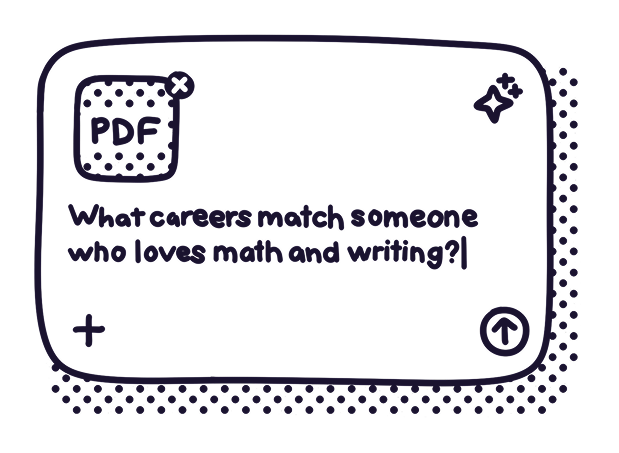
Todd demonstrated a practical example in the live session: pasting a college’s full program catalog into ChatGPT alongside a student’s stated interests and asking the tool to suggest major and minor combinations.
In the demo, a student who described herself as good at math, creative, and interested in writing got a list of options—simulation, animation, and gaming with a math minor; English with a statistics minor; communications with creative writing—along with potential career paths for each.
“Our brains only work so fast,” Todd said. “I could maybe come up with a couple things. But right here, I have everything ready to go. I can copy this and email it right to my student. They can take it to the academic advisor, they can do their registration, they have their ideas ready to go, they also have some career options to think about for internships and full-time jobs.”
The key, she emphasized, is using AI to speed up the early brainstorming phase so that the actual advising conversation can go deeper. It’s not about replacing the career advisor. Rather, it’s about freeing them up from tasks that AI can handle so they can focus on the high-touch, human work that only they can do.
Schifeling suggested a similar approach for career exploration programming: have students bring their strengths and interests to a ChatGPT session and ask it to generate 10 job titles that match—ideally going well beyond the “usual suspects.”
“All of a sudden, they’re like, ‘Wait, I didn’t know about that job. I didn’t know about that,’” he said.
And that’s where the human element becomes essential. As Schifeling put it, if you were a career coach who was only doing resume reviews, AI can probably do that better now.
“But if you were doing the truly transcendent stuff—getting to know another human being, understanding their hopes and dreams, helping them see a possibility—that’s the stuff where, combined with AI’s ability to review that resume, you’ve now got the best of both worlds,” he said.
6. Bring AI into your programming—and make it fun
One of the most creative ways career teams are using AI right now is in workshop and programming design—not just as a prep tool, but as a way to make career content feel fresh and engaging.
Todd shared a prompt she developed for exactly this: she asked ChatGPT to act as a post-secondary career services expert who is also an expert on Harry Potter, and to create an outline for a one-hour workshop on personal branding and elevator pitches in preparation for a campus job fair.
The result? A workshop titled The Wizarding World of Crafting Your Personal Brand, complete with:
- A Hogwarts house icebreaker
- A “discover your unique wand” activity mapping students’ skills, values, and interests
- A Triwizard Tournament-themed section on achievements
ChatGPT even generated a post-workshop survey using the same theme.
“I love the idea that you can take an existing topic that we know students need, but let’s make it a little bit more fun,” Todd said. “Student attention is hard to get. So if we do get it, how can we keep them?”
The framework isn’t specific to Harry Potter, of course. Todd mentioned doing the same exercise with Marvel for a K-12 biology lesson. The point is that AI can help you rapidly generate new, engaging frameworks around career content you’re already delivering, without requiring a ton of extra prep time. For teams that are stretched thin, that’s a real advantage.
Cheryl Rotyliano of the Wake Forest University School of Business took a similarly creative approach on the programming front, though she built hers from scratch.
Her HireU 2.0 simulation puts students on the recruiter’s side of the hiring process, reviewing AI-generated and human-written application materials side by side to understand how ATS systems work and why authenticity matters. She used AI to help generate the diverse set of resumes and mock interview responses needed to run the simulation at scale. Learn more about HireU 2.0 in her episode of the Career Everywhere Podcast.
7. Help students “AI-proof” their careers
Beyond the job search itself, there’s a bigger conversation career services leaders need to be having with students: which careers and skills will remain strong as AI continues to reshape the workforce?
This is where career advisors can add enormous value. Because the answer isn’t to steer every student toward a tech career or to dismiss the concern entirely. It’s to help students think carefully about what they’re building toward, and to develop the skills that AI genuinely can’t replicate.
Schifeling talks about this as helping students “AI-proof” their careers, on two fronts:
- Make sure students can actually use AI tools competently, because that’s increasingly a baseline expectation in most industries.
- Steer them toward roles where the human element—judgment, creativity, empathy, relationship-building, storytelling—is central, not incidental.
Sharon Belden Castonguay, Executive Director of the Gordon Career Center at Wesleyan University, sees agility as the real differentiator in this AI era. Despite all the media gloom-and-doom about the class of ’25, her students are holding steady in the job market—largely because they’re able to pivot when one door closes.
“Maybe I thought I would go into that entry level coding job that now no longer exists,” she said. “Now I’m going to pivot into something else.”
That capacity to adapt, she argues, is the skill that compounds over an entire career.
“I don’t care if a senior is employed after graduation. I care that they’re employable. I want to know that they have the capabilities to continue to reinvent themselves over and over again,” she said.
Rather than coaching students toward a specific job title, she encourages helping them identify their values, articulate their transferable skills, and approach their career as something they’ll be iterating on for life.
As career services leader Joe Catrino said on the Career Everywhere Podcast, the disruption from AI and technology isn’t new. But it is accelerating.
“Jobs that our students are going to have don’t even exist yet. So how do you prepare students for that? You focus on skills” he said.
The career centers best positioned to help students navigate this are the ones that have expanded their definition of what career coaching looks like—not just “here’s how to write a resume,” but “here’s how to keep growing, pivoting, and finding your footing in a workforce that will keep changing.”
8. Become the AI thought leader on your campus
Here’s a reframe worth sitting with: a lot of the higher ed community is still pretty uncomfortable about AI. Faculty are scrambling to rethink assignments. Administrators are trying to write policies. Students are experimenting without much guidance.
Career services has an opportunity to step into the gap.
“If career leaders can truly lead on this topic—be that one point of light inside the higher education firmament that says, ‘Hey, this is happening, this is here, and we’re all over it and we’re ready to lead’—that gives them not just much more respect, but the resources they need to go out there and do it,” Schifeling said.

In practical terms, this might look like hosting a campus workshop on AI and the job search (open to students and faculty), sharing a regular digest of AI-and-work news with your faculty partners, or partnering with a professor to co-develop a module on AI in a career-adjacent course.
Todd, too, sees career professionals as having a unique responsibility here—not just to their students, but to their broader campus communities. As co-chair of the NCDA AI task force, she’s actively working to shape how the career services field approaches AI at a policy level, and she encourages others to get involved.
“I encourage you to participate if you’re interested,” she said of the task force’s ongoing work. “There’s a lot of opportunity. You just have to go looking for it.”
Being known as the office that gets AI and helps people navigate it is a very different position than being seen as a resume review service. And that distinction matters more every year.
9. Know the ethical guardrails—and share them with your team
All of this potential comes with real responsibility. And if there’s one thing Todd wants career services professionals to understand, it’s that using AI ethically isn’t optional. It’s part of the job.
The NCDA AI task force developed a framework of seven ethical considerations for AI use in career development. A few of the most actionable for career services teams:
- Data privacy and security. Never paste personally identifiable information—name, address, contact info—into a public AI platform. De-identify student documents before using them in any AI tool. And when your institution is evaluating AI platforms to onboard, ask vendors directly: Where is the data stored? Who has access to it? What are their security policies? This applies to institutional platforms like VMock or HireVue, too—not just public tools.
- Transparency and informed consent. If you’re using AI during a student consultation, tell them. Ask for their consent. Todd recommends getting into the habit of “resource showing instead of resource sharing“—meaning, don’t just hand a student a tool and walk away. Show them how it works and why you’re using it.
- Equity and accessibility. Not all AI tools work equally well for all students. Tools that assess interview performance, for example, may not account for diverse communication styles, accents, or students with disabilities. “What if a student has a visual impairment and can’t make eye contact with the camera?” Todd asked. “Are they going to get docked points for that?” These are questions that need to be asked before a tool is ever put in front of a student.
- AI outputs are drafts, not final products. Whatever AI generates—bullet points, interview questions, workshop outlines, cover letter language—is a starting point. “We’re gonna take this. We’re gonna use it. We’re gonna use our brains because we still have them,” Todd said.
Getting familiar with your institution’s existing AI policies is also worth doing sooner rather than later, both so you can point students to them and so you can participate in shaping them as they evolve.
A final thought
AI is a lot to take in. It’s moving fast, the stakes feel high, and it’s easy to feel like you’re already behind. But as Schifeling pointed out, most of higher ed is still figuring this out, which means there’s still real opportunity for career services leaders to get ahead of it.
Start small. Use the tools yourself. Bring that knowledge into your coaching and programming. And don’t underestimate what it means for your career center to show up as a credible voice on this topic at a moment when everyone on campus is looking for guidance.
To hear more from Jeremy Schifeling on AI and the future of work, check out his episode of the Career Everywhere Podcast. And to watch the full recording of Logann Todd’s live session on integrating AI ethically in career development, visit the Career Everywhere Community.