
We’re living through a reckoning in higher education.
Institutions are being measured differently – and more publicly – than ever before. Retention rates, graduation rates, employment outcomes, earnings data, performance-based funding, new federal accountability measures. And underneath all of it, a single question that every president, provost, and trustee is wrestling with: What is the return on investment of a degree from this institution?
Everything rolls up to student outcomes. That’s the new currency of higher ed credibility.
And for career services, that’s both a massive opportunity and a significant pressure.
The problem with outcomes as a metric
Here’s the thing nobody loves to say out loud: outcomes are a lagging indicator.
By the time employment rates and earnings data show up in your reporting, by the time they’re cited in accountability frameworks or used in federal rankings, they’re already locked in. They reflect decisions students made years ago. You cannot improve them retroactively. They offer essentially no real-time guidance for the work happening on your campus today.
So if student outcomes are the ultimate measure of success for higher education, and outcomes are inherently a lagging indicator, then the more important question becomes: what are the leading indicators that institutions can actually influence in real time?
Engagement is the answer – and the data proves it
Career services engagement is the single biggest leading indicator of student outcomes. Full stop.
Engaging meaningfully with the full range of what career services offers – utilizing tools and resources, attending events and career fairs, networking with alumni and mentors, taking advantage of one-on-one advising and mock interviews – can have a greater impact on post-graduation outcomes than many of the courses a student takes. In some cases, even more than what they major in.
That’s not a hunch. That’s what the data shows.
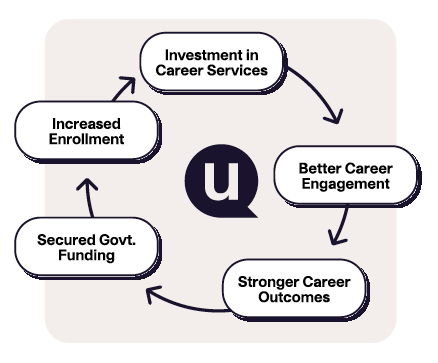
Institutions that invest in scaling career engagement are seeing it translate directly into outcomes: significantly higher median earnings, positive outcome rates exceeding NACE benchmarks, higher six-year graduation rates, and improved first-year retention. When career engagement is working, it creates a flywheel. Investment in career services drives engagement, engagement drives outcomes, outcomes drive enrollment and funding, which enables more investment. The loop reinforces itself.
Institutions that get this right are seeing measurable results. See how in uConnect’s white paper, From Engagement to Outcomes →
So why aren’t students engaging with career services?
Here’s where it gets uncomfortable.
Despite the fact that getting a good job is one of the primary reasons students enroll in higher education in the first place, despite the fact that career services engagement is the most powerful thing a student can do to improve their post-graduation trajectory, the data tells a different story about what’s actually happening.
According to a 2023 survey of 3,000 college students conducted by Inside Higher Ed and College Pulse, nearly 50% of students visit career services only once, or not at all. Roughly 30% never interact with career services during their entire enrollment.
This is not a motivation problem. Students want outcomes. They care deeply about what comes next. The problem is structural.
In our experience working with hundreds of institutions over more than a decade, the biggest barriers to career engagement come down to two things:
- Limited visibility. Students don’t know what’s available to them. The full range of career services – tools, resources, events, employer connections, alumni networks, advising, job simulations – is simply not on their radar.
- Severe fragmentation. And here’s what that actually looks like in practice: career services websites with pages of static links pointing to dozens of disconnected tools, each behind its own login, with no real sense of what’s on the other side. PDFs that haven’t been updated in years. Resources scattered across multiple offices and departmental pages, organized around how the institution is structured rather than how a student actually searches for help. Everything technically exists. Almost none of it is easy to find.
The career services team knows the full picture. Students almost never do.
And now there’s ChatGPT
If limited visibility and fragmentation weren’t enough, career services is now competing with something far more formidable than Google.
Students have a personal career coach in their pocket, available 24/7, requiring zero navigation, no appointments, no logins. They ask a question and get an answer instantly. The friction is essentially zero.
This isn’t hypothetical. This is what’s happening. And it’s making the engagement problem meaningfully worse.
But here’s what’s important to understand: ChatGPT is not actually a great career coach for your students. It’s a general-purpose tool pulling from the open web with no knowledge of your institution. It doesn’t know your employer relationships, your alumni network, your outcomes data, your specific programs, the workshops happening next Thursday, or the mentor who went on to work at exactly the company a particular student is targeting.
The generic AI answer isn’t necessarily wrong. It’s just not yours.
Career services’ competitive advantage is institutional specificity
This is where the real opportunity lives.
Career services has something ChatGPT fundamentally cannot replicate: institutional context. The employer partnerships built over years. Alumni mentors and affinity communities specific to your student population. Outcomes data from your own graduates. Resources, programs, and workshops created for students at your institution, not students in general.
That’s a powerful competitive advantage. It’s the difference between generic career advice and a personalized pathway informed by everything your institution knows.
But that advantage only exists if two things are true.
The content is there. Rich, current, comprehensive…not a collection of outdated PDFs and stale links.
And it’s discoverable. If a student can’t find it easily, in the moment they’re looking, it might as well not exist.
The real work ahead
The accountability era isn’t going away. The pressure on institutions to demonstrate ROI through student outcomes is only going to intensify. And career services is sitting on the most powerful lever available: the one leading indicator institutions can actually move in real time.
But to move that lever, students have to engage. And to engage, they have to be able to find what’s there.
The institutions that figure this out – that solve for visibility and fragmentation, that make the full depth of their career resources as frictionless to access as asking ChatGPT a question – are the ones that will have the outcomes data to prove their value, drive enrollment, and build the flywheel.
Content density, discoverability, institutional specificity: that’s the competitive moat. And it’s only as strong as the infrastructure built to surface it.
See how your institution stacks up. Take the Career Digital Readiness Score assessment and find out if your career services content is visible, current, and built to drive engagement. Get Your Score →